By: Eugene Robinson, Opinion Writer, The Washington Post, January 13, 2012
Insulting Comments At Fox News Debate Show Newt Gingrich Clueless On Black Americans
If you want to understand why the GOP is so ill prepared to compete in an increasingly nonwhite America, just look at the exchange between Fox News questioner Juan Williams and Newt Gingrich halfway through last night’s Republican presidential debate.
It being Martin Luther King Jr. Day, Williams asked Gingrich whether some poor and minority voters might not be insulted at his claim that poor kids lack a work ethic and that black people should be instructed to demand jobs, not food stamps. Gingrich, as is his wont, haughtily dismissed Williams’s question, to wild applause.
Then Williams tried again, mentioning a black woman who had taken Gingrich to task for calling Barack Obama a “food stamp” president. By this point, the overwhelmingly white crowd had begun to boo the only African-American on stage. When Gingrich insisted that Obama was indeed the “food stamp” president—because more Americans are now on food stamps—and dismissed Williams’s criticism as “politically correct,” the crowd began to scream with delight. By the time Gingrich finished his answer, the crowd was on its feet in a standing ovation.
The fascinating thing about the exchange is that Gingrich is not a racist. I suspect he genuinely cares about the African-American poor. In fact, he’s convinced himself that his willingness to say things that many African-Americans consider insulting is an expression of that concern; that only he cares enough about African-Americans to speak the “politically incorrect” truths that black leaders won’t.
Gingrich’s problem isn’t racism; it’s ignorance. Only someone profoundly ignorant of African-American politics would suggest that black Americans have spent the past few decades seeking food stamps, not jobs. We celebrate Martin Luther King Jr. Day, after all, in part because of the speech King gave at an event called the March on Washington for Jobs and Freedom. If you look at the budgets proposed by the Congressional Black Caucus over the years, you’ll see that they often include huge, FDR-style government jobs programs. Gingrich may not think that’s the best way to go about providing jobs, but to suggest that African-Americans and their leaders don’t consider jobs important just reveals how shut off from Africa-American politics he actually is.
I’m sure Gingrich also sees nothing offensive in calling Obama the “food stamp” president. After all, under Obama the number of people using food stamps has gone up! So because Alan Greenspan presided over predatory lending policies by banks, perhaps we should have called him the “Shylock” chairman of the Federal Reserve. And if child molestations by priests rise on this administration’s watch, perhaps we should call Joseph Biden the “pedophilia” vice president.
Gingrich would never use those phrases, of course, because he’s familiar enough with Jews and Catholics to understand why they’d find them offensive. But for Gingrich—a veteran politician from the state of Georgia, speaking at a debate in South Carolina on Martin Luther King Jr.’s birthday—not to understand why calling the first African-American in the Oval Office the “food stamp” president would offend African-Americans is simply amazing. The most plausible explanation is that Gingrich inhabits a cultural and intellectual bubble. A bubble called the Republican Party.
I don’t doubt that Newt Gingrich wants to help African-Americans, just like I don’t doubt that George W. Bush wanted to help Iraqis. But in politics, if you want to help people, it’s a good idea to learn something about them first.
By: Peter Beinart, The Daily Beast, January 17, 2012
Remembering Dr. King
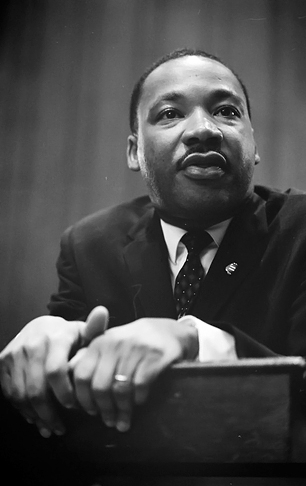
Dr. Martin Luther King, Jr (BuyenLarge/Getty Images)
I was surprised by his assassination. I didn’t see the Poor People’s Campaign as the threat to Washington and the Establishment that I now see it was. We feared for Dr. King’s life more in the early Sixties, through 1963, than we did by 1968. Up through 1965, there was a civil-rights-related death every couple of months, though most of them didn’t make headlines. By the end of ’65, there was a lull in the killings, and I thought perhaps we were finally beyond all that.
In his last year, we worried about Dr. King’s health. He was working eighteen to twenty hours a day. He would stay up all night reading, talking, clowning – whatever he felt like doing – and then wake up at five-thirty raring to go. His wife used to say that he had a war on sleep.
We would tell him that it looked like he was going to be around for a long time, and he couldn’t possibly keep this pace up, because he was close to forty. But if you said anything, he’d brush you off. I could never argue with him anyway. He was a preacher. And whenever we argued, he’d get to preaching. You never won an argument because he would take off on flights of oratory, and you’d forget your point trying to listen to him.
The year he died was the year he felt he had to establish the agenda for America’s future. For fifteen years he’d been struggling with the issues of racism, poverty and war. He refused to be just a civil rights leader. He was a sensitive lover of people who saw his primary responsibility in the black community. By 1968, though, it was clear to him that the black community could not concern itself with civil rights issues alone. The country was spending billions of dollars in Vietnam, and he saw racism and war becoming ever more tied up into one big problem for this country.
It was a time of increasing desperation for him. The SCLC had a fraction of the budget it should have had, about $700,000, and a small staff of fifty people, trying to take on the problems of the urban North, as well as the South, which still had large pockets of resistance. Not only weren’t we getting any aid from the federal government, but we had legions of FBI agents tracking us down, harassing us, trying to disrupt the work we were doing – work which I thought was the only thing that was giving America a fighting chance to survive.
The dangerous times when we were together were always the times he was most humorous. For years we couldn’t go anywhere without FBI men following us around. Dr. King was philosophical about it and very friendly toward them. Every now and then, we would leave a meeting through another entrance – not to escape the car that trailed us, but to sneak up on them. Dr. King would say hello, introduce us and (we always gave them the benefit of the doubt) thank them for the “protection” they were giving us.
I think he would have been quite content to be pastor of the Riverside Church, maybe teach at a university or a seminary. He wanted to teach the philosophy of religion, which was the subject of his Ph.D. He turned down a chance for the presidency of the NAACP when he first came to Montgomery in 1954, because he wasn’t sure he wanted to become that involved in the growing civil rights movement.
But when the bus boycott came in ’55, he was pressed into action. He had to respond. He was just twenty-six, and he never had the time to be the fun-loving man that he really was. He made the cover of Time magazine only a couple of years after he finished his degree, and then he was a celebrity.
From that time on he felt the burden of the country, his people and the world on his shoulders. He accepted it, but he always said he would have liked to do something else. He felt responsible for America’s future and its survival because he said that nobody understands nonviolence except black Americans, and if America was going to learn to live with the rest of the world, we’d have to help her find a nonmilitary course. In his Nobel Peace Prize speech, in fact, Dr. King said that the choice was nonviolence or nonexistence. I think back sometimes to what this country would have been like without Dr. King. The South was an armed camp in the Forties and Fifties. The GI bill and better job opportunities had created the beginnings of a black middle class, and they were not going to tolerate oppression any further. The white forces of reaction were trying to resist the advance of this new black middle class.
Every black family in the South had a gun. My father was probably the least violent man I know, and yet there were at least four guns in our household. Had there been no Martin Luther King Jr., the southern part of the United States would have looked like Northern Ireland or Lebanon.
And yet Martin saw that blacks and whites did not hate each other. They were being forced down through history on a collision course. Martin Luther King straightened out that course. He made it possible for blacks and whites to move in a parallel course of development and work together by using the tactic and methodology of nonviolence. He did not blame the white man for the problems that blacks were having. He saw blacks and whites caught up in a situation that they didn’t create, that they inherited. He saw nonviolence as a means for bringing people to realize that they could work their way together out of the situation.
Dr. King never understood why J. Edgar Hoover couldn’t comprehend what he was doing. If you read Hoover’s FBI reports on the March on Washington speech, you realize that he never saw Dr. King’s vision of a New America. He saw a powerful, radical political voice trying to destroy the nation.
I didn’t know then, but I now think that there lies the indirect responsibility for his assassination. I don’t know if it can ever be pinned down, but there are so many client groups that did dirty jobs around and for official people. I think now that Dr. King’s assassination was directly related to the fear that officialdom had of his bringing large numbers of poor people to the nation’s capital, setting up tents, demanding some response from them.
By: Andrew Young, Rolling Stone, January 13, 2012. (This story is from the December 1, 1977 issue of Rolling Stone). Writing in 1977, the famed civil rights activist Andrew Young reflects on the life and legacy of Martin Luther King.
“Embracing The Possibilities”: Martin Luther King And The Dream That Came True
He would be an elder statesman now, a lion in winter, an American hero perhaps impatient with the fuss being made over his birthday. At 83, he’d likely still have his wits and his voice. Surely, if he were able, he would continue to preach, to pray — and to dream.
For the Rev. Martin Luther King Jr., dreaming was not optional. It was a requirement of citizenship to envision a fairer, more prosperous nation no longer shackled by racism and poverty. It was a duty to imagine a world no longer ravaged by senseless wars. His most famous speech was less an invitation to share his epic dream than a commandment.
In these sour, pessimistic times, it is important to remember the great lesson of King’s remarkable life: Impossible dreams can come true.
This is not a partisan message; King was every bit as tough on Democrats as Republicans. His activism even transcended ideology. His call for social justice and his opposition to the Vietnam War were rightly seen as liberal, but his insistence on the primacy of faith and family was deeply conservative. His birthday is a national holiday because his words and deeds ennoble us all.
Thinking about King’s legacy reminds me that this is hardly the first time our society has been bitterly divided and fearful of an uncertain future. When he led the 1963 March on Washington and gave his indelible “I Have a Dream” speech, many Southern whites, including officials, were still determined to resist racial integration by any means necessary. Many black Americans were fed up, no longer willing to wait patiently for the rights promised them under the Constitution.
We were inured to television images that today would be shocking. Police dogs turned loose on peaceful protesters. Columns of smoke rising from cities across the land following King’s assassination.
As he predicted, King did not live to reach the mountaintop. But his leadership — and that of so many others in the civil rights movement — set us on a path that changed the nation in ways that once seemed unimaginable. Racism, sexism and all the other poisonous -isms have not been eradicated, but they have been dramatically reduced and marginalized. It is difficult for young people to believe that overt discrimination — “You can’t have that job because you’re black” or “I’m going to pay you less because you’re a woman” — used to be seen as normal.
Today, the nation is suffering what I see as a crisis of confidence. Economic globalization and advances in productivity have hollowed out the U.S. manufacturing sector, eliminating millions of blue-collar jobs. For the first time, parents have to worry whether their children’s standard of living will decline rather than improve. Demographic change is about to make this a nation without a white majority; by the middle of the century, we’ll be an increasingly diverse collection of racial and ethnic minorities — held together, even more than in the past, by the ideals of the nation’s founding documents.
We’re struggling to climb out of the worst recession in decades. We’re deeply in debt. Most of us agree on the need for a social safety net but not on how to structure it or how to pay for it. Our political system is sclerotic if not dysfunctional. The past few elections have not produced a consensus on the way forward. The next won’t, either.
I consider myself fortunate that, when I’m feeling pessimistic about all of this, I’m able to visit the new King memorial that was dedicated in October. The towering statue of King looks out toward the Jefferson Memorial, which honors the man whose stirring words now apply to all Americans, not just a few. Behind King is the Lincoln Memorial, a tribute to a leader who shepherded the nation through days much darker than these.
The plaza surrounding King’s statue opens up to the Tidal Basin as if to demonstrate how our nation, at its best, embraces possibility.
The first time I visited the memorial, I ran into former senator George Allen from Virginia. He and I disagree on almost everything — and since he’s running for office again, I’m sure we’ll be on opposite sides of many issues. But on a crystalline morning, we were able to stand together, awed by King’s moral vision and humbled by his challenge: We can be better. We must. We will.
Share This Blog


 Unknown Feed
- An error has occurred; the feed is probably down. Try again later.
 mykeystrokes.com
You must be logged in to post a comment.