Did Santorum Win Iowa?: Caucus Vote Counter Says Typo Gave Mitt Romney 20 Extra Votes
An Iowa GOP caucus voter who helped count the votes at his small caucus meeting in Moulton, Iowa claims that former Gov. Mitt Romney (R-MA) accidentally received 20 extra votes than he earned — a claim which, if true, would change the winner of the unusually close caucus to former Sen. Rick Santorum (R-PA):
Edward True, 28, of Moulton, said he helped count the votes and jotted the results down on a piece of paper to post to his Facebook page. He said when he checked to make sure the Republican Party of Iowa got the count right, he said he was shocked to find they hadn’t.
“When Mitt Romney won Iowa by eight votes and I’ve got a 20-vote discrepancy here, that right there says Rick Santorum won Iowa,” True said. “Not Mitt Romney.”
True said at his 53-person caucus at the Garrett Memorial Library, Romney received two votes. According to the Iowa Republican Party’s website, True’s precinct cast 22 votes for Romney.
Des Moines TV station KCCI 8 captured an image of Moulton’s handwritten vote count:
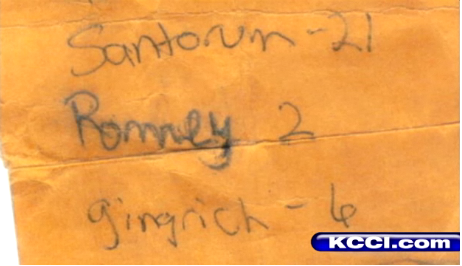
Minor counting errors such as this one are extremely common on election day, so it is perfectly plausible that Moulton is correct and Romney did receive 20 unearned votes. It is equally plausible, however, that these lost votes could be canceled out by a similar error at another caucus site. The tentative results, which showed Romney with the barest 8 vote lead, have not yet been certified.
Nevertheless, the Iowa GOP does not seem happy that True is questioning the early result. According to KCCI, a spokesperson for the Iowa GOP said that “True is not a precinct captain and he’s not a county chairperson so he has no business talking about election results.”
By: Ian Millhiser, Think Progress, January 5, 2011
Indecision 2012: In Iowa And The GOP
Just a few hours before the Iowa caucuses opened, Don Acheson, a general contractor from West Des Moines, remained as he had been for months: wracked by indecision.
First, he had been for Rick Perry, then Newt Gingrich. When I caught up with him, he was preparing to give Rick Santorum a hard look, but Mitt Romney was “not far behind” in Acheson’s esteem.
“This late in the game I’ve never been undecided before,” he lamented. “A lot of people are going to walk into the caucus and say, ‘I’m not sure’ and just pick one. This probably is the most bizarre caucus I’ve been to.”
His drift is typical, and revealing. In a Des Moines Register poll published three days before the vote, fully 49 percent of likely Republican caucus-goers said they had not firmly made up their minds. This is what caused the extraordinary volatility in the polls and a parade of seven different front-runners, culminating in Tuesday’s virtual tie between Santorum and Romney, with Ron Paul just behind them.
Much of the political world has come to regard Iowans as a bit flaky. The prospect that the indecisiveness could allow a gadfly such as Paul to win prompted many commentators to write Iowa obituaries: It could “do irreparable harm” (Politico), “discredit the Iowa caucuses” (Fox’s Chris Wallace) and perhaps bring about “the demise of Iowa” (handicapper Stuart Rothenberg).
I disagree: The Iowa Republicans’ indecision captures perfectly the existential struggle within the GOP nationally and within conservatism. They don’t know what they want — or even who they are. Are they Tea Partyers? Isolationists? Pro-business? Populists? Moralists? Worried workers? Do they want the corporate caretaker (Romney), the oddball isolationist (Paul) or the cultural warrior (Santorum)?
Tuesday night’s returns indicated that Iowans never did make up their mind, as the three men carved up the vote almost evenly. A poll of voters entering the caucuses found that nearly one in five said they hadn’t chosen a candidate until Tuesday.
In their internal conflicts, Iowans fulfilled perfectly their first-in-the-nation status, by faithfully acting out the Republican fissures. “The jumble at the top is very reflective of the Republican Party nationally,” argued David Yepsen, the longtime Register political writer now with Southern Illinois University. “It’s activists here reflecting activists all over the country: Who are we? What are we for?”
“This is a fight for the soul of the party,” former Republican National Committee chairman Michael Steele told me this week.
The final events before the caucuses convened neatly demonstrated this. Romney, suffering from chronic awkwardness known as Al Gore’s disease, took the stage in jeans and penny loafers, with a phalanx of lawmakers behind him to show support. He spoke as if lecturing (“output per person is the highest in the world”), which induced audience members — even the officeholders onstage — to scan their smartphones.
To affect passion, Romney read a few lines from “America the Beautiful.” To affect jocularity, he said his kids refer to his wife as “The Mitt Stabilizer.” This produced laughter — from members of the press corps, who couldn’t picture Romney requiring extra stability.
Like their candidate, Romney supporters are a pragmatic if uninspired bunch. There were only about 100 of them on hand for the final rally in Des Moines, leaving many seats empty at the event’s start time. Those who applauded their man did so for a grand total of six seconds. The one passionate Romney supporter I found (“I love Mitt!”) was a London School of Economics student who admired Romney’s electability.
The Paul supporters, by contrast, were all heart. Not allowed inside to see the candidate’s final speech (to a group of students), they stood in the cold for hours, waving signs and waiting for a glimpse of their man. They shouted: “We love you, Ron!” And: “Forty-fifth president!” When Santorum left the same event, they heckled him.
“I took the day off work for this,” said insurance salesman Justin Yourison, a Paul precinct captain. “If he doesn’t get the nomination, I’m not voting for anyone else. . . . If the GOP doesn’t let us in, they can do without us.”
If the Romney supporters were cerebral and the Paul supporters passionate, the Santorum supporters didn’t know quite what they were. At one of Santorum’s final appearances, he buttonholed one undecided voter, Sue Koch, and asked her, repeatedly, to caucus for him. She finally told him she would.
When the candidate walked away, Koch gave a shrug. “I had to say something,” she said.
By: Dana Milbank, Opinion Writer, The Washington Post, January 3, 2012
Romney’s Decision-Making Algorithm: “It Seems To Me, He Lives His Life With A Finger In The Wind”
Byron York had an interesting report the other day on the process Mitt Romney went through before running for the Senate. He noted, for example, that the Massachusetts Republican traveled to Salt Lake City in 1993 in order to brief several leaders of his church about the policy positions he intended to take.
That in itself may prove controversial, and raise questions about Romney’s appreciation for the church-state line.
But before he did even that, Romney took a poll.
How Romney handled that dilemma is described in a new book, “Mitt Romney: An Inside Look at the Man and His Politics,” by Boston journalist Ronald Scott. A Mormon who admires Romney but has had his share of disagreements with him, Scott knew Romney from local church matters in the late 1980s.
Scott had worked for Time Inc., and in the fall of 1993, he says, Romney asked him for advice on how to handle various issues the media might pursue in a Senate campaign. Scott gave his advice in a couple of phone conversations and a memo. In the course of the conversations, Scott says, Romney outlined his views on the abortion problem.
According to Scott, Romney revealed that polling from Richard Wirthlin, Ronald Reagan’s former pollster whom Romney had hired for the ‘94 campaign, showed it would be impossible for a pro-life candidate to win statewide office in Massachusetts. In light of that, Romney decided to run as a pro-choice candidate, pledging to support Roe v. Wade, while remaining personally pro-life. [emphasis added]
So, let me get this straight. Mitt Romney was pro-choice because a poll told him it was the easiest way to advance his political ambitions? And then he decided he wasn’t pro-choice anymore, when that was the easiest way to advance other political ambitions?
There’s going to be a point later this year when voters will be asked, “How can you trust Mitt Romney?” and the answer, even for Republicans, will be far from clear.
By: Steve Benen, Contributing Writer, Washington Monthly Political Animal, January 2, 2012
Mitt Romney Takes His China-Bashing Campaign To Company That Touts Its Chinese Outsourcing
Well, this is awkward. Mitt Romney, who’s been on the trail recently talking tough on China, is making his last campaign stop of the day before the caucuses at a business that touts the way it outsources much of its manufacturing to China.
Competitive Edge is a firm headquartered near Des Moines that creates and sells promotional items with corporate logos. Romney’s scheduled to make a campaign stop there at around 9:00 PM CT, as part of a day-long tour through the Hawkeye State in the run-up to Tuesday’s caucuses.
What he may not mention: customers of Competitive Edge are choosing a company to make their promotional goods that brags about how much manufacturing work it sends to China.
From the company’s website:
We achieve this goal by utilizing a global network of manufacturers that assist us in sourcing, designing and making our products. It is not surprising that most labor-intensive products are produced in China. What may not be as well known is the level of sophistication and technical expertise that Chinese manufacturers have developed. Competitive Edge takes advantage of these foreign assets and has been working with Chinese manufacturers for over 25 years. As a result of our years of experience and our extensive factory and agent relationships in China, we are able to bring great value and a high level of service to our customer.
The website also features pictures of Chinese employees hard at work on what looks to be Competitive Edge orders. They’re really quite good at sending work to China, the website says:
Our extensive use of cutting edge technology makes it easy for us to collaborate and compete in real time with people and companies located anywhere in the world. Utilizing computer networking, e-mail, teleconferencing and dynamic software applications, conducting business in China is as easy for us as working with domestic companies.
At the Clive location, where Romney will be speaking, the company houses its “Screen Printing and Embroidery Departments.”
On the trail, Romney has said he’d take China before the WTO to be penalized for currency manipulation. Rival Jon Huntsman has warned against that, saying it would start a trade war that would boost prices on Chinese goods and, presumably, making life a lot harder for companies like Competitive Edge.
By: Evan McMorris-Santoro, Talking Points Memo, January 2, 2012
Election Day Registration, No Photo ID Requirement Will Help Boost Turnout In Tomorrow’s Iowa Caucuses
Tomorrow, when Iowa Republicans gather across the state to vote on their party’s presidential nominee, one important tool will be available to boost turnout: election day voter registration.
Though Iowa, unlike most states, permits those who haven’t registered (or just need to update their file after a move, for instance) before election day to do so when they show up at their precinct during regular elections, the Huffington Post notes that the Iowa GOP is in charge of setting the rules for its own caucuses.
Despite nationwide efforts to make voting more difficult, the Republican Party of Iowa decided to buck the trend and allow for on-site registration. In doing so, however, they necessarily undercut the argument being made by GOPers in many other states that election day registration (EDR) invites fraud. (Of course, voters are 39 times more likely to be struck by lightning than commit fraud at the polls, and EDR actually helps prevent already-miniscule levels of fraud.)
Residents of just nine states currently enjoy EDR: Idaho, Iowa, Maine, Minnesota, Montana, New Hampshire, North Carolina, Wisconsin, and Wyoming. However, in a number of these states, the GOP-led war on voting has targeted EDR for repeal, most notably in Maine. Republicans in the Maine legislature passed a bill ridding the state of EDR, only to see the popular program reinstated by referendum in November by an overwhelming 61%-39% margin.
Election day registration will certainly help boost participation in tomorrow’s Iowa caucuses. A 2001 study found that states which employ election day registration (EDR) boost their voter turnout rate by 7 percentage points, without partisan gain for either side. The study found that poorer and less educated voters benefited the most from EDR. ThinkProgress spoke with a number of Maine voters who also lauded the ability to update their registration if they’ve recently moved, particularly because most residents are at work during the day and unable to visit the election clerk during normal business hours.
Had the Iowa GOP followed the lead of their brethren in Maine and elsewhere, thousands of Iowans who will cast their vote tomorrow with the help of election day registration could have been turned away from the polls.
Update
Brad Friedman also points out that the Republican caucuses will not require voters to present a photo ID in order to cast their ballot, a requirement GOPers around the country pushed vigorously in 2011.
By: Scott Keyes, Think Progress, January 1, 2011
Share This Blog


 Unknown Feed
- An error has occurred; the feed is probably down. Try again later.
 mykeystrokes.com
You must be logged in to post a comment.