Discrediting the Legislative Process Itself
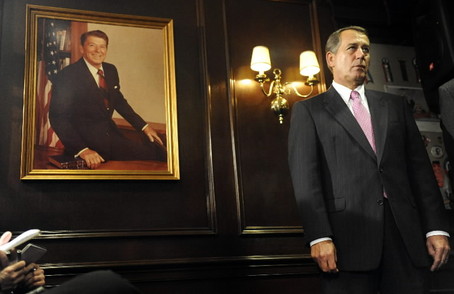
John Boehner-House Minority Leader of "No"
So far in the health-care debate, Republicans have attacked the legitimacy of private negotiations, parochial dealmaking, the budget reconciliation process, self-executing rules, the Congressional Budget Office’s analyses, and even the constitutionality of the legislation. It’s a good theory: Make people hate Washington and mistrust the legislative process and you’ll make people hate and mistrust what emerges from that process.
But it’s also dangerous. As Republicans well know, private negotiations between lawmakers, deals that advantage a state or a district, and a base level of respect for the CBO’s scores have long been central to the lawmaking progress. As the parties have polarized, reconciliation and self-executing rules (like deem and pass) have become more common — and the GOP’s own record, which includes dozens of reconciliation bills and self-executing rules, proves it.
The GOP’s answer to this is that health-care reform is important. Stopping the bill is worth pulling out all the stops. And I’m actually quite sympathetic to this view. Outcomes are, in fact, more important than process. But once you’ve taken the stops out, it’s hard to put them back in. Democrats will launch the very same attacks when they’re consigned to the minority, and maybe think up a few new ones of their own.
The result of this constant assault on how a bill becomes a law — a process that has never before been subject to such 24/7 scrutiny from cable news and blogs and talk radio — will be ever more public cynicism. Evan Bayh put it well in his New York Times op-ed. “Power is constantly sought through the use of means which render its effective use, once acquired, impossible,” he wrote. Republicans, who’re likely to return to power with a majority that’s well below 60 seats in the Senate and a 40-vote margin in the House, will soon find themselves on the wrong end of that calculus.
Photo credit: Melina Mara/Washington Post.
By Ezra Klein | March 19, 2010
Procedurally Correct: The House Can Decide How to Enact Health Reform

House Speaker Nancy Pelosi (D-CA) is considering asking the full House to vote on a package of amendments to the Senate-passed health care bill that would also contain language adopting the Senate bill
People who are opposed to health care reform are raising a real ruckus over a possible parliamentary maneuver being considered by Speaker of the House Nancy Pelosi (D-CA). She is thinking of asking the full House to vote on a package of amendments to the Senate-passed health care bill that would also contain language adopting the Senate bill. That may sound like a fairly exotic method of enacting important legislation, but is it inappropriate? My answer is no.
What this so-called “deeming” provision does is essentially join the two pieces of legislation into one. If the Senate had a different rule on debate this would happen in a conference committee. The House conferees would insist on amendments very similar to those now in the package that Pelosi is bringing to the floor, but the amendments and underlying legislation would all be wrapped together as a single conference report and voted up or down by both the House and Senate.
Because the 59 senators who support health care cannot shut off debate on such a conference report that option is not open, so the House has created this procedure as a substitute.
But, as some might ask, isn’t the 60-vote majority required to end a Senate filibuster part of the legislative process? Is it fair for the House to attempt to circumvent that process by joining two pieces of legislation—one that has already passed the Senate and the other that is being sent to the Senate for consideration?
The answer is yes. Although the filibuster is part of current Senate rules it has not always been. Further, while some continue to think that the 60-vote supermajority required to terminate debate in the Senate has constitutional origins, the Constitution in fact implies that such matters should be resolved by a simple majority—leaving the House free to take whatever view it chooses on the question of the 60-vote supermajority required by current Senate rules.
The possibly apocryphal story of George Washington and Thomas Jefferson arguing over the role of the Senate is often cited by defenders of the filibuster. Washington supposedly asked Jefferson, “Why did you pour that coffee into your saucer?” Jefferson responded, “To cool it.” Then Washington is said to have replied, “Even so, we pour legislation into the senatorial saucer to cool it.”
But the Senate rules did not permit a filibuster at the time this conversation allegedly took place. Filibusters were not allowed under Senate rules until 1806 and they were not practiced until the 1840s—when they were used largely against legislation to limit the practice of slavery.
The Constitution did structure the Senate in a way that it would counterbalance the possibility for erratic tendencies in the House, which elects all of its members every two years. Senators are elected for six-year terms so that only a third of the body is subjected to the scrutiny of the electorate in any one election.
The Constitution does specify that supermajorities are necessary for certain actions by the Senate. For instance, the Constitution requires that two-thirds of the Senate must vote to approve the overturn of a presidential veto or to ratify a treaty. In five other instances the Constitution requires the Senate to act by a supermajority, but for matters such as the passage of ordinary legislation like the health care bill the Constitution provides it to be determined by majority vote.
The House can’t completely circumvent the current Senate rules, but it can respond to the Senate passage of legislation that is unpopular with House members by packaging it as though it were a conference agreement and sending it forward saying that the body agrees to this legislation only if it is amended as specified by the amendments contained in the rest of the package. That is not simply permissible but it provides the House with the only means of voting on the issue that reflects the true sentiment of the body.
Further, it should be noted that use of self-executing or deeming resolutions is in fact not all that exotic and that the record of those feigning great dismay over its use have repeatedly used exactly the same procedure themselves—often with far less justification than can be provided in the current instance. House Minority Leader John Boehner (R-OH) calls the proposed procedure “the twisted scheme by which Democratic leaders plan to bend the rules.” Yet during the 109th Congress alone (a portion of which Rep. Boehner served as his party’s floor leader when his party was in the majority) deeming resolutions were used 36 times and Boehner supported all of them.
What the speaker is now considering as a means of resolving the long-protracted debate on health care is putting the two pieces of legislation that deal with health care together so the House can vote on them up or down as one package. That is the way our new policy on health care should be considered and it is highly regrettable that the archaic and undemocratic rules of the Senate don’t allow that as the order of business in both houses of Congress.
By:Scott Lilly-Senior Fellow at the Center for American Progress-March 17, 2010
Top 10 Reasons Why Voting Yes on Health Care Reform is Good Politics for Democrats
Reason # 10 — Consider the source. Who are the major advocates of the theory that it is bad politics for Democrats to vote for health care reform? None other than Republican leader Mitch McConnell and House Minority Leader John Boehner. If they recommend that Democrats vote no, then any Democrat with half his wits should fall all over himself to vote yes.
Reason # 9 — A receding tide leaves those in the shallowest political waters aground. We all saw what happened in 1994 when President Clinton’s health care reform went down in flames: so did a substantial number of the most vulnerable Democrats. Like it or not, Democrats in swing districts are tied at the hip to the political fortunes of their own President. And fundamentally, Senator Jim DeMint (R-SC) was right last year when he argued that if Republicans can stop the President on health care reform, they will cripple him politically. Like President Clinton, President Obama could fight back from such a setback. But there is no doubt it would massively injure his political stature and that of the Democratic Party going into the fall elections. Let’s face it, people don’t like to vote for losers — or for people who they put in charge who then can’t deliver. Since leaving office, former President Clinton has argued persuasively that the party that nationalizes the mid-term elections always wins. There will be no running away from the national Democratic Party for members in swing districts – no immersing yourself in “local issues.” If health care fails, it will lower the ambient level of support for Democrats across the country among swing voters, and it will depress turnout in the Democratic base. Let’s recall that the biggest reasons the Republicans took power in 1994 was that the depressed and dispirited Democratic base failed to appear at the polls. The defeat of health care reform would hurt every Democrat. And it will mortally wound those in the toughest districts – whether or not they vote for the bill.
Reason # 8 – The Republicans will say you did anyway. When I was 16 years old, it snowed in my hometown of Shreveport, Louisiana. When it snows in Shreveport, everything stops and the schools let out. This snowstorm happened right in the middle of Mardi Gras, so a friend and I set off on the train to stay with his brother in New Orleans and partake in the Mardi Gras fun. In the course of that trip, we were naive — and with wide eyes — walking down Bourbon Street, when a big hawker at a strip joint said something that taught me an important lesson in life and politics. He said: “Come on in, sonny, they’re going to say you did anyway.” Most Democrats have already voted in favor of health care reform. The Republicans will attack them for that vote regardless. So much better to be able to point to the upsides of passing the legislation. So much better to overcome the negatives created by kilotons of negative advertising, by demonstrating that the sky did not fall when health care reform was passed – and that many positive benefits immediately accrued to everyday Americans.
Reason # 7 – Even voters who say they oppose “health care reform” tell pollsters they support the major elements of the reform. That’s because “Obamacare” as a concept has been vilified by incessant negative advertising and the right wing noise machine. But it wasn’t so easy to convince people not to like concrete policies that were good for them, such as banning insurance companies from denying care because of pre-existing conditions, or preventing them to continue massive rate increases. Once the bill passes, the Republicans will be confronted with having to rail against popular policies – not rant about vague concepts like “Obamacare.”
Reason #6 – Nobody ever votes based on “legislative process.” Democrats who worry that voters will retaliate against them for “jamming through” health care need to take a deep breath. First, of course, no one ever “jams through” a piece of legislation if it passes by a majority vote. Majority rule is the central premise of democratic governance. But that aside, no one ever remembers — or cares — how a law is passed. They care about its effect on everyday people. What normal person remembers how Medicare or Social Security, or the minimum wage, or the State Children’s Health Insurance Program (SCHIP), or any other bill is passed? It doesn’t happen — ever.
Reason #5 – The bill is a great “starter house.’ Some progressive Members of Congress are concerned that the final health care bill will not include a public option, as it should. It won’t be perfect in other respects either. But as Senator Tom Harkin says, it is a great “starter house” to build on and add to. The other side knows that. And that’s one of the reasons they want to kill it dead in its tracks. People ask, why isn’t the insurance industry wild about having more customers? The answer is that they don’t care about customers, they care about the freedom to make big profits and provide huge paydays to top executives. In fact, in the last few months, profits have shot up at the same time that the number of people covered has actually dropped. That’s possible because in most states these companies — fundamentally bereft of competitive pressure — can raise premiums until they are blue in the face. The insurance industry knows that this is the beginning of the end of their ability to stalk the countryside unchallenged — to do whatever it is they want to do to make money – and they will do everything they can to stop it cold.
Reason #4 – A victory on health care reform will completely change the political narrative. Instead of “Obama fails to deliver on promises” or “Democrats confront gridlock” the new narrative will be “Obama and Democrats raise health care — like a Phoenix — from the dead.” That new narrative is heroic. It is about people who stay tough when things get hard and triumph in the end — who overcome massive odds to succeed. It is about taking on the massive insurance industry — with its infinitely deep pockets — and winning. Voters like winners. And voters love heroes. That narrative is part of a winning political narrative for the fall elections.
Reason #3 – The boost from passing health care reform will massively increase the odds that Democrats can pass other critical, politically popular measures in Congress this year. Success on health care will enormously increase our ability to pass tough legislation to hold the big Wall Street banks accountable, to create more jobs,and to forge a path to energy independence. For Hispanic voters it will greatly increase the odds that Obama can lead the way to pass bi-partisan immigration reform. All of these measures, and many others, will boost his ability to show swing voters that Democrats deliver — and inspire support and enthusiasm among base voters. But the opposite is also true. If we lose the health care battle, our ability to win other legislative fights will be greatly reduced — and with it the political benefit as well.
Reason #2 – Voters hate the insurance industry. They will be thrilled that Obama and the Democrats have vanquished them on the field of battle. They will love that we have begun to hold them accountable, and rein in their power. It will enable us to frame the legislative battles of the last year and a half — and the electoral battle this fall — as a contest between everyday Americans and the insurance industry, Wall Street and the oil companies. Of course the most important thing about this narrative is that it rings true, because it is true. Victory will allow us to escape the quicksand of “policy speak” and legislative procedure, to the pure essence of who is on whose side.
Reason #1 – Finally, victory will allow Members of Congress to be on the right side of history. Social Security, Medicare, Civil Rights, a woman’s right to vote, ending slavery…. every one of the major steps on America’s road to become a more democratic society has been marked by controversy and conflict. But how many people today would want to brag that their grandfather voted against Social Security or Medicare? There is a reason why progressive leaders are the heroes and heroines of American history. They embody the values and aspirations that are at the core of American values — and human values. When the House of Representatives finally votes this week to make health care a right in America it will be making history that will be remembered for generations. And in the final analysis, there can be no better politics than that.
By: Robert Creamer, political organizer and strategist, and author of the recent book: “Stand Up Straight: How Progressives Can Win” -March 16, 2010, The Huffington Post.
Dem Leaders To Rank And File: Public Was Closely Divided On Medicare, Too!
Democratic leaders have a message for nervous rank and file Dems: The public was also closely divided on whether to pass Medicare in the 1960s. And now look at how much the public loves it!
In an effort to stiffen Dem spines, senior Dem leadership aides are circulating among House Dems some polling numbers from the 1960s that underscore how controversial Medicare was in the months leading up to its historic passage.
Dem leadership staff is highlighting a series of numbers from 1962 on President John F. Kennedy’s proposal. In July of that year, a Gallup poll found 28% in favor, 24% viewing it unfavorably, and a sizable 33% with no opinion on it — showing an evenly divided public.
A month later, after JFK’s proposal went down, an Opinion Research Corporation poll found 44 percent said it should have been passed, while 37% supported its defeat — also showing an evenly divided public.
Also in that poll, a majority, 54%, said it was a serious problem that “government medical insurance for the aged would be a big step toward socialized medicine.”
After Lyndon Johnson was elected, a Harris poll found only a minority, 46%, supported a Federal plan to extend health care to the aged. Today, of course, Medicare is overwhelmingly popular.
To be clear, it’s not clear how reassured nervous House Dems will be by these numbers. A half century has passed since the passage of Medicare, while Democrats in Congress will face the voters in around nine months.
But perhaps some of them will take this blast from the past as a reminder that passing dramatic, history-making reform in the face of intense organized opposition has never been politically easy.
Posted by Greg Sargent | 03/16/2010-WhoRunsgov.com
What Failure Would Cost the Democrats-A Cold Analysis of This Weeks Vote
Disgruntled (if not former) Democrats Pat Caddell and Doug Schoen are the latest to join in offering advice to President Obama and Congressional Democrats to abandon their health reform quest before it causes catastrophic damage to the party. Caddell and Schoen close their Washington Post article with the following warning: “Unless the Democrats fundamentally change their approach, they will produce not just a march of folly but also run the risk of unmitigated disaster in November.”
The case Caddell and Schoen make parallels the one made the previous day by Karl Rove in the Wall Street Journal, and that is made daily by a parade of Republican pollsters and lawmakers: The Democrats’ health reform plan is wildly and deeply unpopular, mirroring the unpopularity of Washington and big government. If it passes, it will result in a huge political backlash, especially if Democrats use reconciliation, which Caddell and Schoen call manipulation and liken to the “nuclear option” that Senate Republicans threatened during the Bush administration. For Rove, the use of reconciliation will open the way for Republicans to use the same technique to repeal health plan when they recapture the majority.
We fundamentally disagree; the surest path to political debacle for Democrats is to fail to enact health reform, and the best way to avoid a rout in November is to show that the party in charge can actually govern. The reconciliation process is entirely appropriate for amending the Senate-passed bill; in any case, the public will judge the Democrats on the basis of the results, not the inside-baseball process. In fact, the Democrats most reluctant to support health reform–those from more conservative, Republican-leaning districts and states–are the ones most likely to lose in November if health reform is defeated.
The obvious first antecedent to examine is 1994. Democrats went into the midterm elections after a presidential contest in which they grasped the full reins of power in Washington for the first time in a dozen years. Early momentum disappeared when first President Bill Clinton’s modest stimulus proposal went down in the Senate and then his deficit-reduction package staggered to the finish line after eight long months and without a single Republican vote in either house. It looked more like a setback than a victory. This was followed the next year by a lengthy struggle to enact sweeping health care reform that ended in a complete collapse, without even a vote on the Clinton plan. A shocking loss in the House on a crime bill, though ultimately reversed, reinforced the image of a president and party that could not govern competently.
What followed was a disastrous midterm for Democrats—losses of 54 seats in the House and eight in the Senate. Heading into that election season, House Minority Whip Newt Gingrich, described the Democrats’ condition bluntly: “Imagine it’s October, and the Democrats are going to get up and make the following case: ‘We’ve run the House for 40 years, we’ve run the Senate for eight years, we have the White House, and the Republicans are so much more clever than we are that they’ve obstructed us. We need you to elect more dumb Democrats so we can overcome those clever Republicans.’” Conservative Democratic Senator John Breaux, of Louisiana, echoed that point on health policy, saying, “We can blame the Republicans for filibustering, but we have the responsibility to govern.”
To be sure, there were many reasons for Democrats’ massive losses in 1994, including scandals and angry gun owners. But the failure to fulfill their responsibility for governing contributed mightily to the debacle. That was the conclusion of pollsters from both parties in the aftermath of the November contests. Two weeks after the election, Republican pollster Bill McInturff found that “one of the most important predicates for Republican success was not having health care pass.” He noted that the collapse of the plan reinforced voters’ belief that Washington was in a dysfunctional state of gridlock. At the same time, Democratic pollster Mike Donilon, who worked on the losing campaign of Pennsylvania Senator Harris Wofford, said he believed that Wofford would have won had health reform passed.
It is undeniably true that a Washington plan to reform health care is not overwhelmingly popular. But that’s mostly because Washington is unpopular these days. When the component parts of the Democrats’ plan are parsed out, surveys show high approval for nearly all of them, including removing preexisting conditions, ending lifetime benefit caps, providing tax credits to small business to get them to cover employees, subsidizing low- and middle-income families to enable them to buy insurance, and creating a health-insurance exchange to shop for policies.
We also know that voters are warming somewhat to the idea of a reform plan, in part because the president has ramped up his efforts on its behalf beginning with the State of the Union and the health-reform summit—letting voters know what is actually in the bills. The actions of insurance companies like Anthem and Wellpoint, raising premiums sharply before enactment of reform, has also contributed to a public receptiveness to change. And we know that there was a noticeable bump in public approval when bills passed the House and the Senate—voters like action, and like success. Even where we are skeptical about the benefits of government programs, we want government to work.
It is also true that the health-reform plan, contrary to conventional wisdom, will not simply frontload the costs and backload the benefits. The plan will move quickly to erase the unpopular “doughnut hole” that results in a costly jolt for many seniors buying prescription drugs, to end discrimination based on preexisting conditions for children, to ease the insurance burden on those losing or leaving their jobs, and to enable parents to carry children up to the age of 26 on their family policies. Many House and Senate Democrats are understandably nervous about voting to enact health reform. We are convinced that the political damage will be far, far worse if they fail to do so.
By: Norman J. Ornstein and Thomas E. Mann. They are co-authors of The Broken Branch: How Congress is Failing America and How to Get It Back On Track. March 15, 2010-The New Republic
Share This Blog


 Unknown Feed
- An error has occurred; the feed is probably down. Try again later.
 mykeystrokes.com

You must be logged in to post a comment.