Pool Fools: Republicans Denounce Republican Health Care Plan
As pointed out by Jonathan Chait in his recent article in The New Republic on January 12, 2011, “When you combine the GOP’s intense opposition to Obama with its very weak commitment to any alternative policy architecture, you get this kind of wild, opportunistic flip-flopping”. Reference the following enlightening article by Timothy Noah:
Of all the arguments Republicans have been waging against Obamacare as the House of Representatives prepares to vote for its repeal, none is harder to take than their criticism of the federally subsidized high-risk pools the law created to provide immediate relief to the uninsured. In May, the House Republican Conference complained that these high-risk pools would be unfair to people currently enrolled in existing state-run risk pools because the latter group was paying higher premiums. In July, the House Republican Conference complained that implementation of this unfair federal program was being delayed. By January, the House Republican leadership was grousing (in a report titled Obamacare: A Budget-Busting, Job-Killing Health Care Law) that costs for this unfair-but-wrongly-delayed program were higher than expected even as participation in this unfair-but-wrongly-delayed-but-too-costly program was lower than it should be.
Republican health care policies, I noted not quite one year ago (“Pool Party“), typically segregate the healthy majority from the unhealthy minority in order to lower insurance premiums for the healthy. Never mind that that raises insurance premiums sky-high for the unhealthy. High-risk pools are the most efficient way to achieve such segregation and about the least efficient way to pay medical bills here on planet Earth. A health insurance pool consisting entirely of people too sick to qualify for private insurance is like a fire-insurance pool consisting entirely of pyromaniacs. The best that can be said for such groupings is that the hospitalizations (or the fires) probably won’t all happen in the same month. Health insurance high-risk-pool premiums are typically 125 percent to 200 percent above normal premiums, but even so, a government subsidy is typically required to cover costs.
Conservatives claim the problem is not the inherent contradiction in insurance pools consisting entirely of people who need lots and lots of health care, but rather in poor management by the Obama administration. The American Enterprise Institute’s Thomas P. Miller and the Ethics and Public Policy Center’s James Capretta have argued that the administration ought to narrow eligibility; increase the subsidy; and introduce “more effective incentives and tools for both patients and providers to make higher-value health care decisions,” i.e., pressure doctors and hospitals to lower costs and eliminate unnecessary procedures. But the first solution is preposterous in light of weak enrollment (in fairness, Miller and Capretta wrote before that became apparent); the second solution is perhaps necessary but expensive; and the third is a laudable goal that’s much more difficult to achieve with a sick population than with a healthy one. Taken together, these three solutions betray an extreme myopia about the inherent limitations on high-risk pools to begin with.
The poor performance of Obamacare’s high-risk pools aren’t an argument against Obamacare. They’re an argument in favor of it. High-risk pools are a Band-Aid to stanch a hemorrhage. Democrats don’t kid themselves that the Band-Aid will do much to stop the bleeding, which is why they don’t embrace it as a long-term solution. Republicans ought to stop pretending it can be one.
Original Article By: Timothy Noah-Slate, January 11, 2011
Health Reform at Work Today and Tomorrow: Improvements That Began Last Year Will Continue
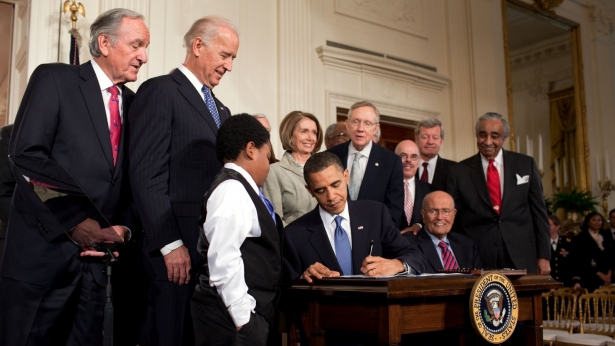
President Barack Obama is applauded as he signs the health care reform bill, on March 23, 2010, in the East Room of the White House in Washington. The bill includes many benefits for Americans who have health insurance today and those who have struggled to find and maintain health coverage.
2010 was a momentous year for the American health care system. In March, Congress passed—and President Barack Obama signed—landmark legislation that reforms the health insurance market, provides all Americans with affordable access to health coverage, and reduces the growth of health care costs.
The Department of Health and Human Services and other parts of the executive branch have begun to implement the new law in the subsequent 10 months. The Affordable Care Act, or ACA, includes many benefits for Americans who have health insurance today and those who have struggled to find and maintain health coverage. Many of these benefits came on-line in 2010.
Signature achievements include:
- Establishing pre-existing condition insurance plans in every state so that individuals with health problems who cannot find coverage in the regular market have a reliable source of coverage
- Requiring employer-sponsored health plans to offer coverage to the young-adult children of policyholders
- Helping employers with unpredictable health care spending for retired workers
- Providing more than 1 million rebate checks to Medicare enrollees who incurred high out-of-pocket prescription drug spending in 2010
- Prohibiting health insurance plans from denying coverage to children with pre-existing conditions
- Protecting individuals with high health care costs from the financial risk of absurdly low annual and lifetime limits on their benefits
- Prohibiting health insurance plans from rescinding coverage when a policyholder gets sick
These changes bring a new degree of stability and security to millions of Americans’ health coverage. And even more improvements are around the corner. Beginning this month, seniors will enjoy meaningful new benefits and significant improvements in their prescription drug coverage, while individuals and businesses will receive premium rebates from their insurance company when the insurers incur excessive administrative costs.
Specific improvements in 2011 include:
- Closing the Medicare prescription drug coverage gap. Seniors and people with disabilities who obtain prescription drug coverage through Medicare Part D will enjoy a new discount on brand-name and generic prescription drugs when they hit the so-called “doughnut hole” in their Part D benefits. Since the beginning of the program, enrollees have hit a gap in coverage when their total drug spending—including out-of-pocket costs and expenses covered by their Medicare Part D plan—exceeds a preset limit (currently $2,830). Patients then pay the total cost of their prescription drugs, without help from their drug plan, until their total drug expenses hit an upper limit and coverage kicks in again. With the new discount, people with drug spending high enough to hit the coverage gap will save almost $500 on average this year, while people with very high drug costs will save more than $1,500.
- Launching new prevention benefits for Medicare enrollees. Good coverage of preventive services helps seniors and other Medicare enrollees better manage their health. New benefits include coverage without cost-sharing for recommended preventive services (those that receive an “A” or “B” rating from the U.S. Preventive Services Task Force) and new coverage for a personal prevention plan.
- Increasing access to primary care. Medicare will pay primary care providers a 10 percent bonus payment, which offers a new incentive for physicians, nurses, and others to provide primary care services.
- Requiring insurers to provide high value for premium dollars. Beginning in 2011, insurers will pay rebates to policyholders—individuals and employers—when plan spending on clinical services falls below 80 percent of premium revenue in the individual and small group market, and 85 percent of premium revenue in the large group market.
Looking ahead, ACA provisions that will touch real people every day will continue coming on-line through 2011. These include providing more consumer information on healthy food choices by requiring chain restaurants and vending machines to provide nutritional data no later than March, and improving long-term care by sending enhanced federal Medicaid payments to support new state investments in community-based long-term care services starting in October. Tangible improvements will continue beyond this year, such as fully closing the coverage gap in Medicare Part D and improving Medicaid coverage for preventive care.
The Affordable Care Act’s most striking impact will come in 2014 when new health insurance exchanges launch, premium subsidies become available, and Medicaid coverage expands to include all low-income individuals regardless of family composition, age, or disability status.
These headline-grabbing changes in our health care system may be a few years down the road. But millions of Americans are already benefiting from the Affordable Care Act—and millions more will receive better care in the near future thanks to the changes in the new law.
By Karen Davenport | January 13, 2011-Center For American Progress. Photo: AP/Charles Dharapak
More Small Businesses Offering Health Care To Employees Thanks To Obamacare
The first statistics are coming in and, to the surprise of a great many, Obamacare might just be working to bring health care to working Americans precisely as promised.
The major health insurance companies around the country are reporting a significant increase in small businesses offering health care benefits to their employees.
Why?
Because the tax cut created in the new health care reform law providing small businesses with an incentive to give health benefits to employees is working.
We certainly did not expect to see this in this economy,” said Gary Claxton, who oversees an annual survey of employer health plans for the nonprofit Kaiser Family Foundation. “It’s surprising.”
How significant is the impact? While we won’t have full national numbers until small businesses file their 2010 tax returns this April, the anecdotal evidence is as meaningful as it is unexpected.
United Health Group, Inc., the nation’s largest health insurer, added 75,000 new customers working in businesses with fewer than 50 employees.
Coventry Health Care, Inc., a large provider of health insurance to small businesses, added 115,000 new workers in 2010 representing an 8% jump.
Blue Cross Blue Shield of Kansas City, the largest health insurer in the Kansas City, Mo. area, reports an astounding 58% increase in the number of small businesses purchasing coverage in their area since April, 2010-one month after the health care reform legislation became law.
“One of the biggest problems in the small-group market is affordability,” said Ron Rowe, who oversees small-group sales for the Kansas City operation for Blue Cross Blue Shied. “We looked at the tax credit and said, ‘this is perfect.”
Rowe went on to say that 38% of the businesses it is signing up had not offered health benefits before.
Whatever your particular ideology, there is simply no denying that these statistics are incredibly heartening. However, for those of you who cannot get past your opposition, even for a moment of universal good news, let’s break it down.
The primary, most enduring complaint of the opponents of the ACA has been that the law is deathly bad for small business.
Apparently, small businesses, and their employees, do not agree.
The next argument has been that the PPACA is a job killer.
If these small businesses found the new law to be so onerous, why have so many of them voluntarily taken advantage of the benefits provided in the law to give their employees these benefits? They were not mandated to do so. And to the extent that the coming mandate obligations might figure into their thinking, would you not imagine they would wait until 2014 to make a move as the rules do not go into effect until that time?
Of course, there is the nagging banter as to how Obamacare is leading us down the road to socialism.
Let it go, folks.
Private market insurance companies are experiencing significant growth because of a tax break provided by the PPACA. I may have missed the day this was discussed in economics class, but I’m pretty sure this is not a socialistic result of federal legislation.
When data like this appears, we have the opportunity to really find out who is talking smack for political benefit and who actually cares about getting affordable and available health care to America’s workers. Certainly, there will be elements of the new law that will not work out exactly as planned. That’s simply reality when it comes to any new piece of landmark legislation. But if you cannot celebrate what appears to be an important early success, you really should give some thought as to where your true interests and intents lie.
If you’re all about beating up on President Obama, you can conveniently forget this bit of data as if it never really happened. However, if your interest is to make health care available to more Americans, this should be a happy day for you – no matter what your ideological beliefs.
By: Rick Ungar, The Policy Page-Forbes, January 6, 2011
When Opposition to Health-Care Reform Stops Being Polite and Starts Getting Scary
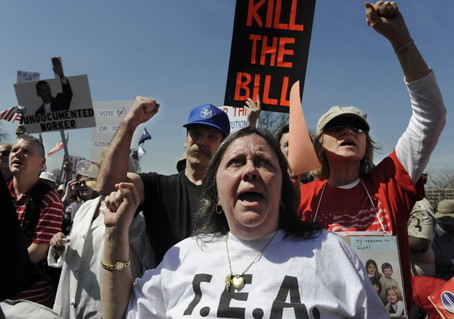
When do you cross the line?
In the Wyoming state legislature, 10 congressmen and three senators have co-sponsored “The Health Care Choice and Protection Act.” The intent? To make it a felony to implement the health-care reform law — which is, you’ll remember, the official law of the land. Here’s the relevant bit:
Enforcement of federal laws prohibited; offenses and penalties.
Any official, agent, employee or public servant of the state of Wyoming as defined in W.S. 6-5-101, who enforces or attempts to enforce an act, order, law, statute, rule or regulation of the government of the United States in violation of this article shall be guilty of a felony punishable by a fine of not more than five thousand dollars ($5,000.00), imprisonment in the county jail for not more than two (2) years, or both.
Any official, agent or employee of the United States government or any employee of a corporation providing services to the United States government that enforces or attempts to enforce an act, order, law, statute, rule or regulation of the government of the United States in violation of this article shall be guilty of a felony punishable by imprisonment for not more than five (5) years, a fine of not more than five thousand dollars ($5,000.00), or both.
There’s not much use in worrying about something like this as it wouldn’t survive two seconds in a court of law. But the sentiments are worth considering: The argument is that this legislation isn’t just policy that the authors disagree with, but rather a deeply, profoundly, un-American threat to liberty. It’s so un-American, in fact, that a plain reading of the Constitution makes clear that the Wyoming legislature, which has sworn to protect and defend the document, must “adopt and enact any and all measures as may be necessary within the borders of Wyoming to prevent the enforcement of the Patient Protection and Affordable Care Act and the Health Care and Education Reconciliation Act of 2010.”
Many of my friends on the right have legitimate technocratic differences with the Affordable Care Act. But many of the politicians they’ve stood with have not made a legitimate case against the bill. Rather, they’ve taken a bill that echoes past legislation Republicans have introduced and called it, as Sen. Jon Kyl did, “a stunning threat to liberty.” They’ve told their supporters, as Sen, Chuck Grassley did, that they’re right to fear that the health-care bill “determines if you’re going to pull the plug on grandma.” This is not merely legislation that they have some technical or philosophical disagreements with. It is, in the words of Speaker John Boehner, “a monstrosity.”
Given the extremism of the rhetoric at the top, is it any wonder that there is incredible fear trickling down to the grass roots? If those are the stakes, then of course criminalizing any implementation of the bill makes sense. Frankly, if those are the stakes, then violent resistance might be required.
Those aren’t the stakes, of course. They’re just the words. And words slip sometimes. Things come out too angry, or too quickly, or too sharply. I’ve had my share of experience with this. But words matter. And the Republican Party hasn’t been slipping up: It’s been engaged in a concerted campaign to scare the population into opposing health-care reform. That may be good politics, but it can have bad consequences.
By: Ezra Klein-Washington Post-January 7, 2011: Photo By: Melina Mara-Washington Post
Health Care Lawsuits: Separating Law From Spin

"Now if we can just fool the Courts"
If a public figure walks on water at noon, by 3 p.m. a dozen talking heads will be explaining that he can’t swim. That’s politics. But we can hope that federal judges won’t think in sound bites.
The current lawsuits challenging the Affordable Care Act raise this question insistently. I return to this lawsuit in yet another column because I believe this case will dominate both constitutional law and political discourse over at least the next 12 months–and because I believe its stakes far transcend its immediate consequences, important though they will be. I think that if our federal courts are willing to sign on to the challengers’ jejune theory of this case, not only we but our children will spend years dealing the malign consequences of the mistake. Nothing less than the ability of the United States to function as a modern nation may be at stake.
So far, in two of the pending lawsuits, opponents of the law have succeeded in spinning the judges, framing the lawsuits as posing the question whether (as Virginia argued) the federal government can “impose a penalty for what amounts to passive inactivity.”
We know the talk-radio answer to this question: Tyranny! Death panels! Black helicopters! Praise the Lord and pass the ammunition!
But the judicial answer, it seems to me, should be two-fold.
The first, and most important, answer a judge should give is, “I dunno. Find a case where the government does that and get back to me.” Because that description of the Affordable Care Act is simply inaccurate.
The second answer, which a judge shouldn’t give but a Con Law jock like me can, is, “Why ever not?”
I will get to that one later; but first, let’s deal with the canard that the Act somehow “penalizes inactivity.”
Here’s how Judge Henry Hudson put it in his decision in Cuccinelli v. Sebelius: The Act “requires that every United States citizen, other than those falling within specified exceptions, maintain a minimum level of health insurance.”
This snappy apothegm is the logical equivalent of saying that the Defense Appropriations Act “requires that every United States citizen, other than those who leave the country, engage in accepting a minimum level of protection by the United States military.” The provisions of the Health Care Act provide a benefit. The majority of Americans, who already have health coverage (and seem, by and large, to regard this coverage as worth bargaining for) will simply see improvements in their existing health care benefits, such as an end to lifetime benefit limits and the right to include older adult children on their policies. A significant number of others who are currently uninsured will become eligible for government-funded health insurance.
There will remain a small but significant number of Americans who can afford health care insurance but choose not to buy it. But contrary to the sound bite above, even they are not required to “maintain a minimum level of health insurance.” If they wish to keep their uninsured status, they may do so by paying an addition to their income tax bills–ranging from as little as $695 for an individual taxpayer to $2085 for a family of six or more. The claim that the government is “forcing individuals to buy a commercial product” is worse than spin; it is simply false.
In fact, even the choice of procuring insurance or paying a tax is put not to “every United States citizen,” or even “every United States citizen not already covered by insurance,” but only to those who earn enough income to qualify as taxpayers. “A small fraction of fewer than half of United States citizens,” though accurate, is much less thrilling to say, even for a judge, than “every citizen.”
This brings us to the contention that the act somehow regulates “inactivity.” Let’s you and I test this proposition: why don’t you just remain totally inactive in 2014, when the Act first takes effect.
Quit your job and get rid of your investments. The government will not regulate you. (True, it may offer you government-financed health care; but again, that is a benefit, not a regulation or punishment.)
But if you decide actually to work (I recommend that, by the way), you are not being “inactive.” You are taking part in commerce. The Constitution gives Congress plenary authority “to regulate commerce with foreign nations, and among the several States, and with the Indian Tribes.”
A system of regulation might easily include requiring you to pay taxes if you choose to burden commerce; willful refusal to maintain adequate health coverage for yourself and your family is such a burden. To claim otherwise doesn’t pass the straight-face test.
Conservatives like to prate about “individual responsibility” when it is a question of forcing the poor to work; asking the solvent to pay for themselves seems quite in line with these conservative values.
And as to the idea that Congress can only regulate “activity,” here again, verbal formulae are obscuring the practical truth. The Constitution does not say anything about “activity”; that’s a gloss that the Rehnquist Court put on it. Nor does it refer to “interstate commerce,” which to some (apparently including Justice Thomas) means men in knee breeches handing trinkets across state lines. The Constitution says that Congress may “regulate commerce . . . among the several states.”
Chief Justice Marshall (who was a ratifier, though not a Framer, of the Constitution) wrote in 1824 that “among” means “intermingled with,” not “between.” Marshall wrote that Congress’s commerce power reaches everything except that small set of matters “which are completely within a particular state, which do not affect other states, and with which it is not necessary to interfere, for the purpose of executing some of the general powers of the government.” Health care, and the citizen’s economic relationship with it, most assuredly affect all the states, and individual decisions about insurance are an important part of that effect–just as a farmer’s decision to raise private wheat are a part of agriculture’s effect on commerce.
I am somewhat mystified why the state plaintiffs even have standing to appear. In order for them to be injured, the Act would have to infringe some power that is reserved by the Constitution to the states. Judge Hudson placed great emphasis on an obscure 1922 precedent called Bailey v. Drexel Furniture, in which a laissez-faire majority of the Supreme Court invalidated a federal tax on products produced by child labor. The tax, the Court reasoned, was an attempt to prevent exploitation of children in factories and mills; such labor regulations were “a purely state activity.”
The Court has long since given up the idea that “labor laws” are solely state matters. But assume that in the formal sense Drexel is good law. So what? The tax, or penalty, in the Affordable Health Care Act doesn’t regulate any “purely state activity.” If it pretended to regulate commerce but was actually aimed at preventing divorce, or imposing a national zoning code, or requiring homeowners to maintain tasteful wallpaper, there might–might–be a Tenth Amendment issue. But not here: In the guise of regulating commerce, the Act regulates . . . commerce.
Here’s the nub of the objectors’ argument–it is not that this isn’t a regulation of commerce, but that the Commerce Power isn’t strong enough to regulate an entire national market. That kind of limitation on the Commerce Power finds no support in, well, the Constitution.
The doctrine under which the Act is being assailed quite simply constitutes a threat to most of the significant advances in federal law of the past 100 years: federal pension programs, national wildernesses and parks, consumer protection, environmental regulation, and most particularly statutory guarantees of civil rights.
It’s not coincidental that right now Ron Paul laments the Civil Rights Act and that Haley Barbour speaks fondly the segregated South, that anti-immigrant extremists target birthright citizenship, or that right-wingers seek to wreck the Constitution with an old-South style amendment letting states repeal federal laws. A decision to void the Act would furnish a powerful precedent for those who would “restore” a libertarian dreamland that never existed, and that for most of us would quickly become a nightmare.
The great achievement of the Framers–the one they clearly thought most important–was the creation of a national Congress with plenary powers in the spheres assigned to it. Trying to wreck Congress is warring on the Constitution.
That’s not to say that Congress can regulate commerce by unconstitutional means. But the prohibitions on means are in the Constitution, not in the fevered brain of Cuccinelli & McCollum. If a new health care act were to restrict free speech, or impose ex post facto laws, or authorize bills of attainder, or deny due process, the courts should certainly step in.
But that’s not what is at issue here.
Stripped of spin, the state plaintiffs are arguing that Congress can’t use its commerce power to actually regulate commerce. If the courts buy this nonsense, they may fatally damage the power of Congress to manage a modern commercial economy. Repairing that mistake would involve far greater sacrifices than having to pay a tax.
By: Garrett Epps- former reporter for The Washington Post-Original article-The Atlantic, December 30, 2010
Share This Blog


 Unknown Feed
- An error has occurred; the feed is probably down. Try again later.
 mykeystrokes.com
You must be logged in to post a comment.