Iowa And Beyond: “Common Sense” Racism And The Tea Party GOP
The 2012 Republican presidential field, a hydra which self-destructively feeds on itself, had one more battle royale in Iowa. Fighting to a standstill, Romney, Gingrich, Santorum, and Paul bloodied each other. While the Tea Party GOP is still a house divided, their leading candidates share a common, uniting, go to issue: hating on the blacks makes for good politics; it pays substantial political dividends.
As Iowa demonstrated, be it Gingrich’s yearning to have lazy black and brown kids pick up mops and brooms as janitors in work houses, Romney’s nativist Klan inspired opines to keep “America America,” Santorum’s appeals to a belief that African Americans find sustenance by stealing from hardworking white people, or Ron Paul’s assertion that the Civil Rights Act (with its bringing down of Jim and Jane Crow) was an unfair intrusion on white people’s “liberty” and “freedom,” the Tea Party GOP remains addicted to the crack rock of dog whistle politics.
Decades after the founding of the Southern Strategy in the 1960s, the old school remains the true school. Ultimately for conservatives, demagoguing the negroes can still help stir up support among the white populist faithful.
Precision matters here. Research on public opinion and political behavior has demonstrated that not all conservatives are racist. However, racists are much more likely to be conservative–and to identify as Republicans.
Social scientists, historians, psychologists and others have developed an extensive vocabulary to talk about the lived politics of the color line. These terms include such notable phrases as symbolic racism, white racial resentment, the white racial frame, in-group and out-group anxiety, ethnocentrism, prejudice, realistic group conflict, colorblind racism, systems of structured inequality, racial formation, and front stage vs. backstage racism.
In thinking through the politics of race at work in the white conservative political imagination, this seemingly disparate terminology is connected by a common thread. Race and racial ideologies are ways of seeing the world, of locating people and individuals relative to one another, and are a cognitive map for making sense of social relationships. While shocking to outsiders, the type of racism played with so casually by Gingrich, Romney, Santorum, Paul and other conservatives is a type of “common sense” for their public.
For example, the audiences that cheer Romney’s speeches about a country that is lost, one led by an anti-American usurper, are not necessarily “bad people.” They are motivated by a sense of belonging, and made to feel special by virtue of being “real Americans,” part of a special tribe anointed with unique insight and wisdom by their oracles.
Likewise, those who embrace Gingrich’s habit of stereotyping “inner city blacks” as lazy, unmotivated, and criminal, probably identify as “compassionate conservatives,” or “good Christians.” There is no intended malice on their part. To them, “everyone knows” that these observations about black and brown people are “true.”
Rick Santorum’s Iowa speech on the nature of black people’s greed and degeneracy is an especially instructive example of this broader pattern:
“It just keeps expanding – I was in Indianola a few months ago and I was talking to someone who works in the department of public welfare here, and she told me that the state of Iowa is going to get fined if they don’t sign up more people under the Medicaid program,” Santorum said. “They’re just pushing harder and harder to get more and more of you dependent upon them so they can get your vote. That’s what the bottom line is.”He added: “I don’t want to make black people’s lives better by giving them somebody else’s money; I want to give them the opportunity to go out and earn the money.” “And provide for themselves and their families,” Santorum added, to applause. “The best way to do that is to get the manufacturing sector of the economy rolling again.”
“Right,” responded one audience member, as another woman can be seen nodding.
There are several elements at work here.
First, poverty in America is racialized. The image in the public imagination is of black welfare queens, or illegal aliens birthing “anchor babies” who live off of the government tit, profiting from food stamps and the generosity of the American people. The white poor rarely, if ever, enter the picture. Second, black people are in a parasitic relationship with white Americans (Santorum’s “someone” else). In sum, black people are “lazy,” and a dependent class, unable to take care of their families except for the generosity and benevolence of white people.
The most powerful part of Santorum’s appeal to his white audience in Iowa is the implication that black people are receiving some type of “reparations.” For Santorum and the Tea Party GOP, blacks are plagued by “bad culture” and are existentially prone to poverty. Therefore, in a country where labor, capitalism, and citizenship are inexorably connected, blacks are outside of the political community.
In the age of Fox News and the Right-wing echo chamber, one cannot forget how the conservative imagination is constituted as a dream world: it is a mature fulfillment of some of the most sophisticated propaganda in the post World War 2 period.
In this imagination, it does not matter that whites are the majority of America’s poor.
It does not matter that most people on public assistance and welfare in Iowa are white.
It does not matter that there is a deep history which explains how conservatives have spun a fiction about black and brown poverty while ignoring structural economic inequality, and how many of the policies endorsed by the Tea Party GOP in the name of economic austerity and punishing people of color (who are coded as “the poor” or “unproductive citizens”), also disproportionately harm the white working and middle classes.
This local type of common sense helps to explain the feelings of defense, denial, and injury that many white conservatives exhibit when challenged about the racism of the Tea Party GOP and the Right-wing establishment. While the leadership and media elites from which they take their cues skillfully play the race baiting game, rank and file Fox News conservatives simply feel aggrieved at the suggestion that anyone would take their common sense understandings of the world to be racist, bigoted, or based on false understandings about the nature of racism and white privilege in the Age of Obama.
In the same way that a fish does not know that it is wet, the politics of nativism, an authoritarian-like embrace of the politics of us and them, and a fear of the Other, are so central to contemporary white populist conservatism, that they are taken-for-granted assumptions about the nature of the world.
Moreover, politics is essentially about the creation of an imagined community. The stump speeches about evil liberals who hate America, the cheering of dying cancer patients who lack insurance, the booing of gay soldiers, and the numerous fictions about the economy, science, the Constitution, and public policy more generally are taken as divine gospel. These fictions are standing priors for contemporary conservatives which help to mark out the boundaries of their political world.
During an election year, and as a function of a highly polarized 24 hour news environment, it is a given that the incumbent president will be the target of vicious attacks by the out party. By implication, the election of Barack Obama, America’s first black president, has amplified all of these tensions. The election of a member of the racial out-group has made the stakes especially high for white conservatism. Obama is anathema to the Tea Party GOP soul, the living embodiment of a world turned upside down, for no man who looks like him could ever be leader of the free world, where whiteness is inseparable from being “American.”
By implication, there is a short line from the white racial appeals of Gingrich, Santorum, Paul, Romney and others directly to President Obama. He has been called “the food stamp president” and a “ghetto crackhead.” Obama is stained by the Birthers who say he is not an American citizen. The appeals to American exceptionalism are naked arguments that a black man like Obama cannot help but be outside of the “normal” political culture of this country. It has also been implied that President Obama is a perpetual “they,” a member of a marginalized group who by association is lazy, anti-white, unqualified, and an “affirmative action baby” that somehow managed to steal a presidential election and win the popular vote.
Many may laugh at such a formulation. However, the Tea Party GOP, Iowa voters, and others who clamor to participate in the Republican primaries, would take such claims as common sense knowledge. For people of color, the outsider, the Other, and those who are not (in their eyes) “quintessentially American” (and thus have to prove their authenticity to the white conservative gaze), this is not your country.
You people may have built and improved this country, but it is not yours. For the Tea Party GOP and the populist conservatism of the present moment, you people are just guests. They will remind you people of that fact at every moment.
Why? Because it is common sense. Didn’t you know that?
By: Chauncey DeVega, Open Salon Blog, January 4, 2012
Rick Santorum Is Coming For Your Birth Control
Here is an actual Rick Santorum quote: “One of the things I will talk about, that no president has talked about before, is I think the dangers of contraception in this country.” And also, “Many of the Christian faith have said, well, that’s okay, contraception is okay. It’s not okay. It’s a license to do things in a sexual realm that is counter to how things are supposed to be.”
These comments were not dug up from some bygone moment of ideological purity, before dreams of a presidential campaign. He said them in October, to a blogger at CaffeinatedThoughts.com (they met at Des Moines’ Baby Boomers Cafe).
It’s pretty basic: Rick Santorum is coming for your contraception. Any and all of it. And while he may not be alone in his opposition to non-procreative sex, he is certainly the most honest about it — as he himself acknowledged in the interview.
This is important, because while reproductive rights are always cast in terms of pro or against a woman’s right to an abortion and in what circumstances, even liberals are surprised to find out what social conservatives really want to do about contraception. Liberals are even willing to cast the proposed defunding of Planned Parenthood and all Title X programs (a position that has become mainstream in Republican circles) as an abortion issue, when it is actually about contraception. (The Hyde Amendment already bans almost all federal abortion funding.) So is this about “babies” or is this about sex? Rick Santorum isn’t even pretending it’s (only) about childbearing.
Speaking to ABC News’ Jake Tapper, Santorum recently reaffirmed his opposition to Griswold v. Connecticut, the 1965 Supreme Court decision that struck down a ban on discussing or providing contraception to married couples, and established a right to privacy that would later be integral to Roe v. Wade and Lawrence v. Texas. (It is generally better-known how Santorum feels about gay people.) That would be the case where the majority asked, “Would we allow the police to search the sacred precincts of marital bedrooms for telltale signs of the use of contraceptives? The very idea is repulsive to the notions of privacy surrounding the marriage relationship.” Rick Santorum disagrees. He thinks, using the currently popular states’ rights parlance, that “the state has a right to do that, I have never questioned that the state has a right to do that. It is not a constitutional right, the state has the right to pass whatever statues they have.” This is a view Santorum has held at least since 2003.
The trouble with this is that not only have more than 99 percent of sexually active women used at least one form of birth control, helping people get access to birth control is actually a popular issue. According to a June survey by the Public Religion Research Institute, 82 percent of Americans actually want to expand access to birth control for women who cannot afford it, while only 16 percent were opposed.
Santorum isn’t alone. Five of the current or former Republican presidential candidates signed the Personhood Pledge (though unlike Santorum, Michele Bachmann and Herman Cain, Newt Gingrich and Ron Paul added some caveats to their support). Mitt Romney told Mike Huckabee he’d support an amendment saying life begins at conception — which Personhood folks interpret as the fertilization of an egg, meaning that contraceptives like the IUD and sometimes even the pill are murderous. (Good luck figuring out what Romney actually thinks on that one.)
Santorum just happens to be happiest putting it at the top of the agenda. In the Caffeinated Thoughts video, he promises that “all those issues are going to be front and center with me,” and says, ”I know most presidents don’t talk about these things and maybe people don’t want us to talk about these things. But I think it’s important that you are who you are… these are important public policy issues.” Among those important public policy issues: Sex for fun. In the same video, Santorum bemoans sex becoming “deconstructed to the point where it’s simply pleasure.”
Many people don’t want them to talk about these things because it shows the true colors of what social conservatives wish for this country, which is very different from what Americans wish for themselves. Maybe the near-win in Iowa yesterday is the end of the road for Santorum, and maybe no one will ever succeed by openly suggesting a contraception ban that would send the condom police into America’s bedrooms. But that’s clearly the world Santorum wants, and it’s one that is entirely consistent with the antiabortion movement’s goals. That would be the same movement that over the past year decided it had a mandate in states across the country, the same one that demanded endless obeisance from the Republican candidates in Iowa this year — and mostly got it.
By: Irin Carmon, Salon, January 4, 2012
Did Santorum Win Iowa?: Caucus Vote Counter Says Typo Gave Mitt Romney 20 Extra Votes
An Iowa GOP caucus voter who helped count the votes at his small caucus meeting in Moulton, Iowa claims that former Gov. Mitt Romney (R-MA) accidentally received 20 extra votes than he earned — a claim which, if true, would change the winner of the unusually close caucus to former Sen. Rick Santorum (R-PA):
Edward True, 28, of Moulton, said he helped count the votes and jotted the results down on a piece of paper to post to his Facebook page. He said when he checked to make sure the Republican Party of Iowa got the count right, he said he was shocked to find they hadn’t.
“When Mitt Romney won Iowa by eight votes and I’ve got a 20-vote discrepancy here, that right there says Rick Santorum won Iowa,” True said. “Not Mitt Romney.”
True said at his 53-person caucus at the Garrett Memorial Library, Romney received two votes. According to the Iowa Republican Party’s website, True’s precinct cast 22 votes for Romney.
Des Moines TV station KCCI 8 captured an image of Moulton’s handwritten vote count:
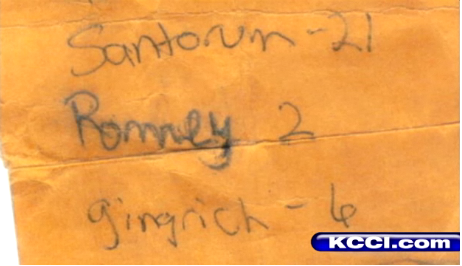
Minor counting errors such as this one are extremely common on election day, so it is perfectly plausible that Moulton is correct and Romney did receive 20 unearned votes. It is equally plausible, however, that these lost votes could be canceled out by a similar error at another caucus site. The tentative results, which showed Romney with the barest 8 vote lead, have not yet been certified.
Nevertheless, the Iowa GOP does not seem happy that True is questioning the early result. According to KCCI, a spokesperson for the Iowa GOP said that “True is not a precinct captain and he’s not a county chairperson so he has no business talking about election results.”
By: Ian Millhiser, Think Progress, January 5, 2011
I Love A Parade: The March Of The Non-Mitts
“This is the New Hampshire primary! This is a big deal! I can’t even believe I’m standing here!” cried Jon Huntsman, who yearns to be the Rick Santorum of New Hampshire. That’s what it’s come to. Do you think this is what Huntsman told himself when he quit his distinguished post as ambassador to China? (“Diplomacy is all well and good, but I believe I was meant for greater things. Like being the Rick Santorum of New Hampshire.”)
Santorum, of course, was the man of the hour when he sort-of-almost-nearly came in first in the Iowa caucuses on Tuesday. Actually, Mitt Romney won. (Eight Republicans can’t be wrong!) But Santorum has the momentum. His strategy of spending his entire life going from one Iowa Pizza Ranch to another paid off.
After campaigning only in New Hampshire, with 150 events in the bag, Huntsman hopes for a similar triumph. It’s the famous one-state strategy that worked so well in 2008 for Rudy Giuliani.
“I’d thought we’d never get here, but here we are!” he told an audience in the Peterborough town hall. Actually, getting to the Peterborough town hall is not all that remarkable. I have personally been there several times, but, of course, that is because I have a glamorous career in journalism, which allows me to have elite access to events like the one headlined: “Tom Ridge Introduces Jon Huntsman.” You may remember Ridge from his stint as chief of the Department of Homeland Security. He was the one with the yellow-orange-red terror colors. Huntsman is incredibly buoyant, to the point of appearing to be just a little bit goofy. (“Last night in Dover I was met by a goat! The same goat that bit my kneecap when I was there three months ago!”) He has a large, attractive family, but large attractive families are a dime a dozen this year. Michele Bachmann had 23 foster children, and she’s already out of the race.
Jon Huntsman is the Republican that the White House most feared, possibly because the White House is full of Democrats. He is way behind in the New Hampshire polls, and he lacks the loony streak that primary voters seem to find so attractive this time around. Really, he is toast unless he does something remarkable over the next week. Not remarkable in the sense of making a good point in the next debate. Remarkable as in saving a baby from being run over by stopping a speeding car with one hand.
There are still plenty of other Republican options. After his fifth-place finish in Iowa, Rick Perry suspended his campaign but then tweeted, “Here we come, South Carolina.” This appeared to surprise some of his staff, who seemed to feel as if their long political nightmare had ended in Des Moines. But it turned out that Perry had jogged his way back into the race.
“I was out on the trail when it kind of came to me,” he said.
Quite a lot comes to the governor of Texas when he’s jogging. You will remember the coyote he killed with his laser-sighted Ruger. No word on whether a pistol was involved in this latest revelation.
Ron Paul is still in competition, as is Newt Gingrich, who appears to be running mainly on rancor, the candidate of the I Want to Eat Mitt’s Liver Party. And Rick Santorum, who continued the excitement of Iowa by flying into New Hampshire for a rally at a nursing home.
Mitt Romney himself was greeted in Manchester by a group of people cordoned off into half a high school auditorium. This helped disguise the crowd’s small size but not the fact that it appeared to be made up mainly of Ron Paul supporters, dragooned teenagers and refugees from Occupy Wall Street. The highlight of the event was supposed to be an endorsement from John McCain, whose innermost thoughts we would love to be privy to. Or maybe not.
McCain’s old loathing of Romney has now been totally overshadowed by his hatred of President Obama. “You can’t hide from your record of making this country bankrupt, from destroying our national security and making this nation one that we have to restore with Mitt Romney as president of the United States of America!” McCain snarled into the mic. It was an endorsement, but not the feel-good moment we were sort of looking for. Fortunately, they did play the new Kid Rock theme song that implicitly compares Romney to a wild stallion.
Can’t wait to see what the Republicans do next. You have to admit they’re desperate. Rick Santorum. Geesh.
Did I ever mention that Romney once drove to Canada with the family Irish setter strapped to the roof of the car? The dog’s name was Seamus. New Hampshire Republicans, if you can’t think of anybody to vote for on Tuesday, consider writing in the name Seamus when you go to the polls. Maybe we can start a boomlet.
Makes as much sense as the Newt Gingrich moment.
By: Gail Collins, Op-Ed Columnist, The New York Times, January 4, 2012
Mitt Romney’s “Not-A-Mandate” Iowa Victory
Mitt Romney and his backers decided that to win in Iowa they had to destroy Newt Gingrich’s campaign. Now Gingrich looks eager — and able — to return the favor.
Romney got his victory, but it doesn’t feel much like one. It’s embarrassing that the supposed Republican front-runner managed to beat Rick Santorum by only eight votes out of about 120,000 cast in Tuesday’s caucuses. It’s troubling that Romney has spent the past five years campaigning in Iowa and still could draw just one-quarter of the vote.
And it’s downright ominous that Gingrich is threatening to do whatever he can to block Romney’s path to the nomination. If the sneering description of Romney in Gingrich’s post-caucus speech Tuesday is a preview — he called him a “Massachusetts moderate” who is “pretty good at managing the decay” — this could get ugly.
I mean uglier. Sometimes it seems as if niceness is Iowa’s state religion, but the way Romney and his crew took Gingrich apart was vicious. A pro-Romney political action committee, Restore Our Future, spent more than $4 million ensuring that Iowans couldn’t watch 10 minutes of television without being assaulted by an ad explaining why Gingrich was a scoundrel, a knave, a hack, a goon or — shudder — a closet liberal.
Romney could claim distance from this sordid barrage since Restore Our Future is “independent,” wink wink, of the campaign. There was a certain poetic justice, since Gingrich has done as much as any individual to make U.S. political rhetoric a blood sport. Could it be that the man who calls Barack Obama a “food-stamp president” can’t take a little heat?
But Gingrich is furious — perhaps not just because he believes that the negative advertising was unfair but because he knows that it was brutally effective. He had surged ahead of Romney and seemed to have a viable path to the nomination. Tuesday night, after being worked over, Gingrich won just 13 percent of the vote and finished fourth.
It’s doubtful Gingrich can become the nominee. But he can inflict as much damage as possible on Romney, especially in this weekend’s two New Hampshire debates.
Gingrich is smart enough to know that the effect will be to give Santorum the time and space he needs to begin building a campaign organization that can compete with Romney’s. This de facto anti-Romney alliance, if it materializes, will be one of convenience, not conviction. But it could be effective.
The Iowa campaign proved what pollsters have been telling us all along: Republicans just don’t like Mitt Romney very much.
Oh, they like him much better than they like Obama. But this past week in Iowa, while it was easy to find support for Romney, it was hard to find passion. Crowds didn’t swoon over Romney the way they did over Ron Paul or Michele Bachmann. Many of the staunch conservatives who dominate Republican politics here simply do not believe that Romney is one of their own.
“I would never vote for Mitt Romney, even if he were the nominee,” said Phil Grove, whom I met Monday afternoon at a Bachmann rally in West Des Moines.
Grove, a chemist, and his wife Sue, a nurse, were still undecided — the caucuses were just a day away — and had reasons for rejecting each candidate. Santorum and Gingrich were creatures of Washington, they said; Bachmann and Paul had good ideas but probably couldn’t beat Obama. Romney, though, was seen by the couple as simply beyond the pale.
Romney’s good fortune is that true-believer conservatives have had multiple candidates from which to choose — until now. With Bachmann dropping out and Rick Perry staggering, the race becomes — from Romney’s point of view — disturbingly simple.
He comes out of Iowa with a win, in the technical sense, but also with a new chief rival who has the potential to do fairly well in New Hampshire and very well in South Carolina. Given the shrinking field, there will be room for Santorum’s support to grow if he campaigns effectively.
Romney, meanwhile, still hasn’t proved that he can break through that 25 percent ceiling he keeps bumping against. And he has to deal with a Newt Gingrich who is wounded, angry and able to make himself the center of attention — the political equivalent of a snarling wolverine.
Yes, a funny thing happened on the way to the coronation.
By: Eugene Robinson, Opinion Writer, The Washington Post, January 4, 2012
Share This Blog


 Unknown Feed
- An error has occurred; the feed is probably down. Try again later.


You must be logged in to post a comment.