Mitt Romney Straining to Get to the Right of Genghis Khan
The unpredictable Republican presidential race has taken another surprising turn as recent numbers show Mongol warlord Genghis Khan seizing the lead in national polls of likely GOP primary voters. Benefiting from widespread doubts about Mitt Romney’s authenticity and ideological commitment, Genghis has changed the shape of the race by sounding sharp populist themes that resonate with supporters of the tea party. “Mitt Romney wants to manage Washington, D.C.,” he told an enthusiastic crowd in Scottsdale, Arizona. “I want to burn it to the ground, slay its inhabitants, and stack their skulls in pyramids reaching to the sky.”
Romney’s advisers privately fret that such sharp rhetoric may play badly with upscale suburban swing voters in a general election. Their dilemma is that they cannot attack Genghis’s often harsh positions without reinforcing doubts about Romney’s own right-wing bona fides. Romney has dispatched previous conservative rivals by sowing doubts about their conservatism, assailing Texas Governor Rick Perry as soft on illegal immigration, Newt Gingrich as a Washington insider, and Rick Santorum as a supporter of earmarks and raising the debt ceiling.
Genghis Khan, who boasts of never having previously set foot in Washington or even the entire Western hemisphere, is the most challenging target thus far.
One vulnerability is his colorful personal life, which includes six wives, countless concubines, and habit of eating raw horseflesh. Romney has subtly exploited these weaknesses, recently appearing with his wife, Ann, at a Burger King in Grand Rapids, Michigan. “Here I am, accompanied by my one wife, consuming a sandwich consisting of cooked animal meat,” he told campaign reporters. (Romney paid for the meal by handing the cashier a $1000 bill, telling him to keep the change.)
Genghis’s surge to the top of the polls began after a recent debate in Williamsburg, Mississippi. After moderator Brian Williams questioned if his popular campaign promise to not only defeat President Obama but to enslave his family was racially insensitive, Genghis angrily replied that he enslaves the families of all his defeated rivals, regardless of race. Then, in a dramatic touch that reminded many Republicans of Ronald Reagan’s famous I-paid-for-this-microphone moment, he charged down from the stage on horseback, decapitated Williams, and displayed his head before the roaring crowd. At a post-debate focus group led by pollster Frank Luntz, numerous attendees praised Genghis for standing up to, as one attendee put it, “the politically correct media.”
His continued strong showings have the Romney campaign contemplating more forceful tactics. Pro-Romney super PAC Restore Our Future today released a new ad assailing Genghis for having established a vast mail delivery network based on riding stations, like the post office, and having failed to completely conquer China. The ad includes the tagline, “More government bureaucracy, soft on defense,” while the screen morphs Genghis’s face into that of Jimmy Carter.
The latest ARG poll has Genghis leading Romney by eight points in Ohio.
By: Jonathan Chait, Daily Intel, February 16, 2012
“Gospel Of Inequality”: Santorum Praises Income Inequality
“Santorum Praises Income Inequality.”
That was Fox News’s headlineabout Rick Santorum’s speech at the Detroit Economic Club on Thursday. Santorum said, “I’m not about equality of result when it comes to income inequality. There is income inequality in America. There always has been and, hopefully, and I do say that, there always will be.”
Unbelievable. Maybe not, but stunning all the same.
Then again, Santorum is becoming increasingly unhinged in his public comments. Last week, he said that the president was arguing that Catholics would have to “hire women priests to comply with employment discrimination issues.”
Also last week, he suggested that liberals and the president were leading religious people into oppression and even beheadings. I kid you not. Santorum said: “They are taking faith and crushing it. Why? When you marginalize faith in America, when you remove the pillar of God-given rights, then what’s left is the French Revolution. What’s left is a government that gives you rights. What’s left are no unalienable rights. What’s left is a government that will tell you who you are, what you’ll do and when you’ll do it. What’s left in France became the guillotine.”
Yet for Santorum to champion income inequality in Detroit, of all places, is still incredibly tone-deaf.
Detroit has the highest poverty rate of any big city in America, according to data provided by Andrew A. Beveridge, a demographer at Queens College. Among the more than 70 cities with populations over 250,000, Detroit’s poverty rate topped the list at a whopping 37.6 percent, more than twice the national poverty rate. And according to the Census Bureau, median household income in Detroit from 2006-10 was just $28,357, which was only 55 percent of the overall U.S. median household income over that time.
This is a city that last year announced plans to close half its public schools and send layoff notices to every teacher in the system.
This is a city where the mayor’s pledge to demolish 10,000 abandoned structures was seen as only shaving the tip of the iceberg because, as The Wall Street Journal reported in 2010, “the city has roughly 90,000 abandoned or vacant homes and residential lots, according to Data Driven Detroit, a nonprofit that tracks demographic data for the city.”
This is not the place to praise income inequality. Last week, at a hearing before the Senate Budget Committee, Kent Conrad, the chairman of that committee, laid out the issue as many Americans see it:
“The growing gap between the very wealthy and everyone else has serious ramifications for the country. It hinders economic growth, it undermines confidence in our institutions, and it goes against one of the core ideals of this country — that if you work hard and play by the rules, you can succeed and leave a better future for your kids and your grandkids.”
This is arguably even more true of people in Michigan than for the rest of us. Even though income inequality in the Detroit area isn’t particularly high, looking at the issue as an urban one in the case of cities like Detroit is problematic. The whole region took a hit. The comparison for cities like Detroit may be more intra-city than inter-city.
As Willy Staley argued in 2010 in an online column for Next American City magazine: “In richer cities, the inequality is put side-by-side, in an uncomfortable, loathsome way; for cities left in the dust of deindustrialization, the inequality is presents (sic) as existing between cities, not within them. Gone is the city/suburb divide between rich and poor, income inequality manifests itself within wealthy cities and between cities.”
And it is this feeling of being left behind by the American economy and abandoned by Republicans that is pushing Michigan into the blue. Public Policy Polling, a Democratic polling company, found this week that Obama would handily defeat all the Republican candidates in head-to-head matchups in the state. The company’s president, Dean Debnam, said in a statement: “Michigan is looking less and less like it will be in the swing state column this fall.” He continued, “Barack Obama’s numbers in the state are improving, while the Republican field is heading in the other direction.”
Santorum went on to say about income inequality during his speech on Thursday: “We should celebrate like we do in the small towns all across America — as you do here in Detroit. You celebrate success. You build statues and monuments. Buildings, you name after them. Why? Because in their greatness and innovation, yes, they created wealth, but they created wealth for everybody else. And that’s a good thing, not something to be condemned in America.”
Santorum might want to take a walk around Detroit to see who’s celebrating and to see how many statues he can find to honor people who simply invented something and got rich.
Furthermore, as a newspaperman and a former Detroiter, I’d like to direct him to the James J. Brady Memorial. Detroit1701.org, maintained by a University of Michigan emeritus professor, calls it “one of the more attractive memorials in Detroit.” It pays tribute to Brady, a federal tax collector, who set out to address the issue of child poverty in the city by founding the Old Newsboys’ Goodfellows of Detroit Fund in 1914 — what is essentially a local welfare fund.
The group provides “warm clothing, toys, books, games and candy” to local children every Christmas in addition to sending poor children to summer camps, the dentist and to college.
Then again, charitable giving doesn’t appear to be high on Motor Mouth Santorum’s list of priorities. As The Washington Post pointed out, based on Santorum’s tax return disclosure this week, he has given the least amount to charity of the four presidential candidates who have disclosed their tax returns. (Ron Paul has not.) His charitable giving was just 1.8 percent of his adjusted gross income.
The Obamas were the highest, giving 14.2 percent, even though their income was second lowest.
Maybe that’s the imbalance we should praise.
By: Charles M. Blow, Op-Ed Columnist, The New York Times, February 17, 2012
Culture Wars: Republicans Are “Unprotected” on Contraception
During the 1928 presidential campaign, nutty right-wing Protestants claimed that Al Smith, the first Catholic nominated for president by a major party, was planning to extend New York’s Holland Tunnel all the way to the Vatican.
Today’s tunnel would run from the Vatican to a suburban Pentecostal megachurch.
We learned this week that U.S. Catholics support President Barack Obama’s Feb. 10 compromise on contraception in almost identical numbers to the population as a whole. Many of those sticking with the Catholic bishops in opposition are evangelical Protestants.
Historians are rubbing their eyes in wonder that the spiritual and political descendants of Protestants who founded the Know Nothing Party in the 1850s on anti-Papist ideas — who hassled not just Al Smith but also John F. Kennedy for supposed ties to Rome — are now embracing Catholics. Rick Santorum was recently greeted at Oral Roberts University by an enthusiastic crowd of 4,000.
Yes, politics makes strange bedfellows, and in this case, the Republicans, by throwing in their lot with the bishops, are using no protection. Like the controversy over the Susan G. Komen for the Cure foundation withdrawing support from Planned Parenthood over its provision of abortion services, this struggle leaves Republicans politically exposed.
Redefining the Debate
At first, the Komen case looked like just another example of anti-abortion activists flexing their muscles against hapless women’s health advocates. Then came a furious, highly effective counterassault fueled by liberal social media, a new counterweight to conservative talk radio in defining the terms of debate. The outcome of that flap, in which the Komen foundation reversed itself and apologized, shows that bashing Planned Parenthood may work in Republican primaries but will be poison in the general election.
The demand for “conscience” exemptions from Obamacare for Catholic hospitals, schools and charities (churches were already exempt) also looked good for the Republicans initially. Conservatives thought that they had a chance to revive the “culture wars” — the wedge-issue appeals to faith and family that have worked so well in the past. For more than a week, Republicans made Obama look like the guy who ordered Joan of Arc burned at the stake.
Their problem is that they never know when to stop. Recall the case of Terri Schiavo, the Florida woman in a persistent vegetative state whose plight led conservative lawmakers to champion federal legislation in 2005 to keep her alive. The measure passed, but public opinion polls afterward showed the law was widely unpopular and a clear case of congressional overreach.
This time conservatives stuck with the argument that the president was abusing religious freedom even when that attack was no longer plausible. By decreeing that insurance companies, not Catholic institutions, will pay for contraceptives in employee health-care plans (as allowed under the Affordable Care Act), the president successfully shifted the subject back to birth control, where he’s on solid political footing.
Obama’s like a quarterback who calls a bad play and seems trapped in the pocket, then scrambles for big yardage.
Put Into Context
The bad play resulted from poor political planning inside the White House, which failed to line up supporters to defend its decision. But it’s a little more defensible when you know the context. For months, the pressure seemed to come from the left. The White House learned that 28 states (including Mitt Romney’s Massachusetts) already require that health plans under their jurisdiction cover contraceptives. These rules had survived court challenges on religious freedom grounds. In fact, women’s groups were threatening lawsuits if Obamacare didn’t also require such coverage, and some government lawyers argued that the new law provided no authority for any exemptions for institutions receiving federal money.
Obama’s team debated the issue and, contrary to published reports, the discussion didn’t break down cleanly along gender lines, with women on one side and Catholic men on the other. When the rule was made public on Jan. 20, White House press secretary Jay Carney faced not a single question about it. Then the regional and religious press embraced the story, and within a week even liberal Catholic columnists like E.J. Dionne and Mark Shields were up in arms.
But the firestorm may prove to be a political blessing. If the president had started on Jan. 20 with the compromise he eventually arrived at on Feb. 10, it would have been a one-day story for health-care policy wonks. Birth control would never have surfaced as a political issue.
Instead contraception is now the elephant in the bedroom — the issue that no one in the Republican establishment wants to talk about because they know it’s a disaster for them.
The Republicans may end up with a nominee, Rick Santorum, who has warned of “the dangers of contraception in this country.” He said: “It’s not OK because it’s a license to do things in the sexual realm that is counter to how things are supposed to be.”
This from a candidate who recently said of the president: “He thinks he knows better how to run your lives.”
Imagine what Obama would do with that in a debate.
Instead of running away from Santorum, many Republicans are running toward him — once again, failing to get the memo on when to stop. Senator Scott Brown co-sponsored a bill this week with Senator Roy Blunt that would let any employer with a “moral conviction” (a term left undefined in the legislation) deny access to any health service, including contraception, they personally oppose. This weapon is aimed at Obamacare, but it will probably boomerang on Brown, who is locked in a tight re- election campaign in Massachusetts against Elizabeth Warren.
With all the major candidates this year enjoying seemingly happy marriages, it didn’t seem as if sex would figure much in this campaign. Wrong. The independent women who will help determine the election want the government — and their bosses – – out of their private lives.
The culture wars are over, and the Republicans lost.
By: Jonathan Alter, Bloomberg News, February 19, 2012
“The Little Man On The Wedding Cake”: Mitt Romney, Plain And Unpopular
Unlike Newt Gingrich, who can claim a regional base, Rick Santorum, who has a solidly defined political persona, or Ron Paul, who has something of a cult of personality, there’s nothing unique about Mitt Romney as a candidate. He is the definition of a generic Republican—a blank slate for the public to register its frustrations. Like Thomas Dewey—who played a similar role in the 1948 election—he is “the little man on the wedding cake.” Indeed, if there is anything close to a reason for his presidential campaign, it’s his vanilla appeal to the broad public, and undecided voters in particular.
Since the beginning of the year, however, that advantage has completely evaporated—the public has gone from slight approval of the former Massachusetts governor, to outright loathing.
In less than two months, Romney has gone from a positive rating of +8.5—43.5 percent favorable to 35 percent unfavorable—to an astonishingly negative one of -17.4, or 31.2 percent favorable to 48.6 percent unfavorable. What’s more, this comes as his name recognition has increased; the more Americans get to know Mitt Romney, the less they like him. This, it should be said, wasn’t true of John Kerry when he ran for the presidency in 2004.
Of course, because this poll measures all voters—and not just independents—this includes some Republicans who will return to the fold if Romney becomes the nominee. But the favorability gains that come with leading a unified party aren’t enough to overcome a deficit of this size. What’s more, it will do nothing for Romney’s standing with independents, which has also collapsed in the last two months. You can also expect these numbers to get worse for the former Massachusetts governor as he moves to bury Rick Santorum under a landslide of attack ads ahead of the Michigan primary. Voters aren’t keen on constant negativity, which has become Romney’s default position as the primaries drag on.
None of this is to say that Romney is doomed if he becomes the nominee, but the situation doesn’t look good. At this point, most Americans don’t trust him to stand up for their interests, a plurality of Americans don’t like him, and independents would rather stick to President Obama. It’s true that this could all change with a crisis in Europe or a war in the Middle East, but if that’s what you’re banking on, you’re not in a good place.
By: Jamelle Bouie, The American Prospect, February 16, 2012
“Rmoney”: Mitt Is The Lobbyists’ Candidate
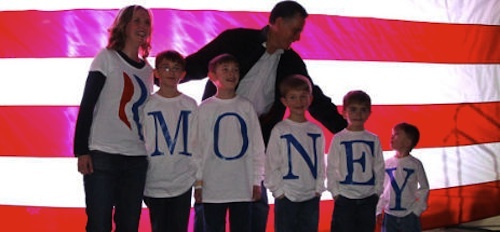
When you think of Mitt Romney, you probably think of a tall, robotic fellow with no discernible strong beliefs or stances (at least, none that can survive longer than a week at a time). That’s terribly unfair, and you should be ashamed for thinking it. He may have started out as an empty husk devoid of strong personal beliefs, but thanks to a crack team of industry insiders, he now is quite filled with opinions. Coincidentally, they happen to be the opinions of an army of top lobbyists in Washington, and the companies they lobby for. Funny how that works.
[Mitt Romney’s] kitchen cabinet includes some of the most prominent Republican lobbyists in Washington, including Charles R. Black Jr., the chairman of Prime Policy Group and a lobbyist for Walmart and AT&T; Wayne L. Berman, who is chairman of Ogilvy Government Relations and represents Pfizer, the drug manufacturer; and Vin Weber, the managing partner for Clark & Weinstock. […]Other lobbyists serve on one of Mr. Romney’s policy advisory teams, have hosted fund-raisers for his campaign or have joined the many influential Republicans whose endorsements Mr. Romney’s campaign has hailed.
Want to know what Mitt Romney’s true policies are? Well, you should have attended Mitt Romney’s $10,000-and-up policy round table, where industry lobbyists led “discussions” on what his policies towards those industries should be:
Mr. Romney’s campaign held an elaborate “policy round table” fund-raiser at a Washington hotel, featuring panel discussions run by lobbyists and former cabinet officials or members of Congress.James Talent, a former senator who runs the lobbying and public affairs firm Mercury Public Affairs, led a panel on infrastructure, according to an invitation. William Hansen, a former deputy secretary of education who is president of the lobbying firm Chartwell Education Group, led the education panel.
Wow. I can’t imagine why anyone would be cynical about American politics these days, can you?
The entertaining thing about this story is just how many large companies are represented. Among those specifically mentioned (and kudos to the three reporters for linking the lobbyists with actual clients, which is rather important information for readers) are Walmart, AT&T, Pfizer (drugs), Microsoft, Altria (tobacco), General Dynamics, Dominion (power), Barclays (finance), Allegheny (steel) and Peabody Energy (coal). Lobbyists are cutting the checks; lobbyists are bundling other people’s checks; lobbyists are holding the panel discussions about how the candidate can best serve the specific industries they represent; lobbyists make up the inner circle of “policy makers,” advising the candidate as to what his own core positions should be.
As for the candidate himself, he’s almost irrelevant at this point. You might as well nominate a bunny named Mr. Buttons: If you surround it with the exact same lobbyist-advisors, you’ll end up with the exact same policies. Sigh, if only we could teach that bunny to hold a pen—but for now we’ll have to settle for our current crop of Republican candidates, all of whom have near-identical policy prescriptions, all of which favor the exact same subset of people and the exact same handful of industries. Go figure.
I’ve given up on the notion that we can keep lobbyists from capturing our politics. I’ve also given up on the notion that we can prevent interests like the oil sector or our current handful of top financial companies from tailoring the American government specifically to serve their needs. Want more profits? Want less environmental protections? Want to crush some emerging industry that threatens to make yours less profitable? Just buy a few congressman, or a senator, or a president. At a few million here and there, it’s cheaper than advertising, and the results are far more secure.
So I’m in the Bill Maher camp on this one. Lobbyists and industries want to buy our politicians? Fine, I give up, let them. Just pass a law saying the candidate has to wear those corporate logos on their jackets whenever they appear on the campaign trail or when they are in office. The more money is contributed, the bigger the logo has to be. Top presidential candidates will look like military dictators-in-training, with badges and medals and ribbons sticking out from them in every direction, and just from looking at them we’ll be able to tell who they serve, and in what proportions. That would certainly be more educational than any rhetoric coming from the candidates themselves.
By: Hunter, Daily Kos, February 15, 2012
Share This Blog


 Unknown Feed
- An error has occurred; the feed is probably down. Try again later.
 mykeystrokes.com
You must be logged in to post a comment.