Charles Krauthammer Is the Fraud
Charles Krauthammer says that Obama has conned Republicans into agreeing to a second stimulus even bigger than the first. Democrats are too stupid to see this (and Republicans are even more stupid, presumably, since they are the victims).
Barack Obama won the great tax-cut showdown of 2010 – and House Democrats don’t have a clue that he did. In the deal struck this week, the president negotiated the biggest stimulus in American history, larger than his $814 billion 2009 stimulus package. It will pump a trillion borrowed Chinese dollars into the U.S. economy over the next two years – which just happen to be the two years of the run-up to the next presidential election. This is a defeat?
He’s right about the Democrats’ stupidity, but this is not Krauthammer at his most lucid.
Yes, Democrats are fools to tear their hair out over this deal, which gives them most of what they wanted: the middle-class tax rates, unemployment benefit extension, payroll-tax cut, and so on. They compound the idiocy by advertising higher taxes on the rich as their core objective. Forget relieving poverty, widening access to health care, improving opportunities for the disadvantaged. What matters more than any of that is sticking it to “millionaires and billionaires” (two-earner households making more than $250,000). You bet, the Democrats are acting like fools.But this stimulus is not bigger than the first, not even close. Two-thirds of its “cost” is keeping tax rates where they currently are. There is no new stimulus in failing to put taxes up–in forgoing a drastic fiscal tightening that nobody wanted and nobody expected. Unlike Krauthammer, I think further short-term stimulus makes sense, so I welcome the $300 billion (over two years) or so of extra stimulus in the deal. Oppose this if you like, but please don’t call it a bigger stimulus than the first.
In any event, the key question is this: does Krauthammer oppose the deal? Having declared Obama guilty of a massive swindle, and recalling that he is opposed to all of Obama’s sinister purposes, Krauthammer is obliged by his own logic to say what a bad thing the agreement must be. So what exactly did he want to happen? Presumably, raise everybody’s taxes next month, with an especially steep rise for $250,000+ households. Has he previously advocated this policy? Maybe he has, and I missed it; if so, I apologize. But if he agrees it makes sense for now to keep taxes where they are, which has been the Republicans’ defensible position, what is so bad about what just happened? Krauthammer is left opposing it because Obama was in favour. It is not every day that Krauthammer is backed into an absurd and dishonest position by his own logic.
What about the long-term deficit? This deal, if temporary, has little effect on that either way, and could easily be deficit-reducing if it avoids a second dip (as Krauthammer seems to concede it might). Obviously, the long-term deficit remains a huge concern. Tackling that requires prolonged Bowles-Simpson-type efforts that were not on the agenda for this deal. They should have been, but they weren’t. Was that a reason for rejecting the deal and letting taxes rise next month? I think not. Again, if that is the outcome Krauthammer wanted, then all right. But if that is not his position, then he is the fraud.
Read David Brooks instead.
BY: Clive Crook, Senior Editor of The Atlantic-December 11, 2010
Tax-Cut Deal: If It’s Good for Regular Americans, Isn’t That Good Enough for Now?
“Absolute disaster.” “Legislative blackmail.” “Almost moral corruptness.” We get it. Democrats in Congress really, really don’t like President Obama’s tax deal with the Republicans. But is it truly as apocalyptically bad as all that?
— Oh yeah, the rich. They’re getting a 35 percent inheritance tax and an exemption for individual estates under $5 million (Obama and Democrats say both are too generous), and — the part that makes Democrats question their reason for being — the lower Bush-era rates on income above $250,000.
When Democrats finally brought their tax cut package to the floor a few days ago, the Senate couldn’t overcome a filibuster threat. Time was running out. Obama said his top priority is to make sure 2 million long-term unemployed don’t lose their lifelines and “tens of millions of hardworking Americans are not seeing their paychecks shrink on January 1st just because the folks here in Washington are busy trying to score political points.” The agreement gives Washington time to have the political argument over taxes, he said, without doing harm to individuals or the economy as a whole.
Some liberal interest groups have pounced on Obama and branded the deal a complete sellout. “If Obama’s theory is that Independent voters will flock to presidential weakness, mission accomplished,” wrote Adam Green, head of the Progressive Change Campaign Committee. His evidence: An Associated Press dispatch Monday headlined “Republicans achieve top goal in Obama tax-cut plan.” Republicans “largely dictated the terms” of the compromise though they don’t control the House, Senate or White House, the AP said.
Never mind that Republicans would have preferred a permanent extension of the high-end tax cuts instead of the two years they got. Or that they agreed to extend unemployment benefits for an unprecedented 13 months, a $56-billion expense, and did not secure spending cuts to offset the cost. Their insistence on such an offset — even as they said there was no need to offset the 10-year, $700 billion cost of the high-end tax cuts — has repeatedly held up attempts to extend the benefits, including twice since Nov. 30.
By Tuesday, the AP had its economic team on the case. New headline: “Tax deal should help economy, analysts say.” Bill Scher of the very liberal Campaign for America’s Future implored Democrats to “do the deal. For the Jobless. For the Economy.” The liberal Center for American Progress (CAP) said the plan could save or create 2.2 million jobs. The group’s ThinkProgress blog says Obama’s priorities get far more money in the deal and help 32 times as many people as the GOP’s priorities.
How To Fight The Tax Cut Wars
The next big fight in Congress revolves around extending the Bush tax cuts. Unlike issues like climate change or stimulus, where the public does not accept the Democrats’ basic analysis of the problem, on the tax cuts the Democrats hold the whip hand. The question is whether they emerge with a political win, a public policy win, or both.
Let’s review a few basic facts about the Bush tax cuts. When Republicans took control of government in 2001, their top priority was reducing tax rates on high income earners. Since tax cuts for the rich were unpopular, they had to pair those cuts with middle-class tax cuts in order to make them politically salable. That’s how they pressured Democrats into supporting them. By packaging the whole thing together, they could accuse Democrats of opposing tax cuts for the middle class if they voted no.
Now, ten years later — and what a decade of bountiful economic growth we’ve enjoyed with the energies of investors and entrepreneurs finally unleashed from restrictive Clinton-era tax rates! — the Bush tax cuts are scheduled to expire. Republicans want to extend the whole thing. Democrats just want to extend the parts that benefit people who earn less than $250,000 a year.
Now, here’s the underlying dynamic. Raising taxes on the middle class is unpopular. But raising taxes on the rich is wildly popular. The truth is that neither party cares very much about the portion of the Bush tax cuts that benefit the middle class. Republicans just threw that in to sell the upper-bracket tax cuts, which is what they care about. Democrats might prefer a more progressive tax code with lower middle-class taxes, but most of them would rather have the revenue instead. But Democrats promised not to raise taxes on people earning less than $250,000 a year — a promise they felt they had to make in order to win. And they can’t break that promise without suffering political consequences.
Republicans, on the other hand, don’t want to pass an extension of the middle-class Bush tax cuts without the upper-bracket tax cuts. That would leave the federal tax code more progressive than it was under Bill Clinton — you’d have a combination of Clinton-era tax rates on the rich and Bush-era tax rates on the middle class. Conservatives have been fretting about such a result for more than a year, warning ominously about a country in which half the population pays no income tax. (They’d still pay other taxes, but the central Republican goal is to minimize the progressivity of the tax code.)
So we’re down to a game of chicken. Here’s why the Democrats hold the whip hand. They can pass an extension of the middle-class Bush tax cuts through the House. If Republicans let the bill pass, then they’ve lost their leverage to extend the unpopular Bush upper-income tax cuts. If they filibuster it, then Democrats can blame them for raising taxes on middle-class Americans. It would let Democrats out of their pledge. (Hey, they tried to keep the middle-class tax cuts.) Then nothing would pass, and we’d instantly revert to Clinton-era rates across the board.
What kind of effect would that have on the deficit? A huge one:
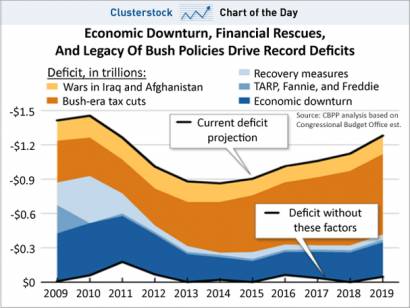
That dark orange stripe is the portion of the deficit attributable to the Bush tax cuts. That would be wiped out. Ending the tax cuts would basically solve the medium-term deficit problem.
The key factor here is that, just as Republicans got to frame the debate in 2001 by combining the tax cuts into an up or down vote, Democrats can frame the debate now by separating the policies Republicans pretend to care about from the ones they actually care about. Republicans want to have a vote on the whole collection of Bush-era tax cuts. Democrats shouldn’t give it to them. You hold a separate vote on the middle class portion and dare them to oppose it.
This seems to be the plan:
“The Senate will move first, and it will be a test to see whether Republicans filibuster” to block the bill in a bid to also win tax cuts for higher earners, said Rep. Chris Van Hollen of Maryland, head of the House Democrats’ re-election effort.
“If you can’t get it out of the Senate, then you take it to the election,” Mr. Van Hollen said in a recent interview. “You say to the American people that Republicans want to continue to hold middle-class tax relief hostage for an extension of tax breaks for [the well-to-do]. That will be the debate.”
Republicans have followed a strategy of opposing nearly everything the Democrats do. It’s worked very well. But the peculiar dynamic of this debate puts the Republicans in a position where they can’t win, and obstructing the Democrats is probably their worst move.
By: Jonathan Chait, Senior Editor, The New Republic-July 26, 2010
“Hypocrisy,” Say Morons

Elephants and facts just don't seem to go together
Republicans plan to hammer the debt and deficit hypocrisy theme in the days and weeks ahead. White House economic adviser Larry Summers has lectured Congressional Democrats that now is a good time for the federal government to borrow to “stimulate demand” because interest rates are low. Yet the President keeps insisting that fiscal responsibility is an important priority of the White House. Republicans are having a field day. A recent email blast reminded supporters of a statement made by President Obama on November 18th: “It is important though to recognize if we keep on adding to the debt, even in the midst of this recession, that at some point, people could lose confidence in the U.S. economy in a way that could actually cause a double dip recession.”
Fiscal schizophrenia reigns in the White House.
Okay, let’s go back and read what Obama said last November 18th:
There may be some tax provisions that can encourage businesses to hire sooner rather than sitting on the sidelines; so, we’re taking a look at those. I think it is important though to recognize that if we keep on adding to the debt, even in the midst of this recovery, that at some point, people could lose confidence in the US economy in a way that could actually lead to a double-dip recession.
And so one of the trickiest things we’re doing right now, is to on the one hand make sure the recovery is supported and not withdraw a lot of money either with tax increases or big spending cuts – and states, for example, need a lot of support to keep hiring teachers and so forth – at the same time, making sure that we’re setting up a pathway longterm for deficit reduction.
Got that? Obama was saying the same thing he’s saying now. In the short run, we have an economic crisis that requires deficits. In the long-run, we’ll need to reduce the deficit. (And the long-term costs of temporary stimulus are pretty low.) Indeed, taking steps that increase long-term deficits could actually hurt in the short run. These are not contradictory ideas. Indeed, in his November interview, Obama endorsed the very notion (helping states mitigate budget cuts for teachers and other things) that he’s pushing for right now.
Moore and the Republicans think it’s “hypocrisy” to be for high deficits during a liquidity crisis but against them during a recovery. Really. The whole Republican message is based on not understanding this distinction.
By: Jonathan Chait-The New Republic-June 18, 2010
Share This Blog


 Unknown Feed
- An error has occurred; the feed is probably down. Try again later.
 mykeystrokes.com
You must be logged in to post a comment.