“Inequality Is A Drag”: There’s No Evidence That Making The Rich Richer Enriches The Nation
For more than three decades, almost everyone who matters in American politics has agreed that higher taxes on the rich and increased aid to the poor have hurt economic growth.
Liberals have generally viewed this as a trade-off worth making, arguing that it’s worth accepting some price in the form of lower G.D.P. to help fellow citizens in need. Conservatives, on the other hand, have advocated trickle-down economics, insisting that the best policy is to cut taxes on the rich, slash aid to the poor and count on a rising tide to raise all boats.
But there’s now growing evidence for a new view — namely, that the whole premise of this debate is wrong, that there isn’t actually any trade-off between equity and inefficiency. Why? It’s true that market economies need a certain amount of inequality to function. But American inequality has become so extreme that it’s inflicting a lot of economic damage. And this, in turn, implies that redistribution — that is, taxing the rich and helping the poor — may well raise, not lower, the economy’s growth rate.
You might be tempted to dismiss this notion as wishful thinking, a sort of liberal equivalent of the right-wing fantasy that cutting taxes on the rich actually increases revenue. In fact, however, there is solid evidence, coming from places like the International Monetary Fund, that high inequality is a drag on growth, and that redistribution can be good for the economy.
Earlier this week, the new view about inequality and growth got a boost from Standard & Poor’s, the rating agency, which put out a report supporting the view that high inequality is a drag on growth. The agency was summarizing other people’s work, not doing research of its own, and you don’t need to take its judgment as gospel (remember its ludicrous downgrade of United States debt). What S.& P.’s imprimatur shows, however, is just how mainstream the new view of inequality has become. There is, at this point, no reason to believe that comforting the comfortable and afflicting the afflicted is good for growth, and good reason to believe the opposite.
Specifically, if you look systematically at the international evidence on inequality, redistribution, and growth — which is what researchers at the I.M.F. did — you find that lower levels of inequality are associated with faster, not slower, growth. Furthermore, income redistribution at the levels typical of advanced countries (with the United States doing much less than average) is “robustly associated with higher and more durable growth.” That is, there’s no evidence that making the rich richer enriches the nation as a whole, but there’s strong evidence of benefits from making the poor less poor.
But how is that possible? Doesn’t taxing the rich and helping the poor reduce the incentive to make money? Well, yes, but incentives aren’t the only thing that matters for economic growth. Opportunity is also crucial. And extreme inequality deprives many people of the opportunity to fulfill their potential.
Think about it. Do talented children in low-income American families have the same chance to make use of their talent — to get the right education, to pursue the right career path — as those born higher up the ladder? Of course not. Moreover, this isn’t just unfair, it’s expensive. Extreme inequality means a waste of human resources.
And government programs that reduce inequality can make the nation as a whole richer, by reducing that waste.
Consider, for example, what we know about food stamps, perennially targeted by conservatives who claim that they reduce the incentive to work. The historical evidence does indeed suggest that making food stamps available somewhat reduces work effort, especially by single mothers. But it also suggests that Americans who had access to food stamps when they were children grew up to be healthier and more productive than those who didn’t, which means that they made a bigger economic contribution. The purpose of the food stamp program was to reduce misery, but it’s a good guess that the program was also good for American economic growth.
The same thing, I’d argue, will end up being true of Obamacare. Subsidized insurance will induce some people to reduce the number of hours they work, but it will also mean higher productivity from Americans who are finally getting the health care they need, not to mention making better use of their skills because they can change jobs without the fear of losing coverage. Over all, health reform will probably make us richer as well as more secure.
Will the new view of inequality change our political debate? It should. Being nice to the wealthy and cruel to the poor is not, it turns out, the key to economic growth. On the contrary, making our economy fairer would also make it richer. Goodbye, trickle-down; hello, trickle-up.
By: Paul Krugman, Op-Ed Columnist, The New York Times, August 7, 2014
“Bizarre Looking-Glass Ideology”: Deficit Scolds Are The Most Crazed Ideologues In America
A new Congressional Budget Office report shows that the projected increase in the national debt has slowed dramatically. Good news for deficit scolds, right? Not for Ron Fournier, who still thinks the nation is on its last legs:
Only in Washington, the place where you land when you fall through the looking glass, could this be hailed as good news… Our deficit levels (annual totals of red ink) are stalled at breathtakingly high levels — and are projected to soar again in a few years… Scary news, right? Not according to many media outlets and a cynical leadership class in Washington. Some news organizations focused on the sugar-high of good news — the (temporary) dip in deficits.
Think of a reporter covering a shooting. The police tell him the victim is dying of blood loss. Is the headline “Shooting Victim Expected to Die” or “Blood Flow Slows for Shooting Victim”? [National Journal]
Fournier’s economic analysis, if it may be so dignified with the phrase, is comprehensively wretched. As I’ve argued, the real problem with the deficit is that it’s coming down way too fast. Premature austerity has crippled the economic recovery and kept millions out of work. The biggest economic problem facing the nation is unemployment, which outweighs the stupid deficit by Graham’s Number levels of importance.
But the main problem is that his scold case is weak even on its own terms. Fournier understands neither what is driving the increase in the national debt nor why that might be a problem — all of which betrays a bizarre ideology that holds that pain must be inflicted before any gains can be made.
The huge increase in the annual deficit in 2008-09 was driven by two things: first, the economic collapse, which caused revenues to fall and spending to increase as people drew on safety net programs like unemployment insurance. Second, the Recovery Act, aka the stimulus, which provided a one-time surge of spending to restore aggregate demand and get people back to work. Though the stimulus was not nearly large enough to fill the hole in demand, this is what macroeconomic policy is supposed to do in a recession (a fact that Republicans were happy to accept when they were in power).
The long-term debt and deficit projections, on the other hand, are entirely about health-care spending. As Peter Fisher once said, the government is basically an insurance company with an army, and for many years the price of health care increased much faster than the rate of economic growth. This made government spending on health care (mostly Medicare and Medicaid) consume an ever-greater portion of the federal budget. Past CBO projections just assumed this trend would continue, which accounts for past reports predicting that the national debt would eventually eat the whole budget.
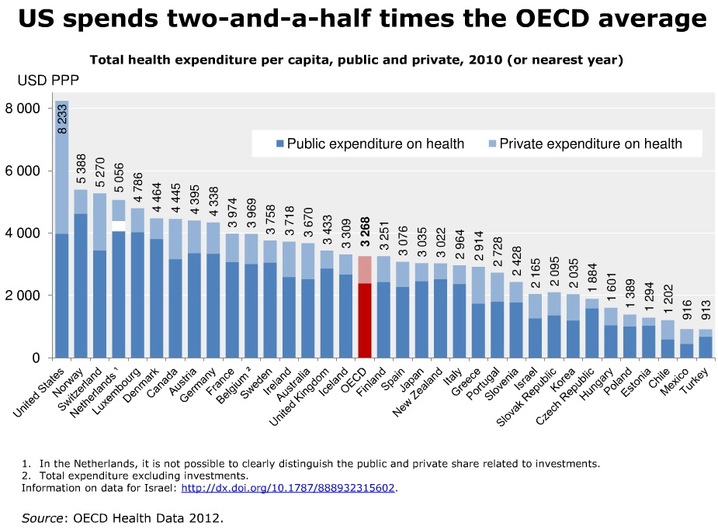
What this means is that Fournier’s preferred solution for dealing with this trend — higher taxes, fewer entitlements — is completely pointless. We have to fix the problem of rising prices, otherwise eventually a single tablet of aspirin will consume the entire federal budget. And the price problem is driven by awful policy design, not excessive generosity. America manages the rare trick of having very patchy and stingy social insurance that is simultaneously incredibly expensive. We spend more government money per person than Canada does — and the Canadians have universal single-payer coverage.
Fewer entitlements or higher taxes will get you a few years of breathing room before price increases eat up all the savings — and the whole point of Fournier’s column is that a couple decades of breathing room is still grounds for hair-on-fire panic.
Luckily, since the passage of ObamaCare, price increases have indeed slowed dramatically. That, plus a new projection that interest rates will stay low for a long time, accounts for the new CBO analysis showing slower debt growth. Just why this is happening is a matter of some dispute; I suspect it is partly the result of several programs in ObamaCare designed to bring prices down, and partly that health-care prices are already so high they’re running into resource constraints.
I think the fact that Fournier is patently uninterested in any of these things, and favors a policy that would accomplish nothing whatsoever on the deficit by his own standards, reveals that the pro-austerity school of punditry isn’t about the deficit at all. Instead, he says that his entitlement-cutting agenda is “going to happen sooner or later, painfully or more painfully.” As with David Gregory, the pain is the operative concept. The centrist definition of responsible politics holds that the American people must suffer a little more to keep the nation healthy. It’s only the “hateful partisans” who are keeping the wise, reasonable moderates from making those tough bipartisan compromises to slash social insurance and inflict pain.
But make no mistake: This has nothing to do with economics, and everything to do with the bizarre looking-glass ideology of “serious people” in Washington, D.C.
By: Ryan Cooper, The Week, July 24, 2014
“Who Wants A Depression?”: The Rich Believe That What’s Good For Them Is Good For America
One unhappy lesson we’ve learned in recent years is that economics is a far more political subject than we liked to imagine. Well, duh, you may say. But, before the financial crisis, many economists — even, to some extent, yours truly — believed that there was a fairly broad professional consensus on some important issues.
This was especially true of monetary policy. It’s not that many years since the administration of George W. Bush declared that one lesson from the 2001 recession and the recovery that followed was that “aggressive monetary policy can make a recession shorter and milder.” Surely, then, we’d have a bipartisan consensus in favor of even more aggressive monetary policy to fight the far worse slump of 2007 to 2009. Right?
Well, no. I’ve written a number of times about the phenomenon of “sadomonetarism,” the constant demand that the Federal Reserve and other central banks stop trying to boost employment and raise interest rates instead, regardless of circumstances. I’ve suggested that the persistence of this phenomenon has a lot to do with ideology, which, in turn, has a lot to do with class interests. And I still think that’s true.
But I now think that class interests also operate through a cruder, more direct channel. Quite simply, easy-money policies, while they may help the economy as a whole, are directly detrimental to people who get a lot of their income from bonds and other interest-paying assets — and this mainly means the very wealthy, in particular the top 0.01 percent.
The story so far: For more than five years, the Fed has faced harsh criticism from a coalition of economists, pundits, politicians and financial-industry moguls warning that it is “debasing the dollar” and setting the stage for runaway inflation. You might have thought that the continuing failure of the predicted inflation to materialize would cause at least a few second thoughts, but you’d be wrong. Some of the critics have come up with new rationales for unchanging policy demands — it’s about inflation! no, it’s about financial stability! — but most have simply continued to repeat the same warnings.
Who are these always-wrong, never-in-doubt critics? With no exceptions I can think of, they come from the right side of the political spectrum. But why should right-wing sentiments go hand in hand with inflation paranoia? One answer is that using monetary policy to fight slumps is a form of government activism. And conservatives don’t want to legitimize the notion that government action can ever have positive effects, because once you start down that path you might end up endorsing things like government-guaranteed health insurance.
But there’s also a much more direct reason for those defending the interests of the wealthy to complain about easy money: The wealthy derive an important part of their income from interest on bonds, and low-rate policies have greatly reduced this income.
Complaints about low interest rates are usually framed in terms of the harm being done to retired Americans living on the interest from their CDs. But the interest receipts of older Americans go mainly to a small and relatively affluent minority. In 2012, the average older American with interest income received more than $3,000, but half the group received $255 or less. The really big losers from low interest rates are the truly wealthy — not even the 1 percent, but the 0.1 percent or even the 0.01 percent. Back in 2007, before the slump, the average member of the 0.01 percent received $3 million (in 2012 dollars) in interest. By 2011, that had fallen to $1.3 million — a loss equivalent to almost 9 percent of the group’s 2007 income.
That’s a lot, and it surely explains a lot of the hysteria over Fed policy. The rich are even more likely than most people to believe that what’s good for them is good for America — and their wealth and the influence it buys ensure that there are always plenty of supposed experts eager to find justifications for this attitude. Hence sadomonetarism.
Which brings me back to the politicization of economics.
Before the financial crisis, many central bankers and economists were, it’s now clear, living in a fantasy world, imagining themselves to be technocrats insulated from the political fray. After all, their job was to steer the economy between the shoals of inflation and depression, and who could object to that?
It turns out, however, that using monetary policy to fight depression, while in the interest of the vast majority of Americans, isn’t in the interest of a small, wealthy minority. And, as a result, monetary policy is as bound up in class and ideological conflict as tax policy.
The truth is that in a society as unequal and polarized as ours has become, almost everything is political. Get used to it.
By: Paul Krugman, Op-Ed Columnist, The New York Times, July 10, 2014
“The Alleged Socialists Are Saving Capitalism”: Why You Don’t Know Obama Has Created 4.5 Million Jobs
The terrific June jobs report may be the signal we’ve been waiting for that we’re finally turning the psychic corner. The overall jobs number was great at 288,000, and the unemployment rate was down to 6.1 percent. But the most important number was that the employment-to-population ratio, which many economists think of as the truest measure of the jobs market, was up a bit to 59 percent, a high for the recovery, indicating that maybe more people are finally out looking for work than staying home.
A lot of liberals puzzle over why the Obama administration isn’t getting more credit, or doesn’t do a better job of making sure it gets credit, for such good economic news. There are a lot of theories, and most of them hold varying amounts of water. But the main reason to me is fairly obvious: Liberals don’t speak as one big fat propagandistic voice on this subject in remotely the same way conservatives do when a Republican president is in power.
Before I get into all that, I want to review some numbers with you, because unless you’re a hyper-informed political junkie, I doubt you know them. How many net jobs has the economy created during Barack Obama’s presidency, and how many did it create during George W. Bush’s tenure? Notice first that I wrote “has the economy created” rather than “did Obama create/did Bush create.” I think it’s a better description of reality.
I also should note that I just measured the numbers under each president—I gave Bush the numbers from January 2001 to December 2008, and Obama the numbers from January 2009 to the present, with the following asterisk. January 2009 was when Obama became president, but he didn’t start until the 20th, of course. That was a particularly awful month, with 798,000 jobs lost. So I think it’s reasonable to give Bush, whose policies helped cause the meltdown anyway, two-thirds of that 798,000. (January 2001, by the way, was a tiny number, 30,000 jobs lost, but just to be consistent, I assigned only 10,000 of those to Bush.)
Here are Bush’s numbers: It’s 8.657 million jobs gained, and 7.121 million jobs lost, for a net job-creation number of 1.536 million. Pathetic. It’s interesting to look back over the numbers from 2001. The economy stank. The month of 9/11, we lost 242,000 jobs. Want to ascribe that just to the attacks? In August, we’d lost 158,000. The decent Bush years were 2004, 2005, 2006, and part of 2007, but even then the numbers were hoppy and inconsistent: 307,000 jobs added in May 2004 and just 74,000 in June, for instance.
And what about Obama’s numbers? I’d bet that even if you’re an Obama partisan, you think they’re not all that different from Bush’s. After all, 2009 was miserable: minus 798,000, minus 701,000, minus 826,000, and so on. The numbers went into the black in early 2010, but dipped back into the red in the summer. But remember, since October 2010, every report has been positive—the now 45 straight months of job growth that the president and his team, to little avail, crow about.
But they’ve added up, because under Obama, the economy has added 9.425 million jobs and lost 4.887, for a net gain of 4.538 million jobs. That’s a 3 million advantage over Bush. Now, 6.5 million jobs doesn’t put Obama up there in Clinton (22 million) and Reagan (around 16 million) territory. But remember—he has 30 months to go yet. Let’s say we average a gain of 250,000 a month the rest of the way. That’s another 7.5 million. And that would edge him up toward Reagan territory. And that seems conservative, if anything. If the recovery gets genuinely humming, we could start seeing months between 300,000 and 400,000 next year. It seems unlikely to happen, but God would it be hilarious if Obama, with everything the Republicans in Congress have done to keep the economy in a state of contraction, ended up surpassing Reagan.
[UPDATE: I rechecked my math this morning, and it’s a good thing I did. I had originally given Obama nearly 2 million more jobs created than the actual numbers reflect. Obviously, I want to be accurate here. I added and re-added these three times.]
But all that’s speculative. After all, there could be a recession coming, too, though most experts don’t seem to fear that much. So let’s just talk about the up to now, the 6.5 million net jobs. As I said before, I bet you didn’t know that. Why?
Two main reasons. One, the administration doesn’t go a great job of trumpeting it, and I think for good reason. Officials may feel constrained from doing too much boasting because a lot of people’s perception and experience is still worse than that. A lot of these aren’t great jobs, and the economy is still only doing real well for the top 5 or 10 percent.
The second reason is that figures on the broad left simply aren’t superficial cheerleaders. The two men who are probably the most influential economic voices on the left, Paul Krugman and Robert Reich, have both been pretty harsh critics of the administration’s economic policies, as have other liberal economists. They, and less well-known but still prominent people such as Dean Baker, look at the numbers and report the truth as they see it. Democratic politicians are cheerleaders in varying degree—there’s Debbie Wasserman Schultz on the rah-rah end, but most Democrats don’t brag too much for the same reason the White House doesn’t.
And the media voices on the left—the folks on MSNBC, say—try to accentuate the positive in political terms, but they don’t ignore the bad news by any stretch of the imagination. MSNBC talks a lot about obstreperous Republicans, a theme to which I certainly contribute on air, but the network also offers a consistent diet of news features on and interviews with people stuck in the dead-end economy and having a hard time of it, segments that usually demand the government do more.
Now, imagine that a Republican president produced 45 straight months of job growth coming off the worst financial crisis since the Depression. Lord, we’d never hear the end of it from Fox and Limbaugh and even from CNBC. They wouldn’t care about the reality that a lot of the jobs are low wage. They’d just trumpet the bottom-line numbers as evidence of their president’s Churchillian greatness.
That’s how they are, and nothing’s going to change them. The important question now, as I said up top, is whether we’re really turning the psychic corner. Corporations have been hoarding record profits, banks still aren’t lending they way they should be, businesses have been skittish about large-scale hiring. It’s a big game of economic chicken, and it certainly has a political element. Most of these corporate titans and bankers and business leaders are Republicans. I don’t think most of them would intentionally hold the economy back because they don’t like the president, but I do think they take their cues from elected Republicans more than from Obama. When the Republicans stand up and say repeatedly that the president’s policies are failing, failing, failing, these private-sector titans hear them, and it influences what they do.
It may be that we’re finally working our way through all that. Happy days aren’t yet here again, but, once again, Democrats, the alleged socialists, are saving capitalism from the supposed lovers of capitalism who almost destroyed it.
By: Michael Tomasky, The Daily Beast, July 7, 2014
“Build We Won’t”: Weakening The Economy In The Short Run While Undermining Its Prospects For The Long Run
You often find people talking about our economic difficulties as if they were complicated and mysterious, with no obvious solution. As the economist Dean Baker recently pointed out, nothing could be further from the truth. The basic story of what went wrong is, in fact, almost absurdly simple: We had an immense housing bubble, and, when the bubble burst, it left a huge hole in spending. Everything else is footnotes.
And the appropriate policy response was simple, too: Fill that hole in demand. In particular, the aftermath of the bursting bubble was (and still is) a very good time to invest in infrastructure. In prosperous times, public spending on roads, bridges and so on competes with the private sector for resources. Since 2008, however, our economy has been awash in unemployed workers (especially construction workers) and capital with no place to go (which is why government borrowing costs are at historic lows). Putting those idle resources to work building useful stuff should have been a no-brainer.
But what actually happened was exactly the opposite: an unprecedented plunge in infrastructure spending. Adjusted for inflation and population growth, public expenditures on construction have fallen more than 20 percent since early 2008. In policy terms, this represents an almost surreally awful wrong turn; we’ve managed to weaken the economy in the short run even as we undermine its prospects for the long run. Well played!
And it’s about to get even worse. The federal highway trust fund, which pays for a large part of American road construction and maintenance, is almost exhausted. Unless Congress agrees to top up the fund somehow, road work all across the country will have to be scaled back just a few weeks from now. If this were to happen, it would quickly cost us hundreds of thousands of jobs, which might derail the employment recovery that finally seems to be gaining steam. And it would also reduce long-run economic potential.
How did things go so wrong? As with so many of our problems, the answer is the combined effect of rigid ideology and scorched-earth political tactics. The highway fund crisis is just one example of a much broader problem.
So, about the highway fund: Road spending is traditionally paid for via dedicated taxes on fuel. The federal trust fund, in particular, gets its money from the federal gasoline tax. In recent years, however, revenue from the gas tax has consistently fallen short of needs. That’s mainly because the tax rate, at 18.4 cents per gallon, hasn’t changed since 1993, even as the overall level of prices has risen more than 60 percent.
It’s hard to think of any good reason why taxes on gasoline should be so low, and it’s easy to think of reasons, ranging from climate concerns to reducing dependence on the Middle East, why gas should cost more. So there’s a very strong case for raising the gas tax, even aside from the need to pay for road work. But even if we aren’t ready to do that right now — if, say, we want to avoid raising taxes until the economy is stronger — we don’t have to stop building and repairing roads. Congress can and has topped up the highway trust fund from general revenue. In fact, it has thrown $54 billion into the hat since 2008. Why not do it again?
But no. We can’t simply write a check to the highway fund, we’re told, because that would increase the deficit. And deficits are evil, at least when there’s a Democrat in the White House, even if the government can borrow at incredibly low interest rates. And we can’t raise gas taxes because that would be a tax increase, and tax increases are even more evil than deficits. So our roads must be allowed to fall into disrepair.
If this sounds crazy, that’s because it is. But similar logic lies behind the overall plunge in public investment. Most such investment is carried out by state and local governments, which generally must run balanced budgets and saw revenue decline after the housing bust. But the federal government could have supported public investment through deficit-financed grants, and states themselves could have raised more revenue (which some but not all did). The collapse of public investment was, therefore, a political choice.
What’s useful about the looming highway crisis is that it illustrates just how self-destructive that political choice has become. It’s one thing to block green investment, or high-speed rail, or even school construction. I’m for such things, but many on the right aren’t. But everyone from progressive think tanks to the United States Chamber of Commerce thinks we need good roads. Yet the combination of anti-tax ideology and deficit hysteria (itself mostly whipped up in an attempt to bully President Obama into spending cuts) means that we’re letting our highways, and our future, erode away.
By: Paul Krugman, Op-Ed Columnist, The New York Times, July 3, 2014
Share This Blog


 Unknown Feed
- An error has occurred; the feed is probably down. Try again later.
 mykeystrokes.com