“Nickel And Dimed”: The Very Real Scourge Of Wage Theft
Last week, the owner of a chain of Papa John’s was ordered to pay $800,000 in back pay to workers he’d shortchanged by rounding down to the nearest hour on their time cards and failing to pay overtime properly. “I didn’t realize if you work 10 hours per day, you are supposed to pay overtime for two hours,” the owner, Emmanuel Onuaguluchi, told the New York Post.
A couple hours of overtime there may not seem like a lot of money, but those amounts could mean everything to workers struggling to get by on minimum wage and, as the judgment shows, it all adds up over the years. This latest judgment is part of a big push by New York’s attorney general, Eric Schneiderman, who has also sued local McDonald’s and Domino’s franchises.
Cases of wage theft—or, at least, the cases officials are pursuing—have been up in California and across the country, too, according to The New York Times. Business interests told the Times that politicians like Schneider are just pursuing these cases to curry favor with unions, but the unions aren’t really behind the legal actions.
If restaurants and other companies in the service industry—where workers are paid by the hour, have hours that change from week-to-week, and are especially vulnerable to wage theft—are complaining that the wage theft cases are coming from people who, in general, want to be paid more, they’re right. The fight for higher minimum wages across the country has highlighted the problems low-wage workers face in their workplaces, and wage theft is one of the most common ways they’re denied even the measly current minimum wage of $7.25 an hour.
Wage theft is old, but before now workers might have been too scared to complain or go to an attorney on their own. “I think one reason why it’s coming up more now is that it’s tied to a real organizing campaign where fast food workers are demanding and protesting,” says Tsedeye Gebreselassie, a senior staff attorney for the National Employment Law Project, which is not directly involved in any of these cases.
By law, companies have to pay their employees minimum wage, and overtime pay should kick in once an employee works past an eight-hour shift in a day. Five years ago, in a survey funded by the Russell Sage Foundation and conducted by researchers from the National Employment Law Project, UCLA, Cornell University, and the University of Illinois, Chicago, a quarter of low-wage employees reported they hadn’t been paid the minimum wage in the prior week, and three-quarters said they were denied overtime.
As someone who has spent the past three years reporting from low-income communities across the country and grew up in working-class family in a poor part of Arkansas, I hear stories of wage theft all the time. Onuaguluchi’s view about overtime is common—I’ve known people who have worked in fast-food restaurants and routinely pulled several double shifts in a week, but as long as their hours did not total more than 80 in a two-week pay period their bosses did not pay overtime.
I’ve also heard of bosses who don’t pay correctly, and paychecks come with hours missing. Those mistakes are harder for workers to figure out than you would think because they need to keep records on exactly when they worked and how many hours it was, and compare it to what their paychecks say when they arrive a week or two later. But at the end of the day, these cases are relatively easy to prove because records of time sheets will show how many hours each employee worked and whether they were paid properly. Rounding down, as Onuaguluchi did, would be evident.
Many stories about wage theft, though, offer more insidious examples that are harder to fight. I know of people who’ve had to run errands on behalf of their workplaces before they even show up for work, and are expected to arrive every morning with said errand completed. I know people who’ve had to clock out for breaks they can’t take. Sometimes, workers are expected to have a certain amount of work done before they clock in at the official start of their shifts, or are asked to or expected to finish a task once they’re already gone, according to their time sheets. It would be harder to tackle cases like that in court because these practices might not be codified or routine, but the basic idea is that bosses at companies like this don’t rank their employees’ time as valuable.
In fairness, the direct bosses like Onuaguluchi are often squeezed themselves. While three-quarters of these kinds of stores are owned by franchisees who own multiple units and are often making quite a profit, their profits rely on running their operations as cheaply as possible. The small-business man or woman who owns one or two might struggle to pay their employees properly, although I have little sympathy for those who break the law. That’s because franchise fees are expensive: even a franchise fee considered relatively affordable, like 7/11, takes $31,000 to start up. McDonald’s requires $45,000 and that the owners have $300,000 in cash or other funds available to them.
Companies like these also require other licensing fees to be paid, and sometimes franchisees even pay rent because the parent company owns the physical location of the store.
So, people like Schneiderman have promised to go after Papa John’s, and other big companies that franchise stores as well. What Papa John’s and their ilk say is that they’re not responsible for the ways their franchisees pay people. Yet they intensely manage their brands, which often includes monitoring time sheets that franchisees send in, quality control tests that could influence hiring and firing decisions, and other fine-grained aspects of their operations. Even more directly, attorneys could argue that these companies charge their franchisees so much in fees that they know, or should know, that the only way for them to make a profit is to shortchange their employees.
In July, the National Labor Relations Board ruled McDonald’s was a joint employer in a similar case, and that pay complaints could be made against them. If suits against the parent companies succeed, it might actually start to end the practice of robbing low-income workers of the little money they have. “At the end of the day, you want to recover the unpaid wages, but you also want to correct the behavior,” Gebreselassie says. “One of the best ways to do that is to reach to the corporate parent.”
By: Monica Potts, The Daily Beast, February 15, 2015
“The Insurgent Strategy”: It’s Going To Be Hard To Convince Voters Of Republicans’ Compassion On The Economy
In recent months, Republicans have been searching for ways to talk about the economy that go beyond their traditional supply-side focus on growth, which says that if we do a few key things (cut taxes, reduce regulations), the economy will grow and everyone will benefit. Since the conversation about economics has shifted to things like inequality and wage stagnation, potential 2016 candidates want to show that they’re concerned about more than growth; this need is particularly acute in the wake of 2012, when Mitt Romney was caricatured as a ruthless plutocrat crushing the dreams of regular people in order to amass his vast fortune, all while heaping contempt on the “47 percent.”
Many Republicans believe that this entirely explains Romney’s loss, and if they can convince voters that they understand their struggles and have ideas to help them, then victory in 2016 is possible. But that would require them to counter some powerful and deeply ingrained stereotypes about their party. As Brendan Nyhan explains today, there is some political science research into the question of whether it can be done, under the heading of “issue ownership” and “issue trespassing”:
The Republican focus on inequality could address this vulnerability by helping the party look more caring, reducing the G.O.P.’s “damaging reputation for caring only about the economic interests of the rich,” as National Review‘s Ramesh Ponnuru put it.
But there is risk in issue-trespassing of the sort that the Republicans are attempting. One political science study found that the strategy is rarely successful and that voters tend to rely on party stereotypes instead — a conclusion that is reinforced by miscues like the infamous Dukakis tank ride. Democrats are already likening Jeb Bush to Mr. Romney in an attempt to buttress the stereotype of the G.O.P. as the party of the rich.
And even if the move to address inequality lessens Republican image problems, it will be only a stopgap. Assuming the economy continues to improve, Republicans will be forced to pursue what Lynn Vavreck, an Upshot contributor, calls an “insurgent” strategy in 2016, trying to focus the election on another issue in which its presidential candidate has an inherent advantage.
Unfortunately, good insurgent issues are hard to find. Inequality doesn’t look like a winner for Republicans in this election. That’s why Mr. Bush, like Mr. Dukakis, has struck some analysts as sounding like a technocrat — he can’t run on the economy and doesn’t have a good alternative issue or trait to emphasize (unlike his brother George, who successfully ran as the Not Clinton candidate in 2000).
The Dukakis example is an interesting and revealing one. In 1988, at the end of a huge military build-up, Dukakis tried to argue that the question wasn’t whether our military was big, but whether we were making smart decisions about what weapons we purchased and what we did with them. Then somebody thought it would be good for him to take a ride in a tank, just to show that he liked big things that go boom just as much as any Republican, ignoring the fact that it would violate the most important rule of presidential campaigning, which is “No hats.” Your candidate should never, ever put on a hat. The Republicans made an ad mocking him for riding in a tank, and suddenly the discussion on defense was back on the strong/weak axis, not on the smart/dumb axis Dukakis wanted.
In 2016, all it’s going to take is one thing to undo months of careful attempts by the Republican candidate to show he’s compassionate and understands people’s economic needs. Maybe it’ll be an infelicitous remark the candidate makes, or it might even be something someone else says. But the Democrats will be waiting to show the voters that the nominee is just like every other Republican, and when it happens they’ll be on it like white on rice.
By: Paul Waldman, Contributing Editor, The American Prospect; Contributor, The Plum, Line, The Washington Post, February 13, 2015
“More Worried About Their Reputation”: Republicans Don’t Really Care About Inequality
The Republican Party appears to accept that poverty and the inequities of wealth and political power that have prevailed over the last 15 years are issues it can no longer ignore. Not without paying a price. After all, Mitt Romney’s cool indifference to the everyday struggles of working Americans went a long way toward sinking his 2012 campaign.
But expressing concern about inequality is one thing. Doing something about it is another. The GOP so far appears more worried about its reputation as being the party of the very, very rich, than the empirical reality of its being the party of the very, very rich.
At a recent Republican gathering, Senator Ted Cruz of Texas gave voice to the party’s incongruity of perception and reality. “I think Republicans are and should be the party of the 47 percent,” he said. Later at that same event, billionaire brothers Charles and David Koch announced plans to spend nearly $1 billion through their political network in the next race for the White House, with virtually all of it going to the Republican Party’s nominee.
If the GOP were truly troubled by historic rates of income and wealth inequality, it would rubber-stamp President Barack Obama’s plan to raise taxes on the wealthy and use the proceeds to fund infrastructure projects like roads, bridges, waterways, and sewer systems. Public investments like these have historically garnered broad support, because they are neutral vehicles for achieving the goals of statecraft. Such expenditures would not only create hundreds of thousands of seasonal jobs, as well as many thousands of permanent jobs, but also stimulate economic activity on a national scale. And they’d pay for themselves over time.
The president’s $4 trillion fiscal budget would tap into offshore accounts and Wall Street transactions that only the very, very rich possess and thus care about. In addition to public works, which Obama has been calling for since his took office, increased revenues would be used for free community college and universal child care.
This, or something like it, is what serious people talk about if they are serious about combating inequality. Progressive redistribution, however bitter-tasting the phrase may be, must be on the table. But all we are likely to hear, especially from Republicans aiming high, are platitudes steeped in conservative morality, homilies to the power of private enterprise freed from the bonds of bureaucratic red tape, or the benefits of cutting taxes. Really. Anything. Anything at all to avoid tax hikes even on the treasonous few who hide their money offshore.
All one needs to do to see the difference between what Republicans are saying and Republicans are doing is look at the current session of Congress. The very first item on Senate Majority Leader Mitch McConnell’s to-do list was passing a bill authorizing the construction of the Keystone XL Pipeline. That project would indeed create thousands of seasonal jobs, but only about 40 permanent ones. It would have virtually no impact on the U.S. economy. Moreover, the public would get nothing in return, unless you count greater levels of global warming.
That’s not to mention other items being pushed which have nothing to do with serving the greater good. A short list: House Republicans have introduced legislation to restrict abortion (the melodramatically titled “fetal-pain bill”), to dismantle part of the Dodd-Frank financial reform law, and to starve to death the president’s modest executive action on illegal immigration.
Even if the Republicans really did believe, as Jeb Bush is trying to convince us, that addressing inequality is the right thing to do, don’t bet on any action. Doing the right thing had rarely been an incentive, because this is a party now committed to total warfare against Obama and the Democratic agenda. The only way the Republicans will take action on inequality is if they are forced to, but even then, they’ll likely do everything short of raising taxes on the very, very rich.
That’s why we should keep our eyes on the minimum wage and paid sick leave. House Speaker John Boehner has said he’d rather kill himself than raise the minimum wage. Conservatives are poised to attack Republicans entertaining mandated sick days. But in terms of inequality, these are the easiest ways to say you’ve done something without raising taxes on the very, very rich.
So yes, inequality is emerging as a major issue in the 2016 presidential race, and Jeb Bush, Ted Cruz and others are going to try hard to convince us that the Republican Party cares, really cares, about the plight of the poor and an ever-shrinking middle class. But remember the last time a major candidate talked about such “compassionate conservatism.” By the end of his second term, the greatest beneficiaries of that compassion were the very, very wealthy.
By: John Stoehr, Managing Editor of The Washington Spectator; The National Memo, February 6, 2015
“Keeping Desperation As High As Possible”: Why The Greedy Upper Class Loves The GOP
Last week, Reihan Salam took a whack at America’s upper class in Slate. His charge? That the upper class uses its considerable political clout to protect itself from competition and keep its own incomes high, thus making life harder on everyone else further down the economic ladder. And he’s not wrong!
But Salam is also a conservative, with a conservative’s standard desire for low taxes, few regulations, and a skimpy social safety net. And what he conveniently leaves out of his screed is the fact that these preferences are themselves the ultimate expression of upper-class greed and self-dealing.
Let’s start with what Salam gets right. He points out that licensing and accreditation laws protect professions like dentists, lawyers, electricians, hairstylists, and the like from competition, which raises the costs of services they provide and prevents other workers from breaking into the market. The local land-use restrictions and zoning regulations that many in the upper class favor drive up housing prices, which makes it harder for the lower class to live in good neighborhoods with good schools, or to benefit from the economic development that comes with gentrification. The upper class seems implicitly content with an immigration status quo that maximizes competition in working-class jobs while minimizing it among high-skill professions. And of course there was the recent collapse of President Obama’s proposal to raise new tax revenue from 529 college savings accounts, a self-interested revolt of the upper class if ever there was one.
However, if you read between the lines, Salam isn’t really talking about the upper class writ large here. He’s talking about the liberal upper class. The issues he cites are mainly a big deal in cities, where liberals cluster. And conservative commentary in general these days has a tendency to talk about the American upper class as if it’s populated entirely by liberal yuppies who love yoga, organic food, Neil deGrasse Tyson, and abortions, and who think that guns are barbaric and that religion is backwards.
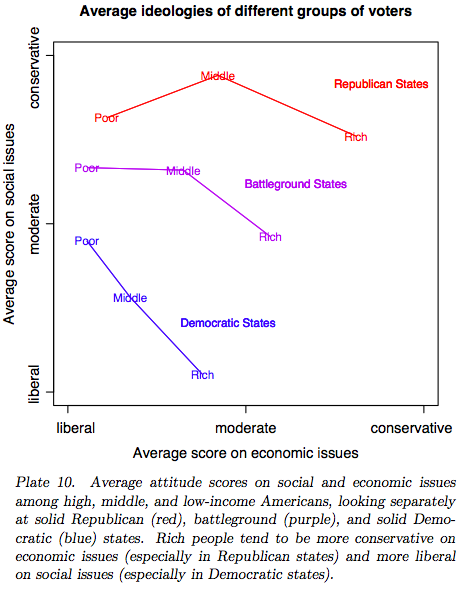
As it happens, however, the GOP relies on the upper class even more than Democrats. Median household income in the United States is $52,250, and if you look at the 2012 election, voters below that mark broke hard for Obama, with those above going for Mitt Romney by lesser margins. This trend of the Democrats getting way more votes below the median income level has roughly held for decades. These days, strong support for Republicans really doesn’t kick in until you get close to $75,000, or roughly the top third of the income ladder.
The difference between the parties is not that one relies on the wealthy and one doesn’t. Both parties lean heavily on those voters and divvy them up in various ways. (Mainly through cultural and social issues.) But the Democrats’ coalition also includes a fair portion that’s lower and working class, that’s still fighting for attention in the party, and that occasionally gets it. Conversely, lower- and working-class voters are mostly just absent from the GOP.
This matters because the upper class also has a pretty distinctive set of economic policy preferences. According to a recent study by Pew, the most financially secure Americans — roughly a fourth to a third of the population, by Pew’s definition — disproportionately say that government can’t afford to do more to help the needy, and that poor people “have it easy” thanks to government benefits. The less financially secure think the opposite. Large majorities of those making below $75,000 say the thing that bothers them the most about taxes is that the wealthy don’t pay their fair share. Large majorities of Americans oppose cuts to everything from Social Security and Medicare to aid for the poor. They support making union organizing easier and more federal spending on education.
Hell, 57 percent of the Republican or Republican-leaning voters who do make less than $30,000 think government doesn’t do enough to support poor people.
The reason the GOP can get away with being on the opposite side on all these matters is the fact that the voting population skews upper class: Even Democrats in the top third of the income distribution are noticeably more economically right-wing than poorer Democrats or Republicans, and Republicans in the top third are really economically right-wing.
There’s a pretty straightforward argument for why the upper class tilts in this direction. As Salam notes, the policy preferences of the upper class that really stick in his craw boil down to protecting their incomes and thus making the goods and services they provide more expensive for everyone else. But the flip side of that is making sure the goods and services everyone else provides — and thus their incomes — come cheap. That’s where the GOP comes in.
The essence of worker bargaining power is the ability to tell an employer “no.” That forces business owners to offer a better deal, driving up wages and benefits. A broad and generous welfare state gives workers leverage in that regard. It also helps boost aggregate demand, getting us closer to the full employment that really gives workers an edge. In short, the income of the working class is inversely proportional to its level of economic desperation. The effect of conservatives’ preferred economic policies — from slashing spending to imposing work requirements for aid — is to keep that desperation as high as possible. And of course, the upper class certainly doesn’t want to shoulder the taxes necessary to make such a system work.
The thing to remember is that, when it comes to what to do with the working class, the interests of the upper class and the super-rich cohere. Whether you’re a corporate CEO, a small-business owner, or just a well-heeled professional who consumes a lot of high-end goods and services, it benefits you to keep the labor of everyday Americans as cheap, compliant, and disposable as possible. It’s true, as Salam notes, that the truly rich aren’t quite as desperate to defend their interests as the upper class is; if you’ve got Mitt Romney’s dough, you can put up with more taxes, regulations, and workers demanding dignified pay and good benefits.
But that just bolsters the point that the fervent bastion of the economic right is the upper class. They’ve got the most to gain by slashing taxes, cutting regulations, scrapping government aid programs, and busting unions.
As Salam acknowledges, he doesn’t want high taxes on the wealthy, or for America to go down the road of the big European welfare states. His fellow reform conservatives and the Republican Party agree with him in this regard. Salam then says of the upper class: “I sensed that their gut political instincts were all about protecting what they had and scratching out the eyeballs of anyone who dared to suggest taking it away from them.”
But aren’t conservative economic policies the perfect expression of that exact impulse?
By: Jeff Spross, The Week, February 3, 2015
“The GOP; Still The Party Of Stupid”: Scott Walker’s Speech Was A Little More Than A Series Of Red-Meat Appetizers And Entrees
Mitt Romney definitely had his down sides as a candidate: the retread factor, and, as I noted two weeks ago, the fact that he made all those dramatic and (apparently) wrong predictions about the future of the economy. But I will say this for him. He did pass the this-guy-looks-and-sounds-like-a-plausible-president test. I always thought that was his greatest strength. He’s central casting.
None of these remaining people looks much like a president, with the exception of Jeb Bush; and more to the point, they don’t sound like presidents either. They sound like they’re running for RNC chairman at best, or more likely leader of the Tea Party caucus. So despite all this spin from conservatives about what a strong field this is, as usual the opposite is the truth. It’s an astonishingly weak field, unified not only in their opposition to Barack Obama and the federal government but also in their hostility to actual ideas that might stand a chance of addressing the country’s actual problems.
I’ve just been reading through their “books.” Yes, I know. You’re welcome. They’re ridiculous. I can’t say this with 100 percent certainty, but I may not have seen the word “wages” once. I certainly didn’t see a discussion of wage stagnation anywhere. That’s just one of a hundred examples I could cite.
It’s not so much that they come up short in terms of personal resumes. God knows, the current incumbent had a short one. Being a sitting or former governor, or a sitting senator—those are qualification enough. And I don’t doubt that they’re intelligent people.
But the problem in the first instance isn’t them. Let me put it this way. The greatest cardiologist in the world could move to town. But if everybody wants to eat chili-cheese fries all day and nobody wants to have bypass surgery, there’s still going to be a lot of heart disease.
You follow me? There could be a man in this presidential field who is the political equivalent of that cardiologist—Lincoln and TR and Reagan all rolled into one, with a little bit of Thatcher on the side and what the hell, a tiny dash of Clinton, just for crossover appeal. And it wouldn’t matter. He wouldn’t be able to demonstrate the breadth of his vision, because that isn’t what the GOP base of today wants.
I finally sat myself down and watched that Scott Walker speech from last week that everyone is raving about. If this was the standout speech, I sure made the right decision in not subjecting myself to the rest of them. It was little more than a series of red-meat appetizers and entrees: Wisconsin defunded Planned Parenthood, said no to Obamacare, passed some kind of law against “frivolous” lawsuits, and moved to crack down on voter “fraud””—all of that besides, of course, his big move, busting the public-employee unions. There wasn’t a single concrete idea about addressing any of the major problems the country faces.
Walker’s blandishments toward the base were bland enough to get under the skin even of James Pethokoukis, the conservative economics writer who laid into the Wisconsin Governor for one particular bit of surreality:
Opportunity is equal? The data, unfortunately, do not seem to support Walker’s optimistic claim. First, there are other countries, such as Sweden and Canada, where the chances of escaping the bottom are just as good as in the United States. Second, American mobility rates have been stagnant over the past 40 years. Third, mobility rates vary greatly by race with 74 percent of white sons making it out of the bottom fifth versus 49 percent of African-American sons. Fourth, even the smartest kids have only a 1-in-4 chance of making it from the bottom fifth to the top fifth.
That’s a conservative writer, remember. And he’s right, obviously. But try to imagine Walker or any GOP candidate acknowledging these complications. That opportunity is not equal in America! That Sweden and Canada are our equals! That it’s harder on black people! That candidate would be hooted out of the Republican Party faster than you can say Charles Murray.
Walker, I see, has surged in a new Iowa poll, while the only one who at least looks like president, John Ellis Bush, has taken a tumble and is viewed more negatively by potential caucus-goers than he once was (46 favorable, 43 unfavorable). We can’t say for sure why Bush has fallen, but it seems clear that Walker has gained on the strength, so to speak, of his empty-calorie bromides.
He’s gained because those items— kicking Planned Parenthood, denying your own citizens subsidized health-care coverage, pretending that voter fraud is a thing—are what pass for ideas in today’s GOP. Walker is even more vacuous on foreign policy, as Martha Raddatz revealed yesterday, twisting him around like a pretzel with a couple of mildly tough questions on Syria. The Democratic Party has its problems, but at least Democrats are talking about middle-class wage stagnation, which is the country’s core economic quandary. Rick Santorum is, in fairness, but a) his solutions are the same ones conservatives have been advertising for years (lower taxes, less regulation, more two-parent families) and b) he’s not going anywhere in the polls so far, undoubtedly precisely because he’s trying to drop the homosexuality-is-bestiality shtick and talk about actual economic problems.
But you can’t really discuss economic problems as a Republican presidential candidate, because in the pond of voters where you’ll be fishing, “America” has no such problems. Some people—roughly 47 percent of them—have economic problems, but that’s all their fault, you see. So these candidates are about to spend a year pandering to that. That will make them weak in more ways than one.
By: Michael Tomasky, The Daily Beast, February 2, 2015
Share This Blog


 Unknown Feed
- An error has occurred; the feed is probably down. Try again later.
 mykeystrokes.com