What Does The Tea Party Want?….The New Litmus Test
Jim VandeHei and Mike Allen argue that the Tea Party redefined the purpose of the GOP as opposition to spending:
The Republican Party is undergoing a messy but unmistakable 20-month transformation from fanatically anti-Obama to fanatically anti-spending, providing top party officials a new and intriguing playbook for recapturing the White House in 2012.
To understand the current evolution, flash back to late spring of 2009. The GOP was disoriented and adrift, its leadership void filled by the bombastic voices of Palin, Beck and Rush Limbaugh. There was no common conservative cause, beyond fear and loathing of Obama. No wonder swing voters were so down on them.
But the tea party, treated at first by the media as exotics, forced Republicans to focus almost exclusively on the size of government. By the time the 2010 elections rolled around, tea party activists and most independent voters were completely aligned on the need to cut, cut, cut.
Midterm election results showed that this approach offers the GOP its best – and maybe only – hope of keeping the interests of independents and tea party activists aligned enough to beat Obama.
The new litmus tests for GOP presidential hopefuls are support for repealing “Obamacare” and taking a cleaver to government spending. If a presidential candidate could harness the smaller-government conservatism, temper it enough to avoid a blatant overreach and articulate a vision for a prosperous future for the country, it’s not hard to imagine swing voters finding such a person appealing.
There’s a superficial appeal to this story. But the evidence that Tea Party activists want to cut spending — at least actual spending programs — is sparse. Polls show that Tea Party supports overwhelmingly oppose cuts to Social Security and Medicare. The main thrust of Tea Party opinion is not the belief that Obama has spent too much money, but the belief that Obama has spent too much money on people unlike them:
More than half say the policies of the administration favor the poor, and 25 percent think that the administration favors blacks over whites — compared with 11 percent of the general public.
They are more likely than the general public, and Republicans, to say that too much has been made of the problems facing black people.
Here’s another cut, showing the Tea Party’s greater comfort with inequality of opportunity and stronger belief that the government devotes too many resources to minorities:
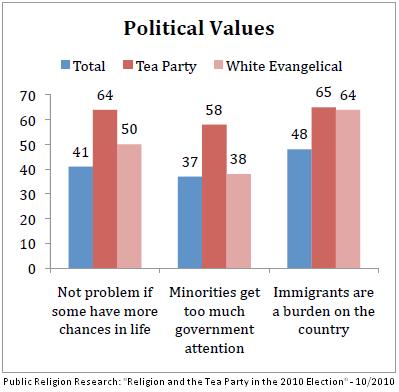
It’s a revolt against the composition of government much more than the level.
Now, it’s true that Republicans aren’t exactly translating this blueprint into action, but they’re not exactly flouting it, either. There is always a generalized antipathy toward spending amongst Republican and swing voters, but it disappears when the subject turns to actual government programs. Usually Republicans decide to just cut taxes for the rich instead. Here’s is the one part of the article proposing a defined policy change:
Even Ralph Reed, the Republican operative most tapped in to evangelicals, reflected the new GOP mindset when he gave this surprising wish list for the next presidential race: “In a perfect world, I’d like to hear the Republican nominee run on a platform that takes the capital gains tax to zero over five years.” Reed, who summoned several of the presidential candidates to Iowa for his Faith & Freedom Coalition this week, made it clear that Christian conservatives will still need to be catered to, but added that his side will understand the nominee’s need to focus on swing voters.
So an article putatively about the GOP redefining itself as an anti-spending party has one actual programmatic detail, and it’s: a zeroing out of the capital gains tax. In the name of appealing to swing voters — who, in fact, oppose tax cuts for the rich. Meet the new boss…
By: Jonathan Chait, The New Republic, March 14, 2011
Public Alert: What If We’re Not Broke?
“We’re broke.”
You can practically break a search engine if you start looking around the Internet for those words. They’re used repeatedly with reference to our local, state and federal governments, almost always to make a case for slashing programs – and, lately, to go after public-employee unions. The phrase is designed to create a sense of crisis that justifies rapid and radical actions before citizens have a chance to debate the consequences.
Just one problem: We’re not broke. Yes, nearly all levels of government face fiscal problems because of the economic downturn. But there is no crisis. There are many different paths open to fixing public budgets. And we will come up with wiser and more sustainable solutions if we approach fiscal problems calmly, realizing that we’re still a very rich country and that the wealthiest among us are doing exceptionally well.
Consider two of the most prominent we’re-brokers, House Speaker John Boehner and Wisconsin Gov. Scott Walker.
“We’re broke, broke going on bankrupt,” Boehner said in a Feb. 28 Nashville speech. For Boehner, this “fact” justifies the $61 billion in domestic spending cuts House Republicans passed (cuts that would have a negligible impact on the long-term deficit). Boehner’s GOP colleagues want reductions in Head Start, student loans and scores of other programs voters like, and the only way to sell them is to cry catastrophe.
Walker, of course, used the “we’re broke” rationale to justify his attack on public-worker collective bargaining rights. Yet the state’s supposedly “broke” status did not stop him from approving tax cuts before he began his war on unions and proposed all manner of budget cuts, including deep reductions in aid to public schools.
In both cases, the fiscal issues are just an excuse for ideologically driven policies to lower taxes on well-off people and business while reducing government programs. Yet only occasionally do journalists step back to ask: Are these guys telling the truth?
The admirable Web site PolitiFact.com examined Walker’s claim in detail and concluded flatly it was “false.”
“Experts agree the state faces financial challenges in the form of deficits,” PolitiFact wrote. “But they also agree the state isn’t broke. Employees and bills are being paid. Services are continuing to be performed. Revenue continues to roll in. A variety of tools – taxes, layoffs, spending cuts, debt shifting – is available to make ends meet. Walker has promised not to increase taxes. That takes one tool off the table.”
And that’s the whole point.
Bloomberg News looked at Boehner’s statement and declared simply: “It’s wrong.” As Bloomberg’s David J. Lynch wrote: “The U.S. today is able to borrow at historically low interest rates, paying 0.68 percent on a two-year note that it had to offer at 5.1 percent before the financial crisis began in 2007. Financial products that pay off if Uncle Sam defaults aren’t attracting unusual investor demand. And tax revenue as a percentage of the economy is at a 60-year low, meaning if the government needs to raise cash and can summon the political will, it could do so.”
Precisely. A phony metaphor is being used to hijack the nation’s political conversation and skew public policies to benefit better-off Americans and hurt most others.
We have an 8.9 percent unemployment rate, yet further measures to spur job creation are off the table. We’re broke, you see. We have a $15 trillion economy, yet we pretend to be an impoverished nation with no room for public investments in our future or efforts to ease the pain of a deep recession on those Americans who didn’t profit from it or cause it in the first place.
As Sen. Al Franken (D-Minn.) pointed out in a little-noticed but powerful speech on the economy in December, “during the past 20 years, 56 percent of all income growth went to the top 1 percent of households. Even more unbelievably, a third of all income growth went to just the top one-tenth of 1 percent.” Some people are definitely not broke, yet we can’t even think about raising their taxes.
By contrast, Franken noted that “when you adjust for inflation, the median household income actually declined over the last decade.” Many of those folks are going broke, yet because “we’re broke,” we’re told we can’t possibly help them.
Give Boehner, Walker and their allies full credit for diverting our attention with an arresting metaphor. The rest of us are dupes if we fall for it.
By: E. J. Dionne, Op-Ed Columnist, The Washington Post, March 14, 2011
Social Security Hysteria Rebutted, Yet again
The WaPo editorial board apparently despises old people as much as Alan Simpson, given what they’re willing to put on their op-ed pages. Unfortunately, though, Charles Krauthammer doesn’t disintegrate into quite the degree of gibberish as Simpson, though he’s a liar. He particularly attacks OMB director Jacob Lew, and Lew’s assertion that Social Security is solvent until 2037 and doesn’t add to the deficit. Krauthammer’s argument: the Treasury bonds Social Security funds are invested in are “worthless” and Lew’s arguing otherwise is “a breathtaking fraud” because the “Social Security trust fund is a fiction.”
Dean Baker refutes.
It’s nice that Mr. Krauthammer thinks that government bonds are worthless…. While he is welcome to believe anything he wants, the bonds held by the Social Security trust fund are backed by the full faith and credit of the U.S. government. Krauthammer may want to default on bonds that belong to the nation’s workers, but his desires are not the same as reality.Selling these bonds to fund Social Security no more raises the deficit than the decision of a rich person to sell bonds to finance their consumption raises the deficit. The deficit was incurred when the money was lent to the Social Security trust fund in the first place.
The size of the deficit, including the money borrowed from Social Security — the on-budget deficit — is reported in every budget document put out by the government (e.g. here and here). Krauthammer might try to learn a bit about how the budget works before he goes off ranting about Jack Lew and Social Security….
In reality, the projected shortfall in the program is relatively distant and minor. The country has far more urgent concerns, like putting 25 million unemployed or under-employed people back to work. This should be the focus of our political leaders right now.
And Jacob Lew defends his, and Social Security’s honor:
Krauthammer is correct when he writes that there is no “lockbox” that keeps the money sent in by workers for until they retire. By design, when more taxes are collected than are needed to pay benefits, funds are invested in Treasury bonds and are held in reserve for when revenue collected is not enough to pay the benefits due. Yet these Treasury bonds are backed by the full faith and credit of the U.S. government in the same way that all other U.S. Treasury bonds are, making them anything but ”worthless IOUs” as Krauthammer suggests. The government has just as much obligation to pay back the bonds in the Social Security trust fund as we do to any other bondholders.Responsibly honoring that obligation – one that we planned for and always knew was there –entails undertaking fiscal policies that would make it easier, not harder, to meet these obligations. When I last was OMB Director at the end of the Clinton Administration, the Congressional Budget Office estimated $5.6 trillion in budget surpluses over the next decade because of fiscally responsible measures that Democrats and Republicans, working together, had taken….
This is the most important point: the problem is not with Social Security, but in the near term the mismatch between what we take in and what we spend in the rest of the budget. Working people had payroll taxes taken from their salaries to pay for future benefits, and instead the money was used to pay for tax cuts and other initiatives. It is hardly fair now to say that those working people caused the problem just when they are ready to collect benefits.
Krauthammer’s argument is inside out. We should not blame Social Security for our current fiscal problems when it is the irresponsible fiscal behavior of the past that has presented the country with future challenges to fund our commitments, including Social Security over the next two decades.
That irresponsible fiscal behavior was unfortunately extended by the tax-cut deal and intensifed by the payroll tax holiday, making it even easier for Social Security to be the target of deficit peacocks and the Very Serious People who believe “shared sacrifice” means everybody but the rich and corporations sacrifice. That aside, Lew is absolutely correct. Social Security is not the problem. Massive tax cuts for the rich and two unsustainable wars are the problem.
By: Joan McCarter, Daily Kos, March 12, 2011
Wisconsin Gov. Scott Walker Shows Why Ideologues Can’t Govern
Ideologues make lousy politicians, even worse office holders. The ideological straight jacket does just what you would expect–it constricts movement. Everything is nice and neat and tight but not conducive to serious efforts to move forward. Politicians such as Scott Walker, who put themselves in ideological straight jackets, either live to regret it or are thrown out on their ear, or both.
Intellectuals sometimes make good ideologues, cultural commentators make very thought provoking arguments, philosophers have the luxury of being way out on the edge at times, but those who go into office find that they are rejected very quickly by the public when all they have is their ideology.
Scott Walker is the latest example of an ideologue–combined with a self righteous, bullying approach, not backed up by intellectual rigor.
My guess is that the events of the last month will not only harm him politically in the short run but will result in a serious problem for those who follow in his footsteps.
First and foremost, his approach to governing won’t work. Cutting taxes for ideological reasons, rather than pragmatic ones, prohibiting local governments from paying for education with their own decisions on local taxes, cutting services to the bone, breaking collective bargaining with unions, making them a scapegoat, just won’t wash.
Look at the governors who are putting forth a balanced, reasonable approach to focusing on the dual realities of too much spending and too little revenue. They are not engaging in a hard and fast ideological battle. They are pragmatic. They do not focus only on slash and burn cuts but, rather, are flexible enough to include tax and fee increases.
What was Walker thinking, cutting taxes by $117.2 million as his first act when his state faced a deficit of $137 million? I guess I get the million dollars he included to encourage businesses to move to Wisconsin but I sure as heck don’t understand a $49 million tax cut for health savings accounts. The rich will take advantage of that boondoggle and it won’t create jobs.
That was ideology, not pragmatism.
Look at Gov. Jerry Brown in California, or Mark Dayton in Minnesota, or John Kitzhaber of Oregon, John Lynch of New Hampshire, Pat Quinn in Illinois, or Andrew Cuomo in New York. These are governors, many of whom have a lot tougher problem than Wisconsin, who are struggling and succeeding, not resorting to hard ideology, not refusing to look at the revenue side of the equation.
If members of Congress take lessons from the states, they should learn a whopper from Wisconsin. Don’t follow in Walker’s footsteps, look to the governors listed above.
In fact, they can even look to Ronald Reagan who as governor way back in 1967 raised taxes by $1 billion in California as well as cut the budget. As president, he raised taxes in every year but one, when it was necessary. He learned very quickly about “never saying never.” He didn’t put himself in the ideological straight jacket that many now fantasize about. I am not a Reagan fan, but I do recognize he was pragmatic.
Walker is in way over his head. Sadly, he has been a train wreck for his state. Let’s not let his style and approach be a train wreck for the nation.
By: Peter Fenn, U.S. News and World Report, March 11, 2011
Share This Blog


 Unknown Feed
- An error has occurred; the feed is probably down. Try again later.
 mykeystrokes.com

You must be logged in to post a comment.