“Two Different Fantasies”: The Coming Conservative Tax Cut Deficits Will Make Bush’s Look Puny
For going on a year now, a group of reform-minded conservatives has been gently coaxing more pious coreligionists into supporting a tax reform plan that would violate the first commandment of supply-side economic theory.
In a broad sense, the two groups share similar goals. Both want to distribute income upward. The difference is that reformicons would like to limit the amount of upward redistribution to preserve some significant spoils for middle-class workers with children. They’ve rallied behind legislation, drafted by Senator Mike Lee (a Tea Party favorite from Utah) that would lower the top marginal tax rate only modestly—from about 40 to 35—while creating generous new tax credits for families with kids. The supply siders, as you probably guessed, want to ply those spoils into even larger rate cuts for the wealthy. The poor are left almost entirely out of the equation.
Under normal circumstances, the two camps would resolve a policy dispute like this by splitting the baby (the proverbial one; not the human one that comes with a generous tax-subsidy). But as supply-side stalwart Congressman Paul Ryan explained recently, asking rate-cutters like him to check their rate-cutting ambitions would be like asking Lance Armstrong to share his “secret sauce” with mid-tier racers—not much help for them, at the expense of his competitive edge. And on the flip side, the reformicons can’t yield too much to the supply siders, because at some point the political payoff (more money for the middle class) would disappear along with the whatever supposed incentive the credits would create for people to start families.
Enter Ramesh Ponnuru, a high-profile reformicon, with a plan to win Ryan over using clever spin. Just pretend the Lee plan’s child tax subsidies are comparable to tax cuts for investors, except the investors here are parents rescuing the country from a bleak demographic future, and the tax cuts are actually new tax expenditures.
“You can’t draw up a realistic budget with a top tax rate of 25 percent and a large child credit,” Ponnuru writes for Bloomberg. “(You might not be able to draw up a realistic budget with a top rate of 25 percent even without the credit.) You probably can, however, draw up one with a lower top rate than we have today and better treatment for investment — including parents’ investment in the next generation. Because that mix of policies would leave many millions of middle-class families ahead, it may well be easier to enact than a plan that concentrates solely on reducing the top rate. Supply-siders, that is, might achieve more of the rate reduction they seek if they embrace the credit.”
This is another way of saying that the politics of the Lee plan are vastly more appealing than the politics of the Ryan plan. The tax blueprint in Ryan’s budget is such a political disaster that it would likelier die in committee than become law in some less radical form, leaving Ryan with no rate reduction at all. Under the circumstances, he’d be better off settling for less-severe rate cuts and plying some of the projected deficits into the pockets of the middle class.
That’s absolutely true. But for supply-sider zeal, it would settle the argument under the prevailing terms. Yet those terms omit something fundamental to both plans: deficits. Neither party to the conversation has used the word deficit even once. And when you introduce the idea that both of these plans—not just Ryan’s—are deficit-financed (or financed with implicit tax increases on the poor and middle classes) it becomes hard to fathom why a tug of war between the reformicons and the supply-siders is necessary at all.
Lee offsets his tax cuts by eliminating and reducing a swath of tax expenditures. Nevertheless, they would increase deficits $2.4 trillion over ten years. Ryan’s plan would probably increase them by twice as much (before offsets, which he’s never specified). There isn’t a point along the connecting line where this trespasses into fantasy. These are just two different fantasies. Under the circumstances, the smart play isn’t for the reformicons to out-debate the supply siders, or to negotiate with them, but to buy them off. Give Ryan a big rate cut. Keep the middle-class child subsidies. Don’t bother paying for either, in full.
This, as Ponnuru sort of implies, would be deeply irresponsible. But it would enjoy the dual benefits of papering over the rift and solving the GOP’s miser problem, in much the same way that George W. Bush solved his regressivity problem in 2001 by cutting everyone’s taxes (the wealthy merely got a hefty bonus tax cut).
Instead Lee is teaming up with Senator Marco Rubio to narrow the $2.4 trillion shortfall. Perhaps they’ll succeed. But they’ll also have widened the conservative rift, leaving them a plan that’s intended to forge an alliance between the ruling and working classes, but does less for the former than the supply siders and less for the latter than Democrats. Actually legislating will almost certainly require surrendering to one faction or the other.
By: Brian Beutler, The New Republic, August 26, 2014
“Bizarre Looking-Glass Ideology”: Deficit Scolds Are The Most Crazed Ideologues In America
A new Congressional Budget Office report shows that the projected increase in the national debt has slowed dramatically. Good news for deficit scolds, right? Not for Ron Fournier, who still thinks the nation is on its last legs:
Only in Washington, the place where you land when you fall through the looking glass, could this be hailed as good news… Our deficit levels (annual totals of red ink) are stalled at breathtakingly high levels — and are projected to soar again in a few years… Scary news, right? Not according to many media outlets and a cynical leadership class in Washington. Some news organizations focused on the sugar-high of good news — the (temporary) dip in deficits.
Think of a reporter covering a shooting. The police tell him the victim is dying of blood loss. Is the headline “Shooting Victim Expected to Die” or “Blood Flow Slows for Shooting Victim”? [National Journal]
Fournier’s economic analysis, if it may be so dignified with the phrase, is comprehensively wretched. As I’ve argued, the real problem with the deficit is that it’s coming down way too fast. Premature austerity has crippled the economic recovery and kept millions out of work. The biggest economic problem facing the nation is unemployment, which outweighs the stupid deficit by Graham’s Number levels of importance.
But the main problem is that his scold case is weak even on its own terms. Fournier understands neither what is driving the increase in the national debt nor why that might be a problem — all of which betrays a bizarre ideology that holds that pain must be inflicted before any gains can be made.
The huge increase in the annual deficit in 2008-09 was driven by two things: first, the economic collapse, which caused revenues to fall and spending to increase as people drew on safety net programs like unemployment insurance. Second, the Recovery Act, aka the stimulus, which provided a one-time surge of spending to restore aggregate demand and get people back to work. Though the stimulus was not nearly large enough to fill the hole in demand, this is what macroeconomic policy is supposed to do in a recession (a fact that Republicans were happy to accept when they were in power).
The long-term debt and deficit projections, on the other hand, are entirely about health-care spending. As Peter Fisher once said, the government is basically an insurance company with an army, and for many years the price of health care increased much faster than the rate of economic growth. This made government spending on health care (mostly Medicare and Medicaid) consume an ever-greater portion of the federal budget. Past CBO projections just assumed this trend would continue, which accounts for past reports predicting that the national debt would eventually eat the whole budget.
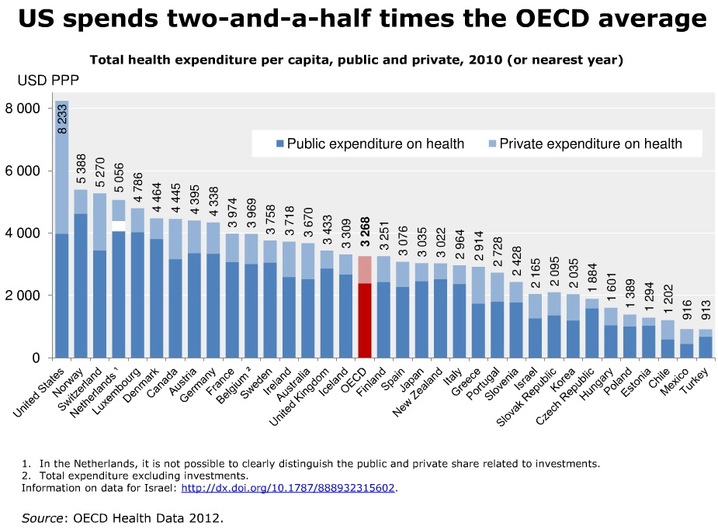
What this means is that Fournier’s preferred solution for dealing with this trend — higher taxes, fewer entitlements — is completely pointless. We have to fix the problem of rising prices, otherwise eventually a single tablet of aspirin will consume the entire federal budget. And the price problem is driven by awful policy design, not excessive generosity. America manages the rare trick of having very patchy and stingy social insurance that is simultaneously incredibly expensive. We spend more government money per person than Canada does — and the Canadians have universal single-payer coverage.
Fewer entitlements or higher taxes will get you a few years of breathing room before price increases eat up all the savings — and the whole point of Fournier’s column is that a couple decades of breathing room is still grounds for hair-on-fire panic.
Luckily, since the passage of ObamaCare, price increases have indeed slowed dramatically. That, plus a new projection that interest rates will stay low for a long time, accounts for the new CBO analysis showing slower debt growth. Just why this is happening is a matter of some dispute; I suspect it is partly the result of several programs in ObamaCare designed to bring prices down, and partly that health-care prices are already so high they’re running into resource constraints.
I think the fact that Fournier is patently uninterested in any of these things, and favors a policy that would accomplish nothing whatsoever on the deficit by his own standards, reveals that the pro-austerity school of punditry isn’t about the deficit at all. Instead, he says that his entitlement-cutting agenda is “going to happen sooner or later, painfully or more painfully.” As with David Gregory, the pain is the operative concept. The centrist definition of responsible politics holds that the American people must suffer a little more to keep the nation healthy. It’s only the “hateful partisans” who are keeping the wise, reasonable moderates from making those tough bipartisan compromises to slash social insurance and inflict pain.
But make no mistake: This has nothing to do with economics, and everything to do with the bizarre looking-glass ideology of “serious people” in Washington, D.C.
By: Ryan Cooper, The Week, July 24, 2014
“Doomsday Prepper Economics”: The Weird Obsession That’s Ruining The GOP
Call it doomsday prepper economics. For more than five years, many Republicans and conservatives have warned that catastrophe is nigh. Washington’s deficit spending and the Federal Reserve’s excessive money printing will lead to a financial crisis worse than the Great Recession, they prophesied. Inflation will skyrocket, the dollar will collapse, and the Chinese will dump treasuries, they swore. As Ron Paul, the libertarian former GOP congressman and presidential candidate, said back in 2009: “More inflation is absolutely the wrong way to go. We’re taking a recession and trying to turn it into a depression. We’re going to see a real calamity.”
Many GOP politicians have since echoed Paul’s prediction. But the Next Great Inflation never happened. The Consumer Price Index, including food and energy, has risen by an annual average of just 1.6 percent since 2008, below the Fed’s 2 percent inflation target. During the Great Inflation of the 1970s and early 1980s, by contrast, prices rose five times faster.
This information isn’t a secret. The Labor Department releases inflation data monthly on its website. Yet inflation fears still rage on the right. Those concerns are a big reason why Republicans continue to push for a balanced budget ASAP. They’re why the GOP wants to saddle the Fed with restrictive new rules.
Regardless of the potential merits of those policy ideas, the inflation alarmism driving them is taking a weird turn. Some Republicans and conservatives now argue that Washington is figuring inflation all wrong, maybe even intentionally. Better, they say, to trust independent outside sources such as the website ShadowStats, which “exposes and analyzes flaws” in government economic data. According to one set of ShadowStats calculations, the true inflation rate is nearly 10 percent today. The inflation truth is out there.
In a recent National Review Online article, conservative author Amity Shlaes approvingly cites ShadowStats as supporting her thesis that “inflation is higher than what the official data suggest.” Others fans include conservative intellectual Niall Ferguson, Sen. Tom Coburn (R-Okla.), and a good chunk of the conservative blogosphere.
ShadowStats’ popularity on the right is crazy — because the site’s methodology has been roundly ridiculed by both economists and business journalists. Critics also note that the subscription price for the ShadowStats newsletter has remained unchanged for years. Inflation for thee, but not for me. Beyond that, MIT’s Billion Price Project, which tracks prices from online retailers every day, puts U.S. inflation at just over 2 percent. And consider this: If inflation were really 10 percent, that would mean the real economy, adjusted for inflation, has been sharply shrinking — yet somehow still adding 2 million net new jobs a year.
If GOP inflationistas had their way, the weak U.S. recovery would almost surely be even weaker. Just look at Europe. Unlike the Fed, the inflation-phobic European Central Bank sat on its hands despite weak growth. The result has been an unemployment rate nearly twice America’s and a nasty double-dip recession. Of course, inflation is lower than in America — so low, in fact, that the region risks a dangerous deflationary spiral of falling prices and falling wages.
Why this GOP inflation obsession? Maybe it’s a legacy of how rapidly rising prices in the 1970s swept conservatives into power in both America and Great Britain. Maybe it’s how many conservative talk radio shows are sponsored by gold companies who stand to benefit from inflation hysteria. Maybe it’s a belief that every single economic metric must be a nightmare under President Obama.
But whatever the reason, the GOP’s preoccupation with phantom price increases is distracting it from the actual problems afflicting the U.S. economy — such as low social mobility, stagnant wages, and the decline of middle-class work. The price of not addressing those issues is rising every year. And that is the kind of inflation worth obsessing over.
By: James Pethokoukis, DeWitt Wallace Fellow at the American Enterprise Institute: The Week, July 23, 2014
“The Fiscal Fizzle”: An Imaginary Budget And Debt Crisis
For much of the past five years readers of the political and economic news were left in little doubt that budget deficits and rising debt were the most important issue facing America. Serious people constantly issued dire warnings that the United States risked turning into another Greece any day now. President Obama appointed a special, bipartisan commission to propose solutions to the alleged fiscal crisis, and spent much of his first term trying to negotiate a Grand Bargain on the budget with Republicans.
That bargain never happened, because Republicans refused to consider any deal that raised taxes. Nonetheless, debt and deficits have faded from the news. And there’s a good reason for that disappearing act: The whole thing turns out to have been a false alarm.
I’m not sure whether most readers realize just how thoroughly the great fiscal panic has fizzled — and the deficit scolds are, of course, still scolding. They’re even trying to spin the latest long-term projections from the Congressional Budget Office — which are distinctly non-alarming — as somehow a confirmation of their earlier scare tactics. So this seems like a good time to offer an update on the debt disaster that wasn’t.
About those projections: The budget office predicts that this year’s federal deficit will be just 2.8 percent of G.D.P., down from 9.8 percent in 2009. It’s true that the fact that we’re still running a deficit means federal debt in dollar terms continues to grow — but the economy is growing too, so the budget office expects the crucial ratio of debt to G.D.P. to remain more or less flat for the next decade.
Things are expected to deteriorate after that, mainly because of the impact of an aging population on Medicare and Social Security. But there has been a dramatic slowdown in the growth of health care costs, which used to play a big role in frightening budget scenarios. As a result, despite aging, debt in 2039 — a quarter-century from now! — is projected to be no higher, as a percentage of G.D.P., than the debt America had at the end of World War II, or that Britain had for much of the 20th century. Oh, and the budget office now expects interest rates to remain fairly low, not much higher than the economy’s rate of growth. This in turn weakens, indeed almost eliminates, the risk of a debt spiral, in which the cost of servicing debt drives debt even higher.
Still, rising debt isn’t good. So what would it take to avoid any rise in the debt ratio? Surprisingly little. The budget office estimates that stabilizing the ratio of debt to G.D.P. at its current level would require spending cuts and/or tax hikes of 1.2 percent of G.D.P. if we started now, or 1.5 percent of G.D.P. if we waited until 2020. Politically, that would be hard given total Republican opposition to anything a Democratic president might propose, but in economic terms it would be no big deal, and wouldn’t require any fundamental change in our major social programs.
In short, the debt apocalypse has been called off.
Wait — what about the risk of a crisis of confidence? There have been many warnings that such a crisis was imminent, some of them coupled with surprisingly frank admissions of disappointment that it hadn’t happened yet. For example, Alan Greenspan warned of the “Greece analogy,” and declared that it was “regrettable” that U.S. interest rates and inflation hadn’t yet soared.
But that was more than four years ago, and both inflation and interest rates remain low. Maybe the United States, which among other things borrows in its own currency and therefore can’t run out of cash, isn’t much like Greece after all.
In fact, even within Europe the severity of the debt crisis diminished rapidly once the European Central Bank began doing its job, making it clear that it would do “whatever it takes” to avoid cash crises in nations that have given up their own currencies and adopted the euro. Did you know that Italy, which remains deep in debt and suffers much more from the burden of an aging population than we do, can now borrow long term at an interest rate of only 2.78 percent? Did you know that France, which is the subject of constant negative reporting, pays only 1.57 percent?
So we don’t have a debt crisis, and never did. Why did everyone important seem to think otherwise?
To be fair, there has been some real good news about the long-run fiscal prospect, mainly from health care. But it’s hard to escape the sense that debt panic was promoted because it served a political purpose — that many people were pushing the notion of a debt crisis as a way to attack Social Security and Medicare. And they did immense damage along the way, diverting the nation’s attention from its real problems — crippling unemployment, deteriorating infrastructure and more — for years on end.
By: Paul Krugman, Op-Ed Columnist, The New York Times, Julo 20, 2014
“Almost Anything Would Be More Important”: Memo To Fiscal Hawks, The Long-Term Deficit Doesn’t Matter
Over the weekend I got in a long argument with some ally of the deficit hawk group Fix the Debt on Twitter, and while most of the conversation turned on who should be blamed for mass unemployment, it did reach an interesting place in one respect. This person took as a given that long-term deficit reduction is a policy priority of the first rank — a belief that is very common among America’s elite.
This priority is misguided both in detail and in general. Here’s why.
There are two points to make here: First, long-term deficits are entirely about the rising cost of health care. Centrist elites insist that this is a reason to make our social insurance programs less generous, but the reality is that America’s high prices are driven by inefficient service provision, not by excessively generous programs. American health care is unfair, monopolistic, and captured by specialist doctors, and our policies are designed poorly, which is why we pay about half again as much as the next-most-expensive developed nation for what is in fact a pretty threadbare safety net.
This point is crucial. What it means is that making our social insurance more stingy, by raising the Medicare eligibility age for example, will accomplish almost nothing. Unless you tackle the skyrocketing cost problem, the budgetary headroom created by benefit cuts will be eaten almost immediately by rising prices. In other words, no matter how many grannies you put into the poorhouse, on predicted trends eventually a single ibuprofen will cost the entire federal budget. (Unless, of course, you just repeal all social insurance altogether and let sick, poor, and old people go bankrupt and die in the hundreds of thousands per year.)
Fortunately, we just passed a gigantic health care reform package. You might have heard of it: It’s called ObamaCare, and it seems to be helping slow health care inflation.
Second, even if we set that issue aside and talk about the Platonic ideal of long-term deficits, there again the case for action is weak at best. The political problem is that America does not actually have the consensus necessary to reduce deficits on a long-term basis, despite the constant whining about it one hears all the time on cable news. One of our two political parties is composed of total hypocrites on this issue — just look at Paul Ryan. It is a near-certainty that any long-term work on the deficit would be immediately squandered on tax cuts for the rich the moment Republicans got a chance — it’s what happened in 2001.
But even on the merits, if you actually run through the economic reasoning (PDF), the case for worrying about the long-term deficit is weak at best. The U.S. is indebted in its own sovereign currency and cannot go bankrupt. Inflation could be a worry, but given current mass unemployment it’s a hypothetical concern at best.
So don’t worry about the deficit in 2050 or whatever. People ain’t got no jobs. People ain’t got no money. That’s what matters.
By: Ryan Cooper, The Week, March 3, 2014
Share This Blog


 Unknown Feed
- An error has occurred; the feed is probably down. Try again later.
 mykeystrokes.com