Clearly Constitutional: A Primer on the Constitutionality of the Affordable Care Act
Nearly three dozen judges have now considered challenges to the landmark Affordable Care Act and the overwhelming majority of these cases have been dismissed. Nevertheless, a single outlier judge in Virginia has embraced the meritless arguments against the new health care law and another judge in Florida also appears poised to break with the overwhelming consensus of his colleagues.
With only a few exceptions, these lawsuits principally challenge the Affordable Care Act’s minimum coverage provision—the provision requiring most Americans to either carry health insurance or pay slightly more income taxes—falsely arguing that Congress lacks the constitutional authority to enact such a provision. It is true that Congress’s authority is limited to an itemized list of powers contained in the text of the Constitution itself, but while Congress’s powers are not unlimited, they are still quite sweeping. There is no doubt that the Affordable Care Act fits within these enumerated powers in three ways, as this issue brief will demonstrate.
Congress has broad power to regulate the national economy
A provision of the Constitution known as the “commerce clause” gives Congress power to “regulate commerce … among the several states.” And there is a long line of Supreme Court decisions holding that Congress has broad power to enact laws that substantially affect prices, marketplaces, or other economic transactions. Because health care comprises approximately 17 percent of the national economy, it is impossible to argue that a bill regulating the national health care market does not fit within Congress’s power to regulate commerce.
Nevertheless, opponents of the Affordable Care Act claim that a person who does not buy health insurance is not engaged in any economic “activity” and therefore cannot be compelled to perform an undesired act. Even if these opponents were correct that the uninsured are not active participants in the health care market— and they are active, of course, every time they become ill and seek medical care—nothing in the Constitution supports this novel theory. Indeed, this theory appears to have been invented solely for the purpose of this litigation. Congress has enacted countless laws which would be forbidden under this extra-constitutional theory:
- Guns: President George Washington signed a law that required much of the country to purchase a firearm, ammunition, and other equipment in case they needed to be called up for militia service. Many of the members of Congress who voted for this mandate were members of the Philadelphia Convention that wrote the Constitution.
- Civil rights: The Civil Rights Act of 1964 compelled business owners to engage in transactions they considered undesirable—hiring and otherwise doing business with African Americans.
- Insurance mandates: The Affordable Care Act is not even the only federal law requiring someone to carry insurance. The Price-Anderson Act of 1957 requires nuclear power plants to purchase liability insurance and the Flood Disaster Protection Act requires many homeowners to carry flood insurance.
- Other mandates: Other laws require individuals to perform jury service, file tax returns, and register for selective service.
The minimum coverage provision is the keystone that holds the Affordable Care Act together
The Constitution also gives Congress the power “[t]o make all laws which shall be necessary and proper for carrying into execution” its power to regulate interstate commerce. As Supreme Court Justice Antonin Scalia explains, this means that “where Congress has the authority to enact a regulation of interstate commerce, it possesses every power needed to make that regulation effective.”
The act eliminates one of the insurance industry’s most abusive practices—denying coverage to patients with pre-existing conditions. This ban cannot function if patients are free to enter and exit the insurance market at will. If patients can wait until they get sick to buy insurance, they will drain all the money out of an insurance plan that they have not previously paid into, leaving nothing left for the rest of the plan’s consumers.
Seven states enacted a pre-existing conditions law without also passing an insurance coverage requirement, and all seven states saw health insurance premiums spiral out of control. In some of these states, the individual insurance market collapsed.There is a way out of this trap, however. Massachusetts enacted a minimum coverage provision in 2006 to go along with its pre-existing conditions provision and the results were both striking and immediate. Massachusetts’ premiums rapidly dropped by 40 percent.
In other words, because the only way to make the pre-existing conditions law effective is to also require individuals to carry insurance, that requirement easily passes Scalia’s test.
The link between the minimum coverage provision and the Affordable Care Act’s insurance regulations also sets this law aside from other hypothetical laws requiring individuals to purchase other goods or services. The national market for vegetables will not collapse if Congress does not require people to purchase broccoli, nor will Americans cease to be able to obtain automobiles absent a law requiring the purchase of cars from General Motors. Accordingly, a court decision upholding the Affordable Care Act would not provide a precedent enabling Congress to compel all Americans to purchase broccoli or cars, despite the law’s opponents’ claims to the contrary.
Congress has broad leeway in how it raises money
Congress also has the authority to “lay and collect taxes” under the Constitution. This power to tax also supports the minimum coverage provision, which works by requiring individuals who do not carry health insurance to pay slightly more income taxes. Taxpayers who refuse insurance must pay more in taxes while those who do carry insurance are exempt from this new tax. For this reason, the law is no different than dozens of longstanding tax exemptions, including the mortgage interest tax deduction, which allows people who take out home mortgages to pay lower taxes than people who do not.
Opponents of the Affordable Care Act respond that the minimum coverage provision somehow ceases to be a tax because the new law does not use the word “tax” to describe it, but this distinction is utterly meaningless. Nothing in the Constitution requires Congress to use certain magic words to invoke its enumerated powers. And no precedent exists suggesting that a fully valid law somehow ceases to be constitutional because Congress gave it the wrong name.
By Ian Millhiser, Policy Analyst and Blogger for the Center for American Progress where his work focuses on the Constitution and the Judiciary-January 18, 2011
The Conservative Constitution of the United States

TeaParty Sacred Text?
Article I
Congress shall have only the powers literally, specifically and expressly granted herein, and no others. That means definitely, without question, absolutely, no regulation of the Health Insurance or Financial Services industries. The Senate of the United States shall be composed of two Senators from each State, elected not directly by the People, but by other people whom the People have elected to better represent the People.
Any law enacted by Congress and signed by the President may be overturned by the vote of three or more States if they find it burdensome, offensive, annoying or in any way touching on Health Insurance, Property Rights or Guns.
Congress shall have no power to raise Taxes except on February 29, and then only if all the People of the United States approve such a measure unanimously, in writing and in English.
Congress shall balance the Federal Budget, preferably by eliminating the Departments of Labor, Energy, Education and State.
The preceding provision shall not apply to spending for the Department of Defense, appropriations for which shall increase three times as quickly as the growth in gross domestic product and upon the approval of House leadership in conference with Boeing, Halliburton, the Ashcroft Group and Kissinger Associates.
Arizona shall have the power to regulate Immigration.
Article II
No person except a natural-born Citizen who can produce video, photographic or eyewitness evidence of birth in a non-island American State shall be eligible to the Office of President.
The President shall faithfully execute the laws, except when, as Commander in Chief, he decides he’d really rather not.
The President shall not negotiate any Treaty without first receiving a signed and notarized note granting him permission, personally executed by every member of the Senate and the House, all 50 Governors and the editorial board of the Weekly Standard. Suspected Terrorists shall be taken to Guantanamo and drawn and quartered in a public ceremony. Trials are optional, but if they occur, must be conducted in a Military Tribunal in which coerced statements are admissible so long as they support a Guilty verdict.
1. Congress shall make no law abridging the Freedom of Speech, except where citizens desecrate the Flag of the United States; respecting an establishment of Religion, except to support Christian schools, religious apparitions in food products and the display of crosses and creches in public places; or abridging the free exercise of Religion, except to block the construction of mosques in sensitive areas as determined by Florida Pastors or the Fox News Channel.
2. The right to bear Semi-Automatic Weapons, AK-47s or Bazookas shall not be infringed by background checks, safety locks, age limits or common sense.
3. The right of Corporations, Hedge Funds, Business Leaders and Lobbyists to spend endless cash on campaigns and influence-purchasing shall not be infringed. The so-called right of Unions to associate shall be denied as fundamentally un-American and contrary to the agenda of the Chamber of Commerce.
4. Marriage and the benefits thereof shall be restricted to the Union of a Man and a Woman, consecrated in a Christian house of worship, with vows to expose any and all progeny to daily viewings of Bill O’Reilly.
5. All persons born or naturalized in the United States are Citizens of the United States of Real America only if their parents, grandparents and great-grandparents were Citizens, and only if they pledge opposition to Health Insurance Reform or New Taxation. Any Citizen convicted of providing material support to Terrorist organizations, wearing clothing bearing images created by Shepard Fairey, or displaying Nancy Pelosi bumper stickers shall be stripped of Citizenship.
6. Aliens, of this world or another, shall have none of the rights guaranteed herein to Citizens.
7. Corporations shall have all of the rights guaranteed herein to Citizens, and then some.
8. No White Male shall be denied equal protection of the law through Affirmative Action or otherwise. In keeping with the intent of the Framers, as discerned by the Honorable Justice Antonin Scalia, distinctions on the basis of sex shall not be deemed to deny equal protection.
9. The right to be uninsured and make other people pay the costs of one’s Health Care shall not be infringed under any circumstances.
10. Congress shall make no law limiting Americans’ right to warm the Planet by using all the energy they darn well please.
11. The Unborn shall have the rights to life, to vote, to bear arms, to practice Religion except in a mosque in Lower Manhattan (see First Amendment) and to make campaign contributions, but once the child is born, it shall have no rights if it is an Alien (see Sixth Amendment).
12. No one may be required to do anything He or She does not want to do. Ever.
Done in Convention by the Unanimous Consent of the Members present the Sixth Day of January in the Year of our Lord Two Thousand and Eleven. In witness whereof We have hereunto subscribed our names, [REDACTED]
By: David Cole who teaches Constitutional Law at Georgetown University and is the legal affairs correspondent for the Nation : Published, Washington Post-January 6, 2011
What The Teaparty Wants From The Constitution
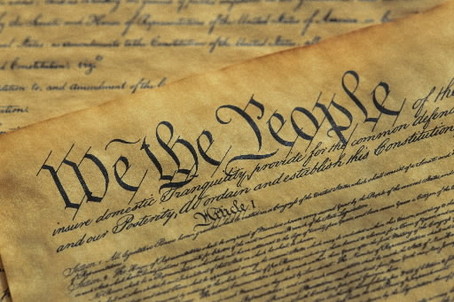
U.S. Constitution: Relevant only when it meets the needs of us "Real Americans"
I’m very curious to know what the GOP — or the tea partyers they’re presumably pandering to — think will happen when every piece of legislation requires “a statement from its sponsor outlining where in the Constitution Congress is empowered to enact such legislation.” What’s the evidence that this will make legislation more, rather than less, constitutional, for whatever your definition of the Constitution is?
Let’s take an example: Most legislation doesn’t currently include a statement of constitutional authority. But there’s one recent measure that did: Section 1501 of the Patient Protection and Affordable Care Act. That is to say, the individual mandate.
“The individual responsibility requirement provided for in this section (in this subsection referred to as the requirement) is commercial and economic in nature, and substantially affects interstate commerce,” reads the opening paragraph. Shortly thereafter, the legislation makes itself more explicit: “In United States v. South-Eastern Underwriters Association (322 U.S. 533 (1944)), the Supreme Court of the United States ruled that insurance is interstate commerce subject to Federal regulation.”
Has that statement convinced the GOP that the individual mandate is constitutional? Of course not. Currently, two judges have ruled in favor of the provision and one judge has ruled against. The split has been clean across partisan lines. The political verdicts have been little different: Sen. Chuck Grassley went from co-sponsoring an individual mandate in June of 2009 when it was still an idea connected to Republicans to condemning it as unconstitutional a few months later when it was clear that President Obama owned it and no Republicans would be joining his health-care bill.
My friends on the right don’t like to hear this, but the Constitution is not a clear document. Written more than 200 years ago, when America had 13 states and very different problems, it rarely speaks directly to the questions we ask it. The Second Amendment, for instance, says nothing about keeping a gun in the home if you’ve not signed up with a “well-regulated militia,” but interpreting the Second Amendment broadly has been important to those who want to bear arms. And so they’ve done it.
That’s their right, of course. Liberals pick and choose their moments of textual fidelity as well. But as the seemingly endless series of 5-4 splits on the Supreme Court shows, even the country’s most experienced and decorated constitutional authorities routinely disagree, and sharply, over what the text means when applied to today’s problems. To presume that people writing what they think the Constitution means — or, in some cases, want to think it means — at the bottom of every bill will change how they legislate doesn’t demonstrate a reverence for the document. It demonstrates a disengagement with it as anything more than a symbol of what you and your ideological allies believe.
In reality, the tea party — like most everyone else — is less interested in living by the Constitution than in deciding what it means to live by the Constitution. When the constitutional disclaimers at the bottom of bills suit them, they’ll respect them. When they don’t — as we’ve seen in the case of the individual mandate — they won’t.
By: Ezra Klein-Washington Post, 12/30/10: Photo credit: Todd Gipstein/National Geographic/Getty Images
Share This Blog


 Unknown Feed
- An error has occurred; the feed is probably down. Try again later.
 mykeystrokes.com
You must be logged in to post a comment.