“Pope Francis Will Not Help Your Political Cause”: Even The Pope Can’t Change The Fundamental Calculus Of Congress
“Pope Francis gets political in remarks at White House,” read the headline at The Hill.
“Pope Francis brings political agenda to Washington,” said Politico.
“Pope Francis wades into U.S. politics,” read The Washington Post.
Seeing all that, you might think that the pontiff had said, “Blessed are the peacemakers, and also, call your representatives and tell them to vote yes on H.R. 2451…”
Meanwhile, countless interest groups are sending out press releases saying the pope agrees with them on their issue of concern (the dumbest I’ve seen has to be the 30-page report from a Democratic group charging that the Koch brothers are “on the wrong side of the Holy Father”). But I have some bad news if you were hoping the pope would aid your particular partisan cause, whatever it is: The pope’s visit is not going to matter much.
I suppose you can’t blame the political press for interpreting the pope’s trip through the lens of politics, since it’s their job to view everything through the lens of politics. And it’s true that the pope is visiting the White House and giving an address before a joint session of Congress while he’s here. But is he really going to change the nature of any of the serious partisan arguments we have?
It’s not too likely, because no matter how popular Francis might be, nobody here is just going to do what he says on any issue just because he’s the pope. It’s strange now to look back at the 1960 campaign and see that people were genuinely concerned that John F. Kennedy would be taking orders from the Vatican instead of doing whatever he thought was best. We’d never accuse a Catholic presidential candidate of that today, less because it would sound intolerant than because it would sound ridiculous. When ordinary Catholics don’t take orders from the pope, why would a Catholic president?
Catholics have a lot of practice at picking the Church edicts they want to obey and those they don’t — and that applies to both liberals and conservatives. The conservatives take all that stuff about helping the poor with a grain of salt, while the liberals have decided to agree to disagree with the Church on matters like same-sex marriage. And most everybody disagrees with the Church on birth control; in this Pew poll, three-quarters of Catholics said the Church should permit contraception, and the overwhelming majority of Catholic women of childbearing age use it.
Of course, this isn’t just about obedience, it’s also about the pope’s ability to add his voice and moral authority to political questions. You could argue that when the pope talks about climate change, he makes concern about it seem like a mainstream position and not the province of lefties and liberals. Which is true as far as it goes, but in the U.S. today, that isn’t that far. In the intensely polarized environment in which we live, even a highly popular religious figure can’t change the fundamental calculus of Congress.
One of our two great parties has committed itself to fight any moves that might address climate change, a commitment that is unlikely to change any time soon. That’s true despite the fact that most of their own constituents believe we ought to do something about it. The dynamics of party politics mean that the Republicans who actually get elected are going to be the ones who are most doctrinaire, on this as on most issues. That means that as long as they control Congress, there will be enough of them to stop any climate legislation, which in turn means that action will only come through the kind of regulatory changes that the Obama administration has instituted. The only thing that will produce meaningful climate legislation is huge Democratic majorities in Congress of the kind they had briefly at the start of Barack Obama’s first term. Might there be a Republican member of Congress somewhere who wishes she could publicly advocate reductions in greenhouse gases, and will finally have the courage to do so now that she can claim Pope Francis as an ally? I suppose it’s possible, but I wouldn’t bet on it — let alone there being some significant number of Republicans who would join her.
The same is true of other issues: the more something matters to us politically, the less the pope is able to change anyone’s mind here in the United States, whether he’s talking about abortion or refugees or tax policy.
Even if some conservative media outlets are now going after Francis like he was Hillary Clinton because of what he’s said about climate and capitalism, they needn’t worry so much. While everyone is parsing the pope’s words to see if he supports their position on something or other — he said he’s an immigrant, so he must be criticizing Donald Trump! He said we need religious liberty, so he must be backing Kim Davis in Kentucky! — what will come out of this visit is a lot of selfies, a lot of media puff pieces, and probably a jump in the pope’s popularity. But politically, everything will stay just the same.
By: Paul Waldman, Senior Writer, The American Prospect; Contributor, The Week, September 24, 2015
“Making Congress Do Its Job, Anyway”: It’s Time For Congress To Start Living In The Real World, Either Do Your Job Or Don’t Get Paid
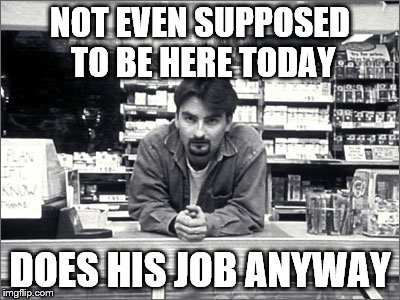
In the wake of county clerk Kim Davis’ refusal to give out marriage licenses to same sex couples a series of internet memes circulated with individuals in jobs that required them to do things they preferred not to do, but did their job anyway. It’s a funny concept, but one that doesn’t apply to Republicans in Congress who repeatedly threaten to shut down the government, failing to do their jobs in order to throw a temper tantrum over the conservative outrage du jour.
It has almost no chance of passing (see, Republicans in Congress) but a bill has been introduced to incentivize Congressmembers to actually govern responsibly:
Rep. Rick Nolan (D-Minn.) introduced a bill Friday that would prevent members of Congress from getting paid in the event of a government shutdown.
“It’s time to put an end to government by crisis management,” Nolan said in a statement. “And it’s time for Congress to start living in the real world — where you either do your job — or you don’t get paid. If hundreds of thousands of other federal employees are to go without their salaries — twisting slowly in the wind in a government shutdown — then the Congress should not be paid either.”
Under Nolan’s bill, members of Congress would go unpaid for the duration of the shutdown. He introduced similar legislation during the 16-day government shutdown in 2013 that left 800,000 federal workers furloughed without pay. While his bill never got off the ground, Nolan donated the money he was paid over the shutdown to charities in his district.
If Republicans want to run government like a business, this would be a good way to start. If you don’t do the work you’re supposed to do you don’t get paid. But the GOP only pays lip service to wanting the government to run efficiently.
At some point in the future when Democrats finally retake Congress, this should be one of the first bills they pass. The era of government by crisis hostage taking needs to end.
By: David Atkins, Political Animal Blog, The Washington Monthly, September 20, 2015
“Buckle Your Seatbelt”: Obama Reminds Congress About Looming Showdowns
Much of the political world’s attention has focused on the presidential campaign trail of late, and for good reason. Congress takes August off; President Obama has been on vacation; and his would-be successors have put on quite a show.
But as August nears its end, the White House remains quite cognizant of the challenges facing federal policymakers. Just yesterday, the president published a message on Twitter, explaining, “Amidst global volatility, Congress should protect the momentum of our growing economy (not kill it).” Obama added that the United States “must avoid” a government shutdown and austerity measures.
The message didn’t come out of the blue. Current funding for the federal government expires at the end of September, and though Republican leaders intended to make progress with talks over their summer break, there’s no indication that officials are any closer to a solution than they were in July. On the contrary, as was the case in 2013, some far-right members seem eager for a fight that would result in a shutdown.
And then, of course, there’s the debt ceiling. On the one hand, we received some good news on this front from the Congressional Budget Office this week. The Washington Post reported:
Congressional leaders may have more time to work out a deal this fall to increase the federal borrowing limit, after new projections from Congress’ scorekeeper showed tax revenues have been greater than expected this year. […]
In July, the Treasury Department estimated the government would hit its $18.1 trillion borrowing limit at the end of October. CBO, however, now projects the debt ceiling will not need to be increased until mid-November or early December, while noting there is a level of uncertainty when determining the exact date.
On the other hand, the delayed deadline won’t necessarily help. The Huffington Post reported:
[The debt-ceiling] deadline is nearing. And the mixture of an ongoing presidential campaign – which encourages lawmakers to play to their base – and the itching for more spending cuts from conservative groups suggests it won’t pass without drama. […]
Asked if he expected debt-ceiling fireworks, longtime GOP consultant Craig Shirley replied: “Without a doubt.”
In fairness, it’s important to note that GOP leaders want no part of this – House Speaker John Boehner and Senate Majority Leader Mitch McConnell haven’t expressed any interest whatsoever in a replay of the 2011 hostage fight in which Republicans threatened to crash the economy on purpose unless President Obama met the GOP’s demands.
But as we’ve seen many times, party leaders often feel as if they have no choice but to follow. And in this case, amid economic uncertainty and market volatility, far-right Republicans see conditions that give them a twisted sense of leverage.
The broader timing doesn’t help, either. The race for the GOP presidential nomination will be pretty intense by the time December rolls around, and it’s likely we’ll see most, if not all, of the Republican field pushing the party to be as radical as possible – each candidate will try to prove to right-wing activists that they’re “tougher” than their rivals.
Buckle your seatbelt.
By: Steve Benen, The Madow Blog, August 28, 2015
“The GOP Candidates Are Pledging To Undo The Iran Nuclear Deal; Don’t Buy It”: Get’s Us Nothing, And Potentially Costs Us A Great Deal
Republicans have spent much of the last six years shaking their fists in impotent protest against the things that Barack Obama has done. That’s the way it is when you’re out of power: There are only so many tools at your disposal to undo what the president does, even if you control Congress. This dynamic also explains some of the restiveness in the Republican electorate, since their leaders have been telling them of all the ways they’ll fight Obama (like repealing the Affordable Care Act), only to be stifled at every turn.
And now it looks like they’re going to fail to stop the deal the United States and five other world powers negotiated with Iran to restrain its nuclear program. Since the agreement isn’t a treaty, it doesn’t require ratification; instead, Congress can try to pass a resolution to stop it, which President Obama would veto. A veto override would require two-thirds of the members of both chambers of Congress, and the deal’s opponents aren’t going to get that.
While there are still a few Democratic senators who have not made their positions known, the last few days have seen one after another come out in favor of the deal (with the exception of New Jersey’s Bob Menendez, to no one’s surprise). Republicans need 13 senators to join them in opposition to the deal, and so far they have only two. As of this writing, there are 13 Democrats who have yet to announce their position; unless 11 of them come out in opposition — which seems all but impossible — the deal will have enough supporters to stop a veto override. Furthermore, such an override would probably fail in the House anyway.
So what will happen then? When all the votes are cast and the deal’s critics come up short, the Republicans running for president will rush to the microphones to repeat what they’ve already said: that this is the worst deal in diplomatic history, that Barack Obama is Neville Chamberlain, that Israel is all but already consumed in a fiery nuclear blast, etc.
If there’s been any disagreement between the candidates, it’s only in how fast they want to tear up the deal. For instance, Scott Walker says he’d do it on “day one” of his presidency, and even suggested he might launch a military strike on Iran to boot. Marco Rubio has said something similar, that he would “quickly reimpose sanctions,” which means tossing out the deal. Jeb Bush suggested that he’d at least hire his cabinet and check in with allies before figuring out what to do next, which is what passes for thoughtfulness in GOP circles these days.
What none of them have grappled with is what happens afterward. It’s possible that the other signatories to the agreement, including Germany, China, and Russia, will say that whatever President Trump thinks, they’ll hold up their end. If Iran agrees, then it might be subject to renewed U.S. sanctions, but the reason the current sanctions regime has been so effective is that the U.N. and so many other nations have participated in cutting Iran out of the world economy; sanctions by the U.S. alone would not have nearly the same impact.
On the other hand, if the agreement falls apart when we pull out — which is what Republicans would obviously prefer — then we return to the status quo, with Iran free to pursue nuclear weapons if it wishes without any inspections at all.
If the past is any indication, I don’t expect Republicans to find the time to discuss what would actually happen if they got their wish, since they’ll be too busy throwing Munich analogies around. But let’s assume that the deal doesn’t get shot down in Congress, and it begins to take effect. A year from now, what will the GOP nominee say about the deal? What if it seems to be working — the sanctions have begun to be unwound, inspections are proceeding, and there’s no indication yet that Iran is secretly trying to create nuclear weapons. What then? Will that nominee say, “I don’t care if it looks like it’s working, Bibi Netanyahu once showed me a picture of a cartoon bomb, so I’m still going to walk away from this agreement”?
Maybe. But the truth is that the next president abandoning this agreement has about as much likelihood of happening as Donald Trump’s plan to convince Mexico to pay for a 2000-mile wall between our two countries. It’s the kind of thing a candidate says when he wants to sound tough, but it’s not the kind of thing a president — even if it’s one of these guys — actually does. It would get us virtually nothing, and potentially cost us a great deal.
Think about that when you see the candidates shouting at the cameras after Congress fails to stop the agreement, pledging to do their utmost to destroy it.
By: Paul Waldman, Senior Writer, The American Prospect; Contributor, The Week, August 21, 2015
“Obama Vs The Republican Cavaliers”: Defending A Long Bipartisan Tradition Of Negotiating Even With Adversaries We Deeply Mistrust
If you wondered why President Obama gave such a passionate and, yes, partisan speech on behalf of the Iran nuclear deal Wednesday, all you had to do was tune in to the Republican presidential debate the next night.
Anyone who still thinks the president has any chance of turning the opposition party his way after watching the candidates (or listening to Republicans in Congress) no doubt also believes fervently in Santa Claus. In fact, the case for Santa — made so powerfully in “Miracle on 34th Street” — is more plausible.
The candidates gathered together by Fox News in Cleveland suggested that the hardest decision the next president will face is whether killing Obamacare or voiding the Iran deal ought to be the first order of business. All who spoke on foreign policy sought to paint the “Obama-Clinton” international strategy as “failed” and “dangerous.”
Obama does not need any private briefings on how Republicans are thinking. He realizes, as everyone else should, that there’s only one way to save the Iran accord. Republicans will have the votes to pass a measure disapproving it, and he needs to keep enough Democrats on his side to sustain his veto.
He also knows that he is in an ongoing battle for public opinion over a very big issue. In broad terms, this is an argument over whether the foreign policy of George W. Bush, with its proclivity toward unilateral military action, or his own approach, which stresses alliances and diplomacy, is more likely to defend the United States’ long-term interest.
The president was not wrong when he said that “many of the same people who argued for the war in Iraq are now making the case against the Iran nuclear deal.” And in light of the language used by Cleveland’s Cavaliers of Unilateralism, it was useful that he reminded Americans of the run-up to the Iraq invasion, when “those calling for war labeled themselves strong and decisive, while dismissing those who disagreed as weak — even appeasers of a malevolent adversary.”
Lest we forget, in September 2002, shortly before the midterm elections, Bush dismissed Democrats who called for U.N. support before U.S. military action in Iraq. “If I were running for office,” Bush said, “I’m not sure how I’d explain to the American people — say, ‘Vote for me, and, oh, by the way, on a matter of national security, I think I’m going to wait for somebody else to act.’ ” Now that’s partisan.
In foreign policy, the past isn’t even past because we have not resolved the debate over how to use U.S. power that opened after the attacks of Sept. 11, 2001. In a June Gallup survey , Americans were as split as ever on whether the war in Iraq itself was a mistake: 51 percent said it was, 46 percent said it wasn’t. Among Democrats, 68 percent said it was a mistake; only 31 percent of Republicans did. Independents split much like the country as a whole.
Those who counsel Obama to be more conciliatory toward Republicans in defending an agreement that could block Iranian nuclear ambitions for at least a decade (and probably more) are nostalgic for a time when many Republicans supported negotiated settlements, saw containment policies as preferable to the aggressive rollback of adversaries and were committed to building international alliances.
Such Republicans still exist, but there are not many of them left in Congress. And we should have enough respect for the party’s presidential candidates to believe that they mean what they are saying when, for example, one of them (Scott Walker) insists that “Iran is not a place we should be doing business with,” while another (Jeb Bush) declares that “we need to stop the Iran agreement, for sure, because the Iranian mullahs have . . . blood on their hands.”
Obama is defending a long bipartisan tradition of negotiating even with adversaries we deeply and rightly mistrust, the prime example being the Soviet Union. For now, the consensus across party lines in favor of such diplomacy is broken. Many of us would like to see it restored, but the evidence of Obama’s time in office is unambiguous: Friendly gestures won’t win over those determined to block his policies.
In the short run, Obama simply has to win enough votes for his Iran deal. For the long run, he has to convince Americans that his measured approach to the world is the safest path for the country. Defending this view aggressively is no vice.
By: E. J. Dionne, Jr., Opinion Writer, The Washington Post, August 9, 2015
Share This Blog


 Unknown Feed
- An error has occurred; the feed is probably down. Try again later.
 mykeystrokes.com