“The Right Defends A New Jim Crow”: 50 Years Since The Civil Rights Act, Wingnuts Still Don’t Get It
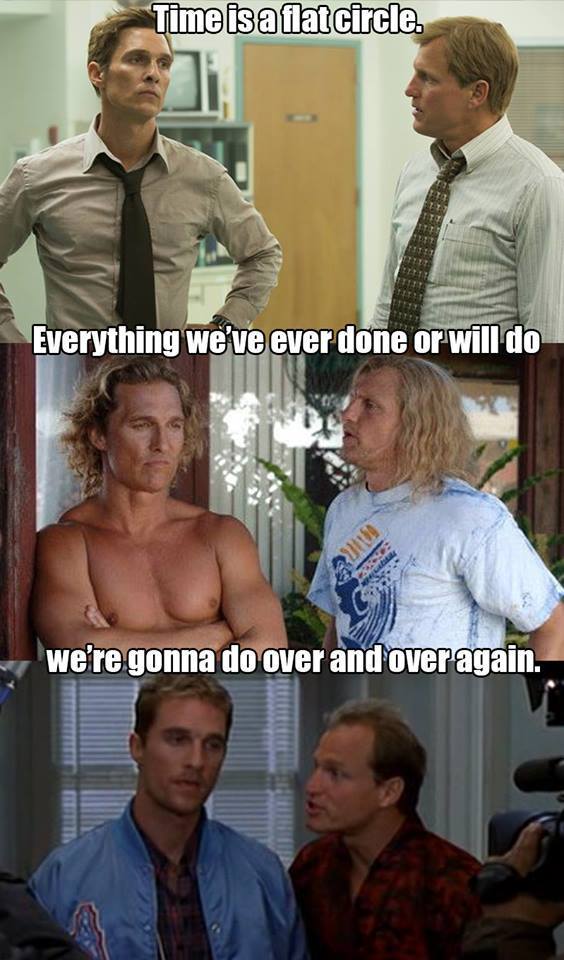
Watching the debate over Arizona’s SB 1062 (better known as the state’s anti-gay Jim Crow law) unfold this past week, I couldn’t help but think of the already iconic line from Matthew McConaughey’s “True Detective” character Rust Cohle: “Time is a flat circle.” As is always the case with the nihilistic and willfully esoteric Cohle, it’s not entirely clear what he’s trying to say with the metaphor, but we get the gist: Like Nietzsche’s “eternal return,” Cohle’s flat circle theory holds that all of us are destined to relive every moment of our conscious lives, forever. It’s as if we all were stuck in the late Harold Ramis’ “Groundhog Day,” but instead of repeating a single day, we repeat our entire lives.
Beyond the fact that, like many others, obsessing over “True Detective” has increasingly become the chief way I spend my free time, Arizona’s brief foray into the politics of segregation reminded me of the flat circle quote because I had recently seen Bryan Cranston’s Broadway debut, “All the Way,” in which the “Breaking Bad” star plays former president Lyndon B. Johnson during the historic period between Kennedy’s assassination and Johnson’s reelection, a time when the 36th president was working feverishly to ensure the passage of the Civil Rights Act of 1964. The play is good and Cranston is great, but what was most striking throughout was how much Johnson’s opponents then sounded like SB 1062’s supporters today. It was, as Cohle would say, some “heavy shit.”
The similarities weren’t merely superficial, either. Sure, the play, written by Pulitzer prize-winning playwright Robert Schenkkan (who obviously did his homework), was littered with hysterical charges of “fascism” and “socialism” and “big government” from no-name Dixiecrats that most of us never knew or were happy to forget. And of course these moments brought to mind much of the anti-Obamacare rhetoric that has emanated from conservatives during the past five years. But the parallels went deeper than that. It wasn’t just the language that sounded so familiar, but the logic behind it, too. Whether conservatives were defending Jim Crow proper or the Southwest’s latest variant, their worldview, all these years later, was disturbingly unchanged.
To explain what I mean, allow me to cite two of conservatism’s leading lights: Kentucky Sen. Rand Paul and all-around media mogul Glenn Beck.
As the opposition to SB 1062 increased in fervency and numbers, the usually loquacious Paul was, unlike his fellow Senate Republican John McCain (who opposed the bill), deafeningly mute. Anyone familiar with Paul’s history knows why: Because the obvious presidential aspirant wanted to avoid reminding people of the unfortunate 2010 interview with Rachel Maddow in which he stated that, even today, he would not support the government-run dismantling of Jim Crow. “I don’t want to be associated with those people,” Paul said, referring to white supremacists who’d bar blacks from their restaurants, “but I also don’t want to limit their speech in any way…” Paul’s orthodox libertarianism told him that the freedom to discriminate was too valuable, too sacred, to let the federal government stand in its way. Like Sen. Barry Goldwater did in 1964, when he voted against the Civil Rights Act, Paul argued that the Constitution had no room for anti-discrimination.
Roughly four years later, Glenn Beck made a similar argument, this time in defense of SB 1062. After doing his best impression of Hamlet, grappling aloud with his competing interest to not be a bigot while on the other hand maintaining allegiance to his understanding of liberty, Beck cut to the chase, telling his coworkers that he could only support Arizona’s bill, because “freedom is ugly.” Like Paul, Beck was sure to make clear that he held no sympathy for anyone who would ban LGBTQ people from their premises. But also like Paul, Beck had no choice but to conclude that the freedom to ostracize and discriminate was, in part, what the American experiment was all about. “I don’t like that world,” Beck said, “but that’s freedom! That’s freedom! Freedom is ugly. It’s ugly.”
High-profile though they may be, Beck and Paul are hardly the only conservatives who still cling to a vision of freedom that many Americans wrongly thought was swept into Reagan’s “ash-heap of history” decades before. Tucker Carlson — who, if Paul is to be Goldwater, we must describe as today’s version of the braying, segregationist Dixiecrats — was adamant in his defense of SB 1062, saying on Fox News that opponents of the bill were advocating for “fascism” and had gone “too far” in their quest to prevent state-sanctioned bigotry. “Everybody in America is terrified to tell the truth,” Carlson warned, “which is, this is insane, this is not tolerance, this is fascism.” Tellingly, when his sparring partner, Fox’s house liberal, Alan Colmes, asked Carlson whether he would have supported the Civil Rights Act, the editor of the Daily Caller could only respond by saying, “Don’t bring [that] into this,” with a sneer.
Even conservatives who are more intellectually inclined than Beck, Paul and Carlson put forward a defense of SB 1062 that could easily and quickly be adopted to oppose the federal government’s dismantling of Jim Crow. Ilya Shapiro of Cato, libertarianism’s premiere think tank and ostensible guardian of liberty for all, wrote, “I have no problem with SB 1062.” Repeating an argument that was offered by Goldwater, Paul, Beck and Carlson, Shapiro maintained that those who would be discriminated against, were SB 1062 to pass, should simply trust that the free market would punish bigots and, eventually, guarantee their liberty. “[P]rivate individuals should be able to make their own decisions on whom to do business with and how – on religious or any other grounds,” Shapiro wrote. “Those who disagree can take their custom elsewhere and encourage others to do the same.”
The fact that this very same logic recently undergirded a century of Jim Crow seemed to escape Shapiro. Either that or he, like W. James Antle III of the American Conservative, was content to dismiss comparisons to Jim Crow on the grounds that Arizona is not the Jim Crow South and 2014 is not the mid-’60s. “People often argue for or against the civil-rights laws of the 1960s on the basis of abstract principles,” Antle wrote, “but they were in fact a reaction to a very specific set of circumstances.” (This is an argument that, more than anything else, raises the question as to whether this is the first time Antle’s come into contact with an analogy.) Perhaps Shapiro, like Antle, was content to support the bill not because it wouldn’t give the government’s imprimatur to homophobia, but because such an outcome is, in their minds, “not very likely.” After all, what’s a little discrimination in the grand scheme of things?
If we put all these and many other conservative defenses of SB 1062 together, it’s hard not to reach a clear and unsettling conclusion: While conservatives themselves have largely given up the racism that coursed through a previous generation’s defense of Jim Crow, conservatism itself has learned no enduring lesson from the Civil Rights Movement and has made no ideological adjustments as a result. Indeed, National Review’s Kevin Williamson recently declared that Goldwater’s brief against the Civil Rights Act “has been proved correct” for worrying that “expanding the federal mandate … would lead to cumbrous and byzantine federal micromanagement of social affairs.” Going further, National Review’s editors, writing on the 50-year anniversary of the March on Washington (which NR at the time opposed) would only concede that the magazine was wrong to oppose the Civil Rights Movement because its principles “weren’t wrong, exactly” but were instead “tragically misapplied.”
For all of her many flaws, Jan Brewer decided on Wednesday to refrain from applying her conservative “principles” in such a “tragic” manner, opting instead to veto the bill and maybe — just maybe — push her party that much closer to joining the rest of us in the 21st century. And while many conservatives received the veto as a crushing disappointment, or even a step toward “slavery,” I’d caution my right-wing fellow citizens against slipping into outright despair. If the events in Arizona have taught us nothing else, they’ve shown that time is indeed a flat circle; future right-wingers will have plenty of chances to keep getting this most basic question of freedom terribly, terribly wrong.
By: Elias Isquith, Salaon, March 1, 2014
“Morally And Legally, The Right Call In Arizona”: Citizens Cannot Opt Out Of Civil Rights Laws
There’s no question that Jan Brewer did the right thing yesterday. No moral question. And no legal question either. Well, let me slightly amend that: With this Supreme Court, you never know about the future. But we know about the past, and decades of civil-rights case law are squarely on Brewer’s side, and supporters of SB 1062 just have to see this clearly and squarely and accept it.
It’s not like we’ve never fought over these questions. We have, of course, and a result, there’s a history here. And that history, that body of court decisions, says clearly, like it or not, that generally speaking, citizens cannot opt out of civil rights laws.
As Harvard law professor Noah Feldman pointed out yesterday in a Bloomberg view column, segregationist business owners in the South argued after the civil rights act of 1964 that their “constitutional right to associate” as they chose should permit them not to serve black customers. (The religious-liberty right, Feldman notes, has the same “constitutional status” as the right to associate.) But courts never said that this was permissible.
We may laugh today at the idea that the racist owner of a hardware store in Natchez in 1965 could have refused to sell a black carpenter a bag of masonry nails. But it was no laughing matter then. This was real. Congress, and then the courts, put a stop to it. As Feldman told me yesterday in a follow-up exchange: “Freedom to associate and exercise religion are basic rights. Excluding customers isn’t.”
The freedom to associate that Feldman mentions is one carve-out that courts have recognized. But that’s a narrow exemption, intended in real life mostly for private or fraternal organizations that are built around some idea of ethnic cohesion—New York’s Ancient Order of Hibernians, for example, which quite famously has been allowed for years to ban gay people and groups from marching in the city’s St. Patrick’s Day Parade.
By the way, doesn’t it seem weirdly anachronistic and reactionary that the Hibernians still enforce this ban? The gay-rights position was controversial back in the early ’90s, when I was covering these things. Now, the Hibernians’ position seems like something better suited to Alabama than New York City. In any case, after Rudy Giuliani and Mike Bloomberg marched in the discriminatory parade every years, new Mayor Bill De Blasio announced that he’s boycotting it.
But, the Hibernians are allowed to do this under their right to associate. There also exists a so-called “Mrs. Murphy” exemption to the Fair Housing Act for owner-occupied rental housing of four or fewer units—that is, if little old Mrs. Murphy subdivided her big house and wants to keep out certain people, she’s probably allowed to do that. And finally, in certain narrow cases, religious institutions that serve mostly religious purposes are allowed to hire only their coreligionists.
But a business vending to the general public? No way. If these “Christians” in Arizona are permitted to deny their services to same-sex couples, then atheist small-businesses owners in Berkeley are perfectly within their rights to hang a sign: “No Christian evangelicals served.” It would be crazy for courts to open that door.
Brewer seemed to understand all this properly with the money passage of her statement yesterday: “Senate Bill 1062 does not address a specific or present concern related to religious liberty in Arizona. I have not heard one example in Arizona where a business owner’s religious liberty has been violated.” She deserves credit for saying this, dismissing this specious religious liberty talk.
The legal history is clear. The legal future, though, is still a bit up in the air. Feldman acknowledges that SB 1062 “may well be constitutional” because the law’s supporters might be able to argue successfully that their tradition of religious liberty is “in jeopardy.” Samuel Bagenstos, a former assistant attorney general for civil rights under Barack Obama who now teaches law at the University of Michigan, explains that the Arizona law and others like it around the country constitute a new and not-yet-settled legal battle front. “These laws, by singling out gays and lesbians for less protection of antidiscrimination laws, are vulnerable to a challenge under the Equal Protection Clause,” Bagenstos says. “But the law’s very much developing in this area, so we really can’t say anything with confidence.”
It’s developing, but it’s mostly developing on the side of shutting down legal discrimination. Ask the Texas judge who yesterday struck down that state’s same-sex marriage ban, writing “that state-imposed inequality can find no refuge in our United States Constitution.” Increasingly, the law is coming to understand what more and more Americans understand. Gay people are equal. Period. There is no real religious basis for thinking otherwise. Ian Millhiser of Think Progress reminded us yesterday of people who used to think the same way:
In 1901, Georgia Gov. Allen Candler defended unequal public schooling for African Americans on the grounds that “God made them negroes and we cannot by education make them white folks.” After the Supreme Court ordered public schools integrated in Brown v. Board of Education, many segregationists cited their own faith as justification for official racism. Ross Barnett won Mississippi’s governorship in a landslide in 1960 after claiming that “the good Lord was the original segregationist.” Senator Harry Byrd of Virginia relied on passages from Genesis, Leviticus and Matthew when he spoke out against the civil rights law banning employment discrimination and whites-only lunch counters on the Senate floor.
It’s painfully obvious that in a mere 10 or 15 years, that’s how these Arizona Christians will be widely seen. They really ought to ask themselves if that’s the historic company they want to keep.
By: Michael Tomasky, The Daily Beast, February 27, 2014
“Discrimination Lapel Pins”: These “Religious Freedom” Bills Are The New Stand-Your-Ground Laws
Awaiting signature on the desk of Arizona Governor Jan Brewer is a bill that might be the most insidious attack on LGBT rights to ever pass both houses of a state legislature. SB1062 would allow anyone—be it an individual, association, partnership, corporation, church, religious assembly, foundation, or other legal entity—to deny services to others simply by asserting their religious beliefs. Interpreted broadly, the bill could override many equal protection clauses in Arizona law, including civil rights: A restaurateur could deny service to an out-of-wedlock mother, a cop could refuse to intervene in a domestic dispute if his religion allows for husbands beating their wives, and a hotel chain could refuse to rent rooms to Jews, Hindus, or Muslims.
Republican legislators have made the intended target of the bill clear in their statements, repeatedly citing a New Mexican photographer who was sued when he refused to shoot a lesbian couple’s commitment ceremony. They claim the bill’s detractors are exaggerating its possible effects and are demonstrating hostility towards people of faith. But there is ample reason to believe that a law like this would open the door to discrimination. Once laws are passed, people who may otherwise be afraid of engaging in questionable behaviors may feel emboldened to do so. Moreover, these laws will likely be used by juries as legitimate reasons to dismiss cases against future defendants—after all, the law is the law.
The perfect case in point for all of this? The stand-your-ground laws which have been enacted in several states across America.
These laws were ostensibly passed to protect citizens from criminals by removing the need to retreat or escape when attacked, the rationale being that criminals would think twice knowing that their victims could legally defend themselves with proportionate force. And yet SYG defenses have been used with alarming frequency, and in scenarios unimaginable when these laws were passed, including by drug dealers and gang members. States which have enacted SYG laws have seen an 8 percent rise in “justifiable homicides,” possibly indicating that those with knowledge of the law are willing to take chances in situations where the law might apply.
Furthermore, SYG defenses are shockingly successful. Seventy percent of people who have invoked the defense have avoided prosecution. In fact, SYG laws seem to have tilted the odds in favor of the shooter: In states that have it, 13.6 percent of homicides have been ruled justifiable, while in those that don’t, only 7.2 percent have been deemed such. Unsurprisingly, the success of a SYG defense has a decidedly racial bias—white-on-black killings are far more likely to be deemed “justified” than any other kind.
What does this all mean for bills like SB1062? Granting people the legal right to invoke religious beliefs to justify their right to refuse service will embolden many people who might have otherwise been afraid to do so. Moreover, the defense could end up being a largely successful one. Certainly jurors who might already be biased will be unafraid to side with the defendants, but even those who might not agree with the law will be hard pressed not to accept its validity; should a defendant make a somewhat rational case for why their religious beliefs would be violated by providing these services, the jurors would be forced by the law to acquit. The law would not only provide cover to judges and juries who might otherwise harbor sentiments against the defendants for whatever reason, but would even compel those who aren’t biased to rule in favor of the accused parties.
Many have compared these laws to the gay propaganda bill that passed in Russia last June, some expressing dismay that such laws could be enacted here in America. In the sense that the Russian law seems to have emboldened many Russians to hunt down LGBT people (a law recently passed in Nigeria seems to doing the same thing), it’s not hard to draw the same conclusions here. These Republican legislators claim to want to protect people of faith, yet they did not invoke a single legitimate instance where a person’s freedom of religion is compromised by having to serve others. Purporting to be against discrimination, these lawmakers are trying to use the victim card against the very people they want to discriminate against. Yet there is a tacit social contract we all sign in pluralistic societies: Even when we do not agree with everyone’s beliefs or lifestyles, we still agree to treat each other fairly.
There’s something vaguely desperate about these laws, the last gasp of a cause aware that it’s dying. They are unlikely to pass constitutional muster; they hardly seem to be trying to do so. In all likelihood, Brewer will veto SB1062. As law, it would not only cause a ridiculous pileup in the courts but could tear at the social fabric of the state, exposing certain prejudices that best remain hidden—the landmines are too numerous for the governor to risk so late into her term. Still, this will hardly be the last we hear of these dubious “religious freedom” arguments. Every step in the civil rights movement was met with resistance. Now that the push for LGBT rights has gained such momentum, the backlash will only get stronger.
By: Eric Sasson, The New Republic, February 24, 2014
“3 Enemas Later, Still No Drugs”: Inequality Is Also About Dignity, Humanity And Access To Justice
If you think that protests about overzealous law enforcement are over the top, listen to what unfolded when the police suspected that David Eckert, 54, was hiding drugs in his rectum.
Eckert is a shy junk dealer struggling to get by in Hidalgo County, N.M. He lives a working-class life, drives a 16-year-old pickup and was convicted in 2008 of methamphetamine possession.
Police officers, suspecting he might still be involved in drugs, asked him to step out of his pickup early last year after stopping him for a supposed traffic violation. No drugs or weapons were found on Eckert or in his truck, but a police dog showed interest in the vehicle and an officer wrote that Eckert’s posture was “erect and he kept his legs together.”
That led the police to speculate that he might be hiding drugs internally, so they took him in handcuffs to a nearby hospital emergency room and asked the doctor, Adam Ash, to conduct a forcible search of his rectum. Dr. Ash refused, saying it would be unethical.
“I was pretty sure it was the wrong thing to do,” Dr. Ash told me. “It was not medically indicated.”
Eckert, protesting all the while, says he asked to make a phone call but was told that he had no right to do so because he hadn’t actually been arrested. The police then drove Eckert 50 miles to the emergency room of the Gila Regional Medical Center, where doctors took X-rays of Eckert’s abdomen and performed a rectal examination. No drugs were found, so doctors performed a second rectal exam, again unavailing.
Doctors then gave Eckert an enema and forced him to have a bowel movement in the presence of a nurse and policeman, according to a lawsuit that Eckert filed. When no narcotics were found, a second enema was administered. Then a third.
The police left the privacy curtain open, so that Eckert’s searches were public, the lawsuit says.
After hours of fruitless searches, police and doctors arranged another X-ray and finally anesthetized Eckert and performed a colonoscopy.
“Nothing was found inside of Mr. Eckert,” the police report notes. So after he woke up, he was released — after 13 hours, two rectal exams, three enemas, two X-rays and a colonoscopy.
The hospital ended up billing Eckert $6,000.
When I came across this case, it seemed far-fetched to me — more like rape than law enforcement. But the authorities, hospital and doctors all refused to comment, and, a few days ago, the city and county settled the lawsuit by paying Eckert $1.6 million.
This wasn’t a unique case. A few months earlier, a man named Timothy Young who lives nearby says that police officers pulled him over, forcibly strip-searched him in a parking lot and then took him to a hospital for a forced X-ray and rectal examination while he was handcuffed. Nothing was found, so he was released — only to receive a hospital bill.
And a few weeks before Eckert’s ordeal, a 54-year-old American woman crossing from Mexico into El Paso was strip-searched and taken to the University Medical Center of El Paso. She says in a lawsuit that, over six hours, she was shackled to an examination table and subjected to rectal and vaginal examinations — with the door open to compound her humiliation. After a final X-ray and CT scan, all of which turned up nothing, she was released — and billed for the procedures.
Joseph P. Kennedy, Eckert’s lawyer, notes that such abuses are not random but are disproportionately directed at those on the bottom rungs of society. “It’s a socioeconomic issue,” he said. “It’s the indignities forced on people who are not articulate, not educated and don’t have access to legal services.”
Police are caught in a difficult balancing act, and obviously the abuse of Eckert isn’t representative. But it is emblematic of something much larger in America, a kind of inequality that isn’t economic and that we don’t much talk about.
It’s the kind of inequality that lies behind police stops for “driving while black,” or unequal implementation of stop-and-frisk policies, or “zero tolerance” school discipline codes that lead many low-income children to be suspended.
This inequality has a racial element to it, but it is also about social class (Eckert is white but struggling financially). This is about Americans living in different worlds. If you’re a middle-class reader, you probably see the justice system as protective. If you’re a young man of color, you may see it as threatening.
So as we discuss inequality in America, let’s remember that the divide is measured in more than dollars. It’s also about something as fundamental as our dignity, our humanity and our access to justice; it’s about the right of working stiffs not to endure forced colonoscopies.
By: Nicholas D. Kristof, Op-Ed Columnist, The New York Times, January 25, 2014
“The Psyche Of An Uninformed Conservative”: Rand Paul Needs To Stop Writing A Revisionist History Of Civil Rights
I understand that a revisionist history of the civil rights movement is of great psychological importance to some conservatives. We’ll probably hear a lot more of it on Monday in conjunction with a MLK Holiday many of their forebears opposed.
But Rand Paul’s forays into this area are just plain ill-advised. Last April he gave a speech at Howard University that pursued the ridiculous theory that the New Deal was essentially a complement to Jim Crow in its “enslavement” of African-Americans to the terrible indignity of material living assistance. And now we have this, via WaPo’s Aaron Blake:
Sen. Rand Paul (R-Ky.), in an interview Thursday, likened President Obama’s governing philosophy to the kind of “majority rule” that led to Jim Crow laws and Japanese internment camps.
Speaking on Fox News, Paul reacted to Obama’s repeated assertions that Republicans should win elections if they want to control the agenda in Washington. Obama has also suggested in recent days that he might pursue more executive actions — changes made without Congress.
“The danger to majority rule — to him sort of thinking, well, the majority voted for me, now I’m the majority, I can do whatever I want, and that there are no rules that restrain me — that’s what gave us Jim Crow,” Paul said. “That’s what gave us the internment of the Japanese — that the majority said you don’t have individual rights, and individual rights don’t come from your creator, and they’re not guaranteed by the Constitution. It’s just whatever the majority wants.”
Paul added: “There’s a real danger to that viewpoint, but it’s consistent with the progressive viewpoint. … Progressives believe in majority rule, not constitutional rule.”
Don’t be confused with the conflation of the Japanese interment outrage—a temporary product of wartime hysteria which no one at the time regarded as “progressive”—with Jim Crow. The original Constitution which Paul and his followers worship certainly didn’t concern itself with the rights of racial minorities. It took the most egregious exercise of “majority rule” in U.S. history—the Civil War—to abolish slavery. Only a majority given extraordinary power by the self-exclusion of southerners was in a position to pass the 13th, 14th and 15th amendments to the Constitution, the most important efforts taken until 1964 to vindicate the rights of racial minorities. It was a failure of will by the majority that led to the abandonment of Reconstruction and the establishment of the Jim Crow regime. And it was the power of the minority in the Senate (and by the 1930s or so, the minority in the Democratic Party) to thwart majority rule via the filibuster that kept Jim Crow in place for so very long.
And BTW, it’s conservatives, far more than progressives, who perpetually chafe at judicial enforcement of individual rights, unless it happens to coincide with their own policy goals. But in any event, Paul and others like him really need to stop trying to invoke the legacy of the Civil Rights movement to attack “majority rule” on behalf of a “constitutional conservatism” aimed at creating a oligarchical or even theocratic dictatorship of absolute private property rights and puny government. The “minorities” they want to protect are snowy white and very privileged.
By: Ed Kilgore, Contributing Writer, Washington Monthly Political Animal, January 17, 2014
Share This Blog


 Unknown Feed
- An error has occurred; the feed is probably down. Try again later.
 mykeystrokes.com