“Shadowy Billionaires”: The Men Who Own The GOP And Your Democracy
Have you heard of William Dore, Foster Friess, Sheldon Adelson, Harold Simmons, Peter Thiel or Bruce Kovner? If not, let me introduce them to you. They’re running for the Republican nomination for president.
I know, I know. You think Rick Santorum, Newt Gingrich, Ron Paul and Mitt Romney are running. They are – but only because the people listed in the first paragraph have given them huge sums of money to do so. In a sense, Santorum, Gingrich, Paul and Romney are the fronts. Dore et al. are the real investors.
According to January’s Federal Election Commission report, William Dore and Foster Friess supplied more than three-fourths of the $2.1 million raked in by Rick Santorum’s super PAC in January. Dore, president of the Dore Energy Corp. in Lake Charles, La., gave $1 million; Freiss, a fund manager based in Jackson Hole, Wyo., gave $669,000 (he had given the Santorum super PAC $331,000 last year, bringing Freiss’ total to $1 million).
Sheldon Adelson and his wife, Miriam, provided $10 million of the $11 million that went into Gingrich’s super PAC in January. Adelson is chairman of the Las Vegas Sands Corp. Texas billionaire Harold Simmons donated $500,000.
Peter Thiel, co-founder of PayPal, provided $1.7 million of the $2.4 million raised by Ron Paul’s super PAC in January.
Mitt Romney’s super PAC raised $6.6 million last month – almost all from just 40 donors. Bruce Kovner, co-founder of the New York-based hedge fund Caxton Associates, gave $500,000, as did two others. David Tepper of Appaloosa Management gave $375,000. J.W. Marriott and Richard Marriott gave a total of $500,000. Julian Robertson, co-founder of hedge fund Tiger Management, gave $250,000. Hewlett-Packard CEO Meg Whitman gave $100,000.
Bottom line: Whoever emerges as the GOP standard-bearer will be deeply indebted to a handful of people, each of whom will expect a good return on their investment.
And this is just the beginning. We haven’t even come to the general election.
Nonprofit political fronts like Crossroads GPS, founded by Republican political guru Karl Rove, are already gathering hundreds of millions of dollars from big corporations and a few wealthy individuals like billionaire oil and petrochemical moguls David and Charles Koch. The public will never know who or what corporation gave what because, under IRS regulations, such nonprofit “social welfare organizations” aren’t required to disclose the names of those who contributed to them.
Before 2010, federal campaign law and Federal Election Commission regulations limited to $5,000 per year the amount an individual could give to a PAC making independent expenditures in federal elections. This individual contribution limit was declared unconstitutional by the District of Columbia Court of Appeals in a case based on the Supreme Court’s grotesque decision at the start of 2010, Citizens United vs. Federal Election Commission.
Now, the limits are gone. And this comes precisely at a time when an almost unprecedented share of the nation’s income and wealth is accumulating at the top.
Never before in the history of our Republic have so few spent so much to influence the votes of so many.
By: Robert Reich, Robert Reich Blog, Published in The Huffington Post, February 21, 2012
U. S. Supreme Court Stays Montana Decision Undermining Citizens United
Late last year, the Montana Supreme Court handed down a decision that was widely viewed as openly defying the U.S. Supreme Court’s election-buying decision in Citizens United. Last night, the U.S. Supremes issued an entirely unsurprising order staying that decision. As a result, Montana will now face the same epidemic of corporate and other wealthy donor money that infected the other 49 states in the wake of the Citizens Uniteddecision.
There are, however, two possible silver linings in last night’s decision. The first is that the Supreme Court did not agree to the corporate parties’ request in this case to simply reverse the Montana decision without a full hearing or even necessarily an opinion. Yesterday’s order suspends the Montana decision “pending the timely filing and disposition of a petition for a writ of certiorari,” meaning that there is still a possibility that the Court could give the case a full hearing that would almost certainly raise the question of whether Citizens United should be overruled.
The second silver lining is a separate statement from Justices Ginsburg and Breyer attached to yesterday’s order:
Montana’s experience, and experience elsewhere since this Court’s decision in Citizens United v. Federal Election Comm’n make it exceedingly difficult to maintain that independent expenditures by corporations “do not give rise to corruption or the appearance of corruption.” A petition for certiorari will give the Court an opportunity to consider whether, in light of the huge sums currently deployed to buy candidates’ allegiance, Citizens United should continue to hold sway. Because lower courts are bound to follow this Court’s decisions until they are withdrawn or modified, however, I vote to grant the stay.
This statement suggests that there are at least two votes on the Supreme Court eager to reconsider one of the modern Supreme Court’s most erroneous opinions just two years after it was decided. Such a swift reversal would very unusual, if not entirely unprecedented. In light of the massive influx of corporate and wealthy donor money flooding our democracy and threatening to elect a generation of candidates personally beholden to wealthy benefactors, however, this kind of swift admission of error by the justices is entirely necessary.
By: Ian Millhiser, Think Progress, February 18, 2012
“Rmoney”: Mitt Is The Lobbyists’ Candidate
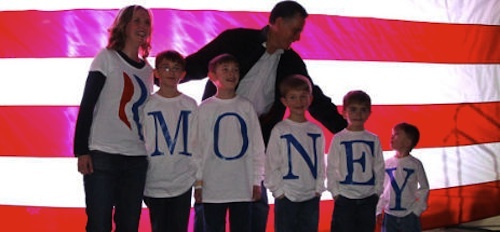
When you think of Mitt Romney, you probably think of a tall, robotic fellow with no discernible strong beliefs or stances (at least, none that can survive longer than a week at a time). That’s terribly unfair, and you should be ashamed for thinking it. He may have started out as an empty husk devoid of strong personal beliefs, but thanks to a crack team of industry insiders, he now is quite filled with opinions. Coincidentally, they happen to be the opinions of an army of top lobbyists in Washington, and the companies they lobby for. Funny how that works.
[Mitt Romney’s] kitchen cabinet includes some of the most prominent Republican lobbyists in Washington, including Charles R. Black Jr., the chairman of Prime Policy Group and a lobbyist for Walmart and AT&T; Wayne L. Berman, who is chairman of Ogilvy Government Relations and represents Pfizer, the drug manufacturer; and Vin Weber, the managing partner for Clark & Weinstock. […]Other lobbyists serve on one of Mr. Romney’s policy advisory teams, have hosted fund-raisers for his campaign or have joined the many influential Republicans whose endorsements Mr. Romney’s campaign has hailed.
Want to know what Mitt Romney’s true policies are? Well, you should have attended Mitt Romney’s $10,000-and-up policy round table, where industry lobbyists led “discussions” on what his policies towards those industries should be:
Mr. Romney’s campaign held an elaborate “policy round table” fund-raiser at a Washington hotel, featuring panel discussions run by lobbyists and former cabinet officials or members of Congress.James Talent, a former senator who runs the lobbying and public affairs firm Mercury Public Affairs, led a panel on infrastructure, according to an invitation. William Hansen, a former deputy secretary of education who is president of the lobbying firm Chartwell Education Group, led the education panel.
Wow. I can’t imagine why anyone would be cynical about American politics these days, can you?
The entertaining thing about this story is just how many large companies are represented. Among those specifically mentioned (and kudos to the three reporters for linking the lobbyists with actual clients, which is rather important information for readers) are Walmart, AT&T, Pfizer (drugs), Microsoft, Altria (tobacco), General Dynamics, Dominion (power), Barclays (finance), Allegheny (steel) and Peabody Energy (coal). Lobbyists are cutting the checks; lobbyists are bundling other people’s checks; lobbyists are holding the panel discussions about how the candidate can best serve the specific industries they represent; lobbyists make up the inner circle of “policy makers,” advising the candidate as to what his own core positions should be.
As for the candidate himself, he’s almost irrelevant at this point. You might as well nominate a bunny named Mr. Buttons: If you surround it with the exact same lobbyist-advisors, you’ll end up with the exact same policies. Sigh, if only we could teach that bunny to hold a pen—but for now we’ll have to settle for our current crop of Republican candidates, all of whom have near-identical policy prescriptions, all of which favor the exact same subset of people and the exact same handful of industries. Go figure.
I’ve given up on the notion that we can keep lobbyists from capturing our politics. I’ve also given up on the notion that we can prevent interests like the oil sector or our current handful of top financial companies from tailoring the American government specifically to serve their needs. Want more profits? Want less environmental protections? Want to crush some emerging industry that threatens to make yours less profitable? Just buy a few congressman, or a senator, or a president. At a few million here and there, it’s cheaper than advertising, and the results are far more secure.
So I’m in the Bill Maher camp on this one. Lobbyists and industries want to buy our politicians? Fine, I give up, let them. Just pass a law saying the candidate has to wear those corporate logos on their jackets whenever they appear on the campaign trail or when they are in office. The more money is contributed, the bigger the logo has to be. Top presidential candidates will look like military dictators-in-training, with badges and medals and ribbons sticking out from them in every direction, and just from looking at them we’ll be able to tell who they serve, and in what proportions. That would certainly be more educational than any rhetoric coming from the candidates themselves.
By: Hunter, Daily Kos, February 15, 2012
Romney For Sale: Mitt Hosts $10K “Policy Roundtables”
Giving a preview of how he would govern as president, Mitt Romney hosted a series of “policy roundtables” with top dollar donors Thursday at the JW Marriott hotel in Washington, DC. Once again demonstrating that he is much more concerned with helping the very rich than the very poor, the panels were open to all interested parties — who were willing and able to raise $10,000for his campaign, each.
The roundtable topics included education, energy, financial institutions and markets, defense/homeland security/foreign policy, health care, and infrastructure. Unsurprisingly, the panels were chaired and hosted by a few prominent Republican politicians and several wealthy investors and industry insiders. They roundtable leaders and industry finance chairs included:
– L.E. Simmons (energy), who has has “guided the investment of over $1.6 billion in private equity capital used to build energy service and equipment companies.”
– Patrick Durkin, managing director of Barclay’s Capital and a top Romney lobbyist-bundler.
– Richard Breeden, a hedge fund manager and a former SEC chairman under President George H. W. Bush.
– Tom Farrell, president and CEO of Dominion Power.
– Former Sen. Jim Talent (R-MO) (infrastructure), now a “distinguished fellow” at the right-wing Heritage Foundation.
– Former HHS Secretary and ex-Utah Gov. Mike Leavitt (R), now head of a “health care intelligence business.”
If the number $10,000 seems familiar, perhaps it was because he offered to make a bet with then-primary opponent Gov. Rick Perry (R-TX) for that amount in a disagreement over his previous positions on federal health insurance mandates. Now, Romney is asking the wealthiest 1 percent to make a similar-sized bet on him. And, according to one of the event’s co-chairs, the event raised $1.5 million for Romney’s campaign.
By: Josh Israel, Think Progress, February 11, 2012
Share This Blog


 Unknown Feed
- An error has occurred; the feed is probably down. Try again later.
 mykeystrokes.com
You must be logged in to post a comment.