“Where There’s Smoke, There’s Money”: Tobacco Giant Reynolds American Inc Funded Conservative Nonprofits
Tobacco giant Reynolds American Inc. last year helped fund several of the nation’s most politically active — and secretive — nonprofit organizations, according to a company document reviewed by the Center for Public Integrity.
Reynolds American’s contributions include $175,000 to Americans for Tax Reform, a nonprofit led by anti-tax activist Grover Norquist, and $50,000 to Americans for Prosperity, a free-market advocacy outfit heavily backed by billionaire brothers Charles and David Koch.
The tobacco company’s donations are just a fraction of the nearly $50 million that those two groups reported spending on political advocacy ads during the 2012 election cycle, almost exclusively on negative advertising. Federal records show that Americans for Prosperity alone sponsored more than $33 million in attack ads that directly targeted President Barack Obama.
But the money, which Reynolds American says it disclosed in a corporate governance document at the behest of an unnamed shareholder, provides rare insight into how some of the most powerful politically active 501(c)(4) “social welfare” nonprofits are bankrolled.
Reynolds American is the parent company of R.J. Reynolds Tobacco, which makes Camel and Winston brand cigarettes.
“The shareholder specifically requested that we disclose information about 501(c)(4)s, and in the interests of greater transparency, we agreed,” Reynolds American spokeswoman Jane Seccombe said.
Large corporations — tobacco companies or otherwise — almost never release information about their giving to such groups, and it’s most unusual for the groups themselves to voluntarily disclose who donates to them.
These groups, which obtain their nonprofit status because they say their “primary purpose” is not political activity, are generally under no legal obligation to detail their funding sources. Super PACs and other recognized political committees, by contrast, must report the names of their contributors who give more than $200 and the amounts they give.
Yet during the 2012 election cycle, various social welfare nonprofit organizations, emboldened by the U.S. Supreme Court’s Citizens United v. Federal Election Commission decision in January 2010, spent more than $250 million to promote or attack federal political candidates, according to the nonpartisan Center for Responsive Politics. The source of most of that money remains a mystery.
Reynolds American’s other contributions last year to 501(c)(4) groups include $100,000 to the Partnership for Ohio’s Future, an organization run by the Ohio Chamber of Commerce that spent several million dollars in a failed 2012 ballot initiative campaign to uphold a law limiting public workers’ collective bargaining rights. It also gave $12,500 to the National Taxpayers Union, a 501(c)(4) group that backed Republican candidates last year with modest expenditures.
Ohio Chamber of Commerce Executive Vice President Linda Woggon told the Center for Public Integrity she wasn’t aware that Reynolds American planned to disclose its donation to Partnership for Ohio’s Future.
But Woggon said she did not have a problem with officials there doing so, adding that “the decision is up to the company.”
Americans for Prosperity, which in 2011 reported to the IRS it received more than $25.4 million in contributions and grants, “leaves it up to our supporters” to decide whether to reveal their donations,” spokesman Levi Russell said.
“It’s their right, and we respect it,” he said.
Officials at Americans for Tax Reform, which in 2011 reported to the IRS that it received nearly $4 million in contributions and grants, did not reply to several requests for comment.
Within the tobacco industry, Reynolds American competitor Lorillard, which manufactures Newport brand cigarettes, has no nonprofit donation disclosure policy in place.
Ronald Whitford, the company’s associate general counsel, said Lorillard “could look at possibly enhancing disclosure in the future.”
Altria, the world’s largest tobacco company, does make contributions to politically active nonprofit organizations, spokesman Bill Phelps said — but he would not name any beneficiaries.
Altria’s corporate policy only requires it disclose its contributions to 501(c)(4) nonprofits in narrow circumstances, none of which applied to its 2012 donations, Phelps said.
For example, Altria, which makes Marlboros, the top-selling cigarettes, would publicly disclose a contribution if a nonprofit used at least $50,000 specifically for “political activities” as defined by the Internal Revenue Service — but only if the nonprofit informed Altria of this fact.
The IRS considers political activity to be the “participation in, or intervention in, any political campaign on behalf of (or in opposition to) any candidate for public office.”
Therefore, by its own rules, Altria would not disclose contributions that a 501(c)(4) used to fund so-called “issue advertisements” that are sometimes barely distinguishable from ads that directly advocate for or against a politician.
Politically active nonprofit groups such as Americans for Prosperity and Crossroads GPS, which was co-founded by GOP strategist Karl Rove, together spent millions of dollars on these kinds of communications last year.
Reynolds American’s written corporate policy on nonprofit donation disclosure is similar to that of Altria. But the policy “represents the minimum disclosure threshold,” said Seccombe, the company spokeswoman.
Reynolds American specifically acknowledged its donation to Americans for Tax Reform “because of expected stakeholder interest, not because the contributions were intended to be used or were in fact used for ‘political activity’ as that term is meant for purposes of the Internal Revenue Code,” Seccombe added.
She declined to speculate on which 501(c)(4) organizations Reynolds American will donate to this year. But officials will release information on its 2013 donations early next year, she said.
The company’s actions, although limited and hardly in real time, “set a precedent” and are “to be commended,” said Bruce Freed, president of the Center for Political Accountability, which tracks and advocates for political transparency by corporations.
“We just haven’t seen this with other companies related to their giving to (c)(4)’s,” Freed said.
By: David Levinthal, The Center for Public Integrity, May 31, 2013
“A Towel, Sunscreen And A Handgun”: Now, You Can’t Ban Guns At The Public Pool
If you feel unsafe at a public pool in Charleston, WV, you may soon have the right to lie there on a towel with a handgun at your side.
For 20 years, Charleston has been an island of modest gun restrictions in a very pro-gun-rights state. But its gun laws — including a ban on guns in city parks, pools and recreation centers — are now likely to be rolled back, the latest victory in a long-standing push to deny cities the power to regulate guns
Since the 1980s, the National Rifle Association and other groups have led a successful campaign to get state legislatures to limit local control over gun regulations. These “preemption” laws block cities from enacting their own gun policies, effectively requiring cities with higher rates of gun violence to have the same gun regulations as smaller towns.
Before 1981, when an Illinois town banned the possession of handguns, just a handful of states had preemption laws on the books. Today, 42 states block cities from making gun laws, according to the Law Center to Prevent Gun Violence. Even Illinois, which has long allowed its cities to pass gun control measures, is about to invalidate local restrictions on concealed handguns and ban any future local regulation of assault weapons.
Gun rights advocates argue that allowing cities to have their own gun laws creates an impossible situation for law-abiding gun owners, who cannot be expected to read ordinances for every town they might pass through.
The preemption campaign has racked up so many victories nationwide, it’s now focusing on holdouts like Charleston, population 51,000.
Charleston’s current gun restrictions include a three-day waiting period to buy a handgun, and a limit of one handgun purchase per month, as well as bans on guns on publicly owned property, such as parks and pools.
West Virginia Delegate Patrick Lane crafted an amendment to an unrelated state bill, now passed, that will likely force Charleston to erase those restrictions.
“Crime could happen anyplace. You obviously want to be able to defend yourself and your family if something happens,” Lane said, when asked why anyone would want to bring a gun to a public pool.
The NRA did not respond to requests for comment, but its website calls Charleston’s restrictions “misguided” and “unreasonable.” Its site has closely tracked the progress of the repeal of the ordinances, which it states “would have no negative impact whatsoever on Charleston.” The site has repeatedly criticized Charleston’s Republican mayor for “speaking out publicly against this pro-gun reform.”
It’s not clear what effect the spread of preemption has had on public safety. “It’s very hard to determine what causes crime to go up and down, because there are so many variables,” said Laura Cutilletta, a senior attorney at the Law Center to Prevent Gun Violence.
But in Charleston, Police Chief Brent Webster says he’s worried about losing the city’s current restrictions, in particular the law banning guns at city pools, concerts and sporting events.
“You will have some citizens say, ‘I can do that now, so I’m going to do that,’” Webster said. “I am greatly concerned.”
“When they’re diving off the diving board, is that [gun] going to be in a book bag? Is that going to be lying under their towel and an eight-year-old kid is walking through the pool area and picks it up?”
Two of the city’s former police chiefs also say they’re worried about losing the ban on guns in public places that attract kids.
“That has nothing to do with the Second Amendment right. It has to do with public safety,” former Chief Dallas Staples said.
Charleston’s mayor, Danny Jones, who’s fought to keep the gun restrictions, said the city now has no choice but to do what the state legislature wants and roll them back. The state legislature packaged the rollback requirement with a popular measure giving Charleston more leeway in how it raises taxes.
“I’m still reeling from all this, because it’s going to affect us in a very negative way,” Jones told reporters after the law passed.
Keith Morgan, president of the West Virginia Citizen’s Defense League, a gun rights group, said the group has been pushing for an end to Charleston’s ordinances for years, and that the change would protect law-abiding gun owners from a “minefield” of conflicting local laws.
Lane, the West Virginia delegate, also said that gun-owning commuters were put at risk as they traveled through different cities with different rules.
But neither Lane nor Morgan could cite an example of a gun owner being prosecuted for accidentally breaking the law during their commute, or by accidentally wandering into a city park. When Morgan himself once showed up at the Charleston Civic Center with a gun, he said, he was simply asked to leave, and he did. In lawsuits the West Virginia Citizen’s Defense League filed against gun ordinances in Charleston and Martinsburg, the plaintiffs cited their fear of potential prosecution.
The main burden of Charleston’s laws for gun owners has been the inconvenience of waiting three days to purchase a handgun, and only being able to buy one handgun at a time — something that can be particularly troublesome “if you’re buying a present for your family and there happens to be a Christmas sale at the retailer,” Lane said.
Former Charleston law enforcement officers say the handgun restrictions, passed in 1993, helped the city tamp down on the drugs-for-guns trade that was rampant at the time. But since then, gun stores have sprung up right at the city’s borders, said Steve Walker, a former Charleston police officer and now president of the West Virginia branch of the Fraternal Order of Police.
“Honestly, I don’t know whether with them repealing it, it is going to help them or hurt them,” Walker said of the handgun restrictions.
State legislators said that city officials are overplaying their fears.
“I don’t see everyone with a concealed carry permit deciding to go to a pool and carry a gun,” said Democrat Mark Hunt, a state delegate, “So what if they do? They’re law-abiding citizens.”
Charleston’s mayor said he has a plan if somebody brings a gun poolside: “We’re going to close down the pool.”
By: Lois Beckett, Pro Publica, June 3, 2013
“There’s Still Louie Gohmert And Ted Cruz”: Even Without Michele Bachmann, The GOP Is Still Crazy
Michele Bachmann is saying goodbye to Congress. Her exit means less work for fact checkers, tougher times for Democrats who tried making her a Republican Party symbol (though they’re planning on running against her anyway), leaner times for comedians — and a huge sigh of relief to the Republican Party’s establishment. The overwhelming consensus is that her leaving will help the GOP.
The Daily Beast‘s John Avlon labeled Bachmann “the congresswoman who represented the worst of modern American politics more than she ever tried to represent her Minnesota constituents.” In Avlon’s words, she “degraded national debate, consistently chose fear mongering over facts, and exhibited every impulse of the demagogue and the ideologue.” Avlon focused on one particular statement in her farewell announcement:
She wants the world to know that “this decision was not impacted in any way by the recent inquiries into the activities of my former presidential campaign or my former presidential staff. It was clearly understood that compliance with all rules and regulations was an absolute necessity for my presidential campaign.” In a word: bullshit. The Office of Congressional Ethics investigation into her presidential campaign that was first disclosed by The Daily Beast is due to release its initial report soon. [Daily Beast]
Ostensibly, Bachmann’s decision not to run is a Godsend to the GOP. She has been a reliable outrageous quote machine who reinforces the perception that the Republican Party’s right wing is way, way, way out there. Conservative Intelligence Briefing‘s David Freddoso further notes that Bachmann’s exit removes a huge financial “black hole” for conservatives since Bachmann “may hold a lifetime record” for wasting campaign donations from small donors:
So if you’re a true conservative, do you want more Michele Bachmanns in the House? What you probably want are more people who share your principles but who won’t subject them to ridicule; who won’t make their re-election races needlessly expensive; and who can hold down a safe congressional seat easily so that they’re not competing for money that could go to conservatives running for shakier seats. [Conservative Intelligence Briefing]
Bachmann was a political celebrity who accomplished little (only one of the 58 bills she introduced passed the House) but whose push-the-envelope assertions tapped into partisan resentments, anger, and rage. She created a following, making her famous in the conservative media and infamous in the mainstream media.
Veteran editor and blogger Robert Stein asks: “How did a mouthy back bencher parlay ignorance that made Sarah Palin look like Winston Churchill into such prominence? And does her downfall amid murky misuse of campaign funds portend a continuing descent of the GOP into a diehard faction of the major party it once was?”
CNN columnist L.Z. Granderson says her retirement should “help the GOP scrub stupid” away:
The fact is, the brand of spitfire politics Bachmann, [Sarah] Palin et al. employ is usually not patient or intelligent. It’s often irresponsible hyperbole designed to generate buzz as opposed to inform. If directed properly, it’s an effective way to win an election. But the problem with spitfire is that it’s sometimes hard to control. [CNN]
That’s why legendary Democratic strategist James Carville remains buoyant. When Morning Joe‘s Republican Joe Scarborough mentioned Bachmann’s retirement, Carville’s response was: “It makes me so sad and you so happy, Joe. God closes one door for Michele Bachmann and opens three to [Republican Texas Rep.] Louie Gohmert.”
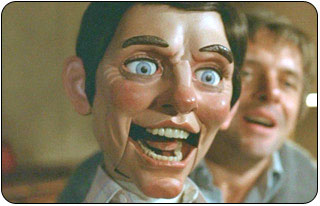
Indeed, the GOP still has many high-profile verbal bomb throwers that will hurt its image — particularly ascending Texas Sen. Ted Cruz, who some say talks like the late Sen. Joe McCarthy, looks like McCarthy, and even resembles the evil puppet in the movie Magic.
Meanwhile, all but the most skillful public relations people would declare the Republican Party’s more inclusive “rebranding” effort a hair away from being embalmed. Democrats are gleefully hammering Republicans for the party’s “recruiting nightmare” for Senate races, and point to the party’s failing effort to woo increasingly influential Hispanic voters. Reuters reports a strong chance that the Republican House will kill immigration reform.
Bachmann built her career on saying no and appealing to hyper-ideologists — thus highlighting the weakness of the House’s Republican leadership. She helped solidify a far-right political style and was instrumental in rallying conservative opposition to ObamaCare. Her retirement means one more member of the Republican Party’s right-wing fringe will pass not-too-quietly into the political night. But many independent and centrist voters will unlikely be impressed if one character has dropped out of political Looney Tunes while the high-visibility series still continues its big-cast-of-characters run.
By: Joe Gandelman, The Week, June 3, 2013
“Here’s To Honesty And Ethics”: Mr. Grand Theft Auto, Arsonist, And Hit And Run Driver Darrell Issa Gets A Brush-Back Pitch
House Oversight Committee Chairman Darrell Issa (R-Calif.), no doubt frustrated his efforts to manufacture White House scandals have faltered, started to lose his composure on CNN yesterday. Perhaps more interesting was the response from a close ally to President Obama.
After lashing out at White House Press Secretary Jay Carney as a “paid liar” — an attack seemingly based on nothing — the California Republican argued without proof that top Obama administration officials were responsible for the IRS controversy. Under scrutiny, however, Issa’s argument quickly crumbled, relying on out-of-context quotes.
It was, however, this reaction from David Plouffe that caught my eye. In President Obama’s inner circle, few are as influential as Plouffe, who ran the Obama campaign in 2008 and served as a White House Senior Adviser to the president up until late January of this year. So when he’s calling the chairman on the House Oversight Committee “Mr. Grand Theft Auto” and a “suspected arsonist/insurance swindler,” it reflects a striking escalation.
Unlike Issa’s rhetorical jabs, Plouffe’s brush-back pitch at least has the benefit of accuracy. As we discussed a few weeks ago, Issa, the man Republicans have tasked with leading investigations into alleged administration misdeeds, really has spent a fair amount of his adult life as a suspected criminal. This Ryan Lizza piece in the New Yorker from a couple of years ago remains relevant.
“Many politicians have committed indiscretions in earlier years: maybe they had an affair or hired an illegal immigrant as a nanny. Issa, it turned out, had, among other things, been indicted for stealing a car, arrested for carrying a concealed weapon, and accused by former associates of burning down a building.”
This is generally one of those truths the political world knows, but chooses not to talk about. It’s not a secret — Issa’s background is the subject of insider jokes and private chatter — but it’s considered impolite to broach the subject publicly.
Which makes Plouffe’s rhetorical shot all the more interesting.
For the record, Lizza’s report on Issa highlighted one run-in with the law after another, including arrests and indictments. There are also many suspected crimes — he’s accused of deliberately burning down a building and threatening a former employee with a gun — which did not lead to formal charges, but which nevertheless cast the congressman in a less-than-flattering light.
The New Yorker report also noted an incident in which Issa was in a car accident with a woman who needed to be hospitalized. He drove away before the police could arrive because, as he told the person he hit, he didn’t have time to wait. Issa didn’t face charges, but he was sued over the matter, and agreed to an out-of-court settlement.
And in case those angles weren’t quite enough, the same article also noted instances in which Issa appears to have lied about his background.
The congressman, for example, claimed to receive the “highest possible” ratings during his Army career, despite the fact that at one point he “received unsatisfactory conduct and efficiency ratings and was transferred to a supply depot.” Issa also claimed to have provided security for President Nixon in 1971, which wasn’t true, and said he won a national Entrepreneur of the Year award, but didn’t.
Perhaps he’s not the kind of guy who should casually throw around words like “liar.”
But the key takeaway here is the fact that Plouffe was willing to go there in the first place, as if to say to Issa, “You want a fight over honesty and ethics? That’s a great idea.” What’s more, also keep in mind that if Democrats seriously pursue this as a line of criticism, Issa and his allies will be cautious in pushing back because they’d prefer not to have this conversation at all — the last thing Republicans want now is a discussion about Issa’s scandalous background and whether he’s the best person available to lead investigations into others’ suspected wrongdoing.
By: Steve Benen, The Maddow Blog, June, 3, 2013
“The Politics Of Free Food”: The Rules On Campaign Contributions In Virginia Are Pretty Much The Same As In Texas
Today, let’s talk about Virginia, host of the nation’s most interesting off-year election. True, the New York mayor’s race has been pretty frisky since we acquired Anthony Weiner as a candidate, but I’m still going with Virginia.
The governor’s race there has a dandy ethics controversy that began with charges that a businessman with a rather dicey background gave Gov. Bob McDonnell $15,000 to pay for the catering at his daughter’s wedding. Actually, this would have been perfectly legal if McDonnell had just disclosed it. Under Virginia’s ethics laws, the governor can accept anything — house, car, private jet, former Soviet republic — as long as he puts it in the proper form.
He also might have been able to get off the hook when the transaction was discovered, just by saying he forgot to mention it. (Virginia’s rules are more flexible than a Slinky.) But McDonnell claimed total innocence, arguing that the $15,000 was a wedding gift to his daughter and, therefore, didn’t count.
“It’s caused a fair amount of pain for me personally,” he said. “I’m a governor, but I’m a dad, and I love my daughter very much.”
What, exactly, do you think that means? That McDonnell feels bad about shoveling the blame onto his offspring? That he could not have afforded to give her all the jumbo shrimp she deserved without financial assistance?
Looks like an investigation for Attorney General Kenneth Cuccinelli! Except — whoops — it turned out that Cuccinelli had also taken gifts from the same businessman, some of which he, too, had failed to report. Like several stays in a vacation home, one of which involved a catered Thanksgiving dinner. Have you noticed a theme here?
McDonnell’s term is up and Cuccinelli is running to replace him. Perhaps unreported freebies will be a big campaign issue. Although in a more perfect world, voters might focus on the attorney general’s two-year investigation of a University of Virginia scientist for the crime of believing in global warming.
But, still, the catered affairs are pretty interesting. When politicians take freebies, it is, alas, generally more compelling than conflicts involving campaign finance. Governor McDonnell had previously taken more than $100,000 in campaign contributions from the same benefactor, the dietary supplement maker Jonnie Williams. But somehow that seemed to pale beside those shrimp.
“There’s a personal relationship attached to gifts and perks,” said Peggy Kerns, the director of the National Conference of State Legislatures Center for Ethics in Government. A former Colorado lawmaker herself, Kerns offered a vision of resentful voters, sitting shivering at the end zone of a Broncos game, while comfy officials enjoyed the buffet in a corporate sponsor’s luxury box.
Campaign contributions do way, way more to corrupt the political process than gifts to politicians. Unfortunately, it’s harder to make the emotional connection to a wayward PAC. This is why so many public officials get into trouble for accepting free home repairs. Everybody wants a kitchen with granite countertops. But few of us yearn to purchase our own negative ad campaign.
Do you remember John Rowland, the governor of Connecticut who got sent to the clink for corruption? A ton of corruption, including an aide who took a bribe in the form of gold coins that he then buried in the backyard. But the thing that stuck in everybody’s mind was the free $3,600 hot tub.
This week, Bernard Kerik, the former New York City police commissioner, celebrated his release from prison after serving three years for eight felony charges, from tax fraud to lying to White House officials. But we will all remember his fall from grace in terms of $250,000 in apartment renovations. (Kerik was welcomed home with a shrimp scampi dinner provided by a star of “The Real Housewives of New Jersey.” It was probably a gift, but we don’t care anymore.)
Virginia believes that as long as officials report what they take, the system will work honorably. But there’s not even a mechanism to assure those reports are accurate. There isn’t a huge record of political corruption, but, as John McGlennon, a professor of government at William and Mary pointed out, “our laws are so loose, it’s hard to run afoul of them.” The home of George Washington and Thomas Jefferson regards itself as someplace special. But the rules on campaign contributions are pretty much the same as in Texas.
“Virginians probably would not want to hear you say that,” said McGlennon.
Some states have already figured out an answer to the gift question, which is to prohibit officials from accepting even a free cup of coffee from lobbyists or people who do business with the government. This appears likely to happen in Virginia several months after hell freezes over. And that’s actually the easier issue. The big problem is campaign contributions, which have become so huge and complicated that it’s hard for despairing voters to get their heads around them.
If we could only figure out a way to require that they all are made in the form of shrimp.
By: Gail Collins, Op-Ed Columnist, The New York Times, May 31, 2013
Share This Blog


 Unknown Feed
- An error has occurred; the feed is probably down. Try again later.