“Little To Show For The Significant Rabbit Hole Expenditure”: Benghazi Investigation Spends Fortune To Harass Hillary Clinton
The Benghazi Select Committee moves slowly but spends quickly, exceeding the budget of the entire House Intelligence Committee.
On June 16th, the Benghazi Select Committee, meeting behind closed doors, questioned Hillary Clinton confidant Sidney Blumenthal for nine hours about emails he sent to the then-Secretary of State containing privately gathered intelligence reports from inside Libya.
The release of new emails from Mr. Blumenthal marked a milestone for the committee, characterized committee chairman, Republican Rep. Trey Gowdy of South Carolina, as “noteworthy,” because no Congressional committee that “has previously looked into Benghazi or Libya has uncovered these memos.”
Yet there was no explanation as to how these emails contained any new insights or information about the September 11, 2012 attack on the U.S. diplomatic compound and CIA base in Benghazi, Libya that resulted in the murders of Ambassador Chris Stevens, Foreign Service Officer Sean Smith, and CIA contractors Tyrone Woods and Glen Doherty.
Mr. Blumenthal himself noted “my testimony has shed no light on the events of Benghazi—nor could it—because I have no firsthand knowledge.”
This has been a consistent theme of the House’s investigation—a frenzy of media fireworks, with little substantive progress made in pursuit of the committee’s actual mandate. (The majority staff of the Benghazi Select Committee did not respond to requests for comment).
Led by a an 18-member Republican staff, whose full time employees are paid an average of $128,750 per year, the Benghazi Select Committee has proceeded at a plodding pace. Thus far, it has held only three hearings and by the end of this week will have interviewed just 29 witnesses. In comparison the Congressional investigation into the Iran Contra scandal lasted 10.5 months, during which time investigators conducted 500 interviews along with 40 days of public hearings.
The lack of progress is especially striking considering seven Congressional committees and a State Department Accountability Review Board already conducted inquires into the attack. Most recently the findings of the Republican led House Intelligence Committee found no evidence for many of the accusations hurled at President Barack Obama, Hillary Clinton and other government officials.
Over 13 months the Benghazi Select Committee has spent more than $3,500,000, exceeding the budget of the entire House Intelligence Committee. This figure does not include significant expenditures made by the State Department and Defense Department to find and declassify material requested by the committee or the expense of witness travel for those who work for the government.
While exact dollar amounts spent by federal agencies are unavailable, details released about other declassification processes shed light on these costs. In March 2014 the Defense Department informed Democratic Rep. Adam Smith, they had spent “millions of dollars” and “thousands of man-hours to responding to numerous and often repetitive Congressional requests regarding Benghazi.” Currently the State Department has 12 full-time staff members paid between $63,700 and $150,000 reviewing Hillary Clinton’s emails “a process that could cost more than $1 million” according to the National Journal. The total cost for these document queries could run well into the eight figures. For example, the IRS spent $14 million responding to Congressional investigations into accusations it politicized the tax-exemption application process.
The Benghazi Select Committee has little to show for the significant expenditure—aside from a trail of unfulfilled promises by its Chairman. “We will have hearings in January, February and March,” Rep. Gowdy (R-SC) announced in December.
That never happened.
The committee held a single hearing in January, focused on berating State Department legislative liaison Joel Rubin about the production of documents. CIA representative Neil Higgins escaped with a mild talking to.
Two days after his December announcement, Rep. Gowdy told Fox News’ Greta Van Susteren the committee would hold a hearing in January to explore why the State Department was in Benghazi. That hearing never occurred.
In February, Rep. Gowdy sent a letter to the committee’s ranking Democratic member Elijah Cummings (D-Md) informing him that “beginning as early as April I intend to start interviewing” a list of twenty prominent members of the Obama administration including Chairman of the Joint Chiefs of Staff Martin Dempsey, former White House Press Secretary Jay Carney, Clinton State Department Chief of Staff Cheryl Mills among others.
According to a Democrat committee staff member, “The committee has yet to interview a single person on Gowdy’s list.”
In April, Gowdy again appeared on Van Susteren’s show claiming, “we’re doing four witness interviews a week, whereas we were doing two.”
A Democratic committee, who requested anonymity, aide told the Observer, “The Select Committee has never done four interviews a week.”
Rep. Gowdy now states the committee will continue its work into 2016 raising its cost to taxpayers to more than $6,000,000, casting his inaction as the result of the Obama administration’s slow pace at producing requested documents, a questionable premise. Rep. Gowdy began receiving documents in August. The committee did not make its first request to the State Department until mid-November, six months after beginning its work. His document request to the Department of Defense was only delivered in early April of this year.
Rep. Gowdy has proceeded in a similar vein while attempting to schedule Hillary Clinton’s appearance before the committee. In early September Stop Hillary PAC, which was “created for one reason only—to ensure Hillary Clinton never becomes President of the United States,” delivered a petition with 264,000 signatures demanding Gowdy call the Secretary of State to testify.
The next day, he asked Rep. Cummings to reach out to Ms. Clinton on his “behalf to determine whether she would testify.” On a November 12 phone call with majority and minority committee staff, Clinton’s team confirmed she would be willing to testify before the committee in December. Rep. Gowdy recently moved the goal posts, asking she appear for a private transcribed interview, as opposed to a public hearing.
Recently, the committee has shifted some of its focus from investigating the actual attack in Benghazi, to reviewing policy decisions made by Hillary Clinton regarding Libya more than nineteen months prior to the attack. Rep. Gowdy, confirmed this to Politico, which reported that “broader problems with the Obama administration’s Libya policy—could prove to be an ugly albatross weighing on the Clinton campaign.”
Rep. Cummings believes these efforts are part of “a fishing expedition for anything they can use against Secretary Clinton in her presidential campaign.” He continued, “After a full year, it now seems obvious that this investigation is being dragged out in order to attack Secretary Clinton and her campaign for president—squandering millions of taxpayer dollars in the process.”
In May of 2014 it was reported that Republicans worried that if they created a Benghazi Select Committee it would fail to produce tangible results. “Investigate and find nothing new, and the committee looks like a bunch of tin-hatted obsessives,” wrote Eli Lake. One House member told Lake, “This could be a rabbit hole.”
It has turned out to be an extremely deep one.
By: Ari Rabin-Havt, Featured Post, The National Memo, June 18, 2015; This piece originally appeared in The New York Observer
“The More Things Change…”: The Charleston Massacre And The Cunning Of White Supremacy
According to Matt Ford at The Atlantic, the Charleston, South Carolina, church where a white gunman murdered nine people was
The oldest black church south of Baltimore, and one of the most storied black congregations in the United States, Emanuel African Methodist Episcopal Church’s history is deeply intertwined with the history of African American life in Charleston. Among the congregation’s founders was Denmark Vesey, a former slave who was executed in 1822 for attempting to organize a massive slave revolt in antebellum South Carolina. White South Carolinians burned the church to the ground in response to the thwarted uprising; along with other black churches, it was shuttered by the city in 1834. The church reorganized in 1865, and soon acquired a new building designed by Robert Vesey, Denmark’s son; the current building was constructed in 1891. It has continued to play a leading role in the struggle for civil rights.
Denmark Vesey is one of the most prominent names in America’s long history of racial terror. And the killer didn’t choose just Vesey’s church but his anniversary. Based on fragmentary evidence, white Charlestonians in 1822 came to believe that Vesey’s revolt “would begin at the stroke of midnight as Sunday, June 16, turned to Monday, June 17.” And they identified Vesey’s church as the center of the conspiracy.
White militia began to arrest both freemen and slaves, 10 that weekend, and many more in the days that followed. Vesey, a freeman, was captured on June 22. It’s not just the executors of the “war on terror” who have used euphemisms to describe torture. A Charleston official referred to the interrogations the captured men were subject to like this: “No means which experience or ingenuity could devise were left unessayed to eviscerate the plot.”
Then, after a quick trial and guilty verdict, Vesey and five others were hung on July 2. More arrests were made, and more executions followed, 35 in total, often in front of immense crowds.
Here’s the historian Ira Berlin, summing up what is known of Vesey’s life:
It is a story well worth the telling. One of millions of young Africans sold into the Atlantic slave marts in the 18th century, the young Telemaque—later transmuted into Denmark—was plucked from a cargo of some 400 slaves by Captain Vesey, who was taken by his ”beauty, alertness and intelligence.” Vesey assigned the lad to his cabin, taught him to read and write, and allowed him to learn a trade—and much else.… The Veseys, both the captain and his slave, eventually alighted in the city of Charleston, mainland North America’s largest slave port. There, Captain Vesey retired to a comfortable respectability, supported in part by the earnings of his slave, who was permitted to hire himself out on his own.… While Denmark Vesey crossed the line from slavery to freedom, he did not…affiliate with Charleston’s growing community of free people of color. These artisans and tradesmen, with light skins that betrayed their mixed racial origins, aspired to the privileges of the master class, whose deportment, speech and values—including slave ownership—they emulated. Rather than being satisfied with a pale imitation of freedom, Vesey became increasingly discontented. In the back alley groggeries and weekly Bible classes, he denounced slavery as criminal usurpation, citing the Scriptures, the Declaration of Independence and even Congressional debates. He sneered at those who accepted bondage and deferred to whites, declaring that they deserved to be slaves. The angry old man awed even those he did not intimidate. Vesey believed slavery would only end with fire, and understood that a successful insurrection rested upon uniting the fragmented black population. While he may have dismissed the assimilationist-minded free people of color, he believed the other elements of the black community could be brought together. To those taken with Christianity, he quoted the Bible. To those mindful of power, he spoke of armies of Haitian soldiers in waiting. To those fearful of the spirit world, he enlisted one Jack Pritchard—universally known as Gullah Jack—a wizened, bewhiskered conjurer whose knowledge of African religious practices made him a welcome figure on the plantations that surrounded Charleston. And while he drew followers from the slave quarter and the artisans’ shops, he also enlisted from the master’s household, recruiting even the personal servant of South Carolina’s governor. Vesey coaxed and cajoled, implored and exhorted, flattered and bullied until his scheme was in place.
Berlin writes that “while slaveholders sent Denmark Vesey to the gallows and committed him to an unmarked grave, they failed to consign him to historical oblivion.… Former slaves preserved his memory, even as former slaveholders denied it. Today it seems clear that Denmark Vesey will not remain buried much longer.”
Maybe others remembered him as well, though it might just be a coincidence that “the clean-shaven white man about 21 years old with sandy blond hair and wearing a gray sweatshirt, bluejeans and Timberland boots” chose the anniversary of Vesey’s preempted revolt to massacre nine members of the congregation Vesey founded.
Or maybe history, along with white supremacy, is just cunning that way.
By: Greg Gandin, The Nation, June 18, 2015
“A History Lesson We Adamantly Refuse To Learn”: Our Racist History Isn’t Back To Haunt Us. It Never Left Us
When, on Wednesday night, a 21-year-old white man named Dylann Roof entered the Charleston church founded by former slave Denmark Vesey on the anniversary of Vesey’s planned 1822 slave rebellion and shot and killed nine people, he provided the United States with the latest installment of a history lesson we adamantly refuse to learn: that our racist past is not past. It is present. It is unending. It is, in many ways that we seem congenitally unable to acknowledge, fundamentally unchanged.
In recent years, especially the years during which Barack Obama has occupied the White House, there have been many valuable meditations on the ways in which American policy structures that were shaped in and informed by the slave-holding and Jim Crow chapters of our nation’s story, continue to define today’s racial power imbalances. There’s been history, analysis, and contemporary commentary: Michelle Alexander’s indispensible The New Jim Crow, about our prison and legal systems; Isabel Wilkerson’s Warmth of Other Suns, about the Great Migration; Tom Sugrue’s books on integration and racism in northern cities and on housing policy in Detroit. At the Atlantic, Ta-Nehisi Coates has produced a body of work—culminating (for now) with his Case for Reparations—showing how we have gotten from “there” to “here,” contemporary America, with its persistently unequal scales of opportunity. Throughout our history, racism has indeed found fresh manifestations: from real estate restrictions and usurious interest rates to physical segregation to job discrimination to stop and frisk and police brutality.
There is usually the sense, however, that at least we’re changing, at least we’re moving in some direction, away from the where we started. Except on days like today, when the reminder is that we have not moved one bit.
In addition to new forms of subjugation and prejudice, we live in a country in which racist violence exists in precisely the same forms it always has—unabated, unreconstructed. We are not distant from the crimes and inhumanities and hatred of the past. We are still acting them out and still refusing to accept them for what they are: this country’s original and defining sin.
What happened on Wednesday night is violence enacted on different individuals than the violence enacted on four little girls who were killed in the bombing of the 16th Street Baptist Church in Birmingham in 1963, but it is a crime with the same shape and contours, a crime that leaves innocent people dead in their place of worship because of their race.
Too often, we look at iconic images of our racist past with a kind of antiqued horror. We recall with horror, if we’re old enough, how police turned dogs on innocent people. If we are younger, we suck in our breath and shake our heads with disbelief as we try to fathom a world inhabited by our parents, our grandparents, in which a city official, Bull Connor, ordered the use of fire hoses on peaceful protesters. But we also know that Bull Connor is long dead, a comfortable relic. We can just barely imagine that this happened to John Lewis. Lewis is now a long-serving congressman; his past is crucial, moving, but remote. That was then, look at him now.
But this—a white policeman shoving a 14-year-old girl’s face to the ground, stepping on her, kneeling on her at a pool party in McKinney, Texas—is also now. It’s this month. This, in Fairfield, Ohio, is not simply an altercation “between police and teens” as the caption says, but between a white police and black teens who scream in terror and anger. It is also this month, also at a community pool. Community pools, a locus for racial conflict. Does that sound distant? Or does it sound contemporary?
It is contemporary.
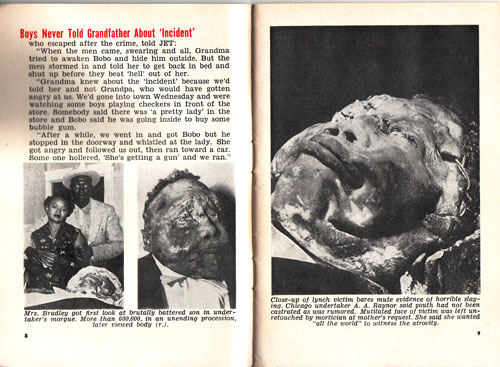
When we think of Emmett Till, the 14-year-old black boy murdered in Mississippi in 1963 after reportedly speaking to a white woman, we recall his open casket. His mother insisted on it, because she wanted the world to see the brutality that had been visited on her son because of the color of his skin. Look at this picture, printed on pages yellowed by all the years that have come between his death and today. Those years have made him famous; we take some cold comfort in the fact that though Till was robbed of the opportunity to love and thrive and work and change the world in life; his death profoundly altered it, kicking off the cycle of social progress that has brought us here, a world away from Money, Mississippi, 1955.
Now look at this image, of Frederick Jermaine Carter, a 26-year-old black man found hanging from a tree in a white suburb in Greenwood, Mississippi. It was taken ten miles south and 55 years after Emmett Till was killed. Carter died in 2010.
Yes, southern (and northern) trees still bear strange fruit. In March of this year, Otis Byrd, a man who had served time for killing a white woman, was found hanging from a tree in Claiborne County, Mississippi. (A special investigation ruled that there was no evidence proving his death a homicide.) Less than a year ago, the body of 17-year-old Lennon Lacey—a young man in a relationship with a white woman—was found hanging from a swing-set in Bladenboro, North Carolina. His death was immediately ruled a suicide, despite a series of inconsistencies and a report from an independent examiner suggesting that given his height and weight, a self-hanging would have been impossible. This death recalled the 2000 hanging of Raynard Johnson from a pecan tree in Kokomo, Mississippi. Johnson, like Lacey, had been dating, and been harassed for dating, a white woman, and his death—on June 16, in advance of a local Juneteenth celebration—was promptly ruled a suicide.
There’s no way to know for sure whether these deaths were lynchings or suicides, but what they are not are echoes of some distant past. They are original sounds. They are simply later chapters in the story of Emmett Till and countless, less well known others. They are a story of violent white resistance to the perceived incursion of blackness on bodies—on women’s bodies and on the nation. These bodies are not just presumed to be white, but presumed to belong to white men, a dynamic made crystal clear by Dylann Roof’s reported locution, during his Wednesday murder spree: “You rape our women and you’re taking over our country. And you have to go.”
We can try to comfort ourselves, as a local news anchor tried earlier this year, by assuring viewers that the cross found burning on the front lawn of a black woman in Elizabethville, Pennsylvania, was “not like those huge crosses from the old days.”
But these are the old days. In February, a Tennessee man and member of a church affiliated with the Ku Klux Klan was fined and sentenced to jail for burning a cross in the yard of a black man in Minor Hill, Tennessee. In 2014 in White River Township, Indiana, a black man was awakened in the middle of the night to find a three-foot cross burning on his front lawn. This is today.
This is Eric Garner, being killed by cops. This is Walter Scott, being shot in the back and killed by a police man. This is Freddie Gray, howling with pain after having had his body broken by police, a week before his death. This is Tamir Rice. He was 12 when he was shot to death, in November of last year, by police.
As Jelani Cobb wrote on Wednesday, recent incidents can “seem like gruesome boomerangs of history until we consider the more terrible idea that they are simple reflections of the present.”
It’s not just a terrible idea, it is a terrible reality. The cold reality of our country right now. We are not post-civil rights. We are not post race. We are not better than we were. We do not inhabit a world in which stray instances of violence might recall a distant and shameful history. This shame is a flood that has never abated.
By: Rebecca Traister, The New Republic, June 18, 2015
“Making Congress More Stupider”: Making Congress Dumber Has Not, In Fact, Made Government Smaller
You may recall Paul Glatris and Haley Sweetland Edwards’ cover article, “The Big Lobotomy,” from the June/July/August 2014 issue of the Washington Monthly. It documented how congressional Republicans had worked for decades to reduce Congress’ capacity for intelligent decision-making–while making it vastly more dependent on lobbyists and special interests–via reductions in appropriations for staff and committees and research initiatives.
The article clearly made an impression on Harry Stein and Ethan Gurwitz of the Center for American Progress, who cited it in reporting the latest self-lobotimizing effort in Congress in the FY 2016 appropriations process:
As Congress writes spending bills that attempt to implement the first year of its budget resolution, it is clear that the legislative branch intends to continue operating with one hand tied behind its back.
On June 12, 2015, the Senate Appropriations Committee advanced the fiscal year 2016 legislative branch appropriations bill, which would cut funding for the legislative branch by 17 percent from inflation-adjusted FY 2010 levels. The House of Representatives has already passed its version of the FY 2016 legislative branch appropriations bill, which makes roughly the same overall funding cuts as the Senate bill. These cuts may seem like a good way to score cheap political points at a time when Congress is deeply unpopular, but in the long run, they only increase congressional dysfunction and make the federal government less efficient and responsive to the American people.
The fact remains that the legislative branch includes much more than just members of Congress. When members vote to slash legislative spending, they undermine the professional staff and independent agencies that make it possible for Congress to oversee federal programs and understand complex policy questions. As funding and staffing levels for these legislative branch institutions have declined, Congress has become increasingly dependent on privately funded lobbyists and outside policy experts.
As the CAP article notes, the cuts include those unique legislative branch entities the Congressional Budget Office and the Government Accountability Office–both essential for understanding and reforming government spending.
The House’s FY 2016 legislative branch appropriations bill cuts the GAO budget by 15.4 percent from its FY 2010 inflation-adjusted level, while the Senate bill cuts GAO funding by 14.9 percent. If every $1 cut from the GAO equates to $15.20 of unexposed waste, fraud, and abuse, cuts of this magnitude could result in about $1.4 billion in missed opportunities for government savings, or between $7 billion and $8 billion based on the larger return-on-investment ratio of 80 to 1.
Even for conservatives who want a smaller federal government, Glastris and Edwards note that “making Congress dumber has not, in fact, made government smaller.” It just makes government less effective.
If you don’t really believe in any legitimate mission for the federal government beyond national defense, of course, this this is a distinction without a difference. But the rest of us are saddled with big, dumb government.
By: Ed Kilgore, Contributing Writer, Political Animal Blog, The Washington Monthly, June 16, 2015
“In A Terrible Predicament”: A Victory For Obamacare’s Challengers Will Be A Disaster For Republican Candidates
Once the conservative legal strategy that gave rise to King v. Burwell got off the ground, Republicans in Congress probably had no choice but to become cheerleaders for, or active participants in, the ensuing litigation.
The imminence of the decision in the Obamacare challenge, expected from the Supreme Court sometime this month, is exposing the terrible predicament the entire strategy created for the party.
The problems Republicans will encounter if they win King—eliminating billions of dollars worth of insurance subsidies—are fairly clear and have been detailed at length. But it is also quite conceivable that the whole effort will boomerang on the GOP even if the government wins in King, and the federal subsidies survive for those states using federally facilitated exchanges. A number of persuasive legal arguments point to a victory for the government. But one of the most likely paths begins with the Court concluding that the Affordable Care Act statute is ambiguous—that both parties’ readings of the law are plausible—and that deference should go to the government.
As Chief Justice John Roberts suggested with his one and only question at oral arguments, this would leave the door ajar for a future presidential administration to reinterpret the statute, and discontinue the subsidies.
It’s difficult to fathom that any Republican president would turn off the subsidies quite as abruptly as the challengers want the Court to do. But if the government wins in this way—on what’s known as the second step of the Chevron deference standard—it will create a new conservative litmus test for Republican presidential candidates. If elected, will you shut down the subsidies? I suspect most of the candidates will yield to pressure from the right and promise to do precisely that. Most immediately, this promise becomes a general election liability for the Republican primary winner. If that person becomes president, it will turn into an administrative and political nightmare, forcing states and the U.S. Congress to grapple with a completely elective policy fiasco.
King, as Josh Marshall noted recently, “is a wholly-owned subsidiary of the Republican Party.”
That the case was conceived by conservatives and endorsed by Republicans has created an extensive paper trail tying the GOP to the consequences of a decision for the challengers. It has also forced Republicans to playact as if they can and will fix the problems that flow from an adverse King ruling. Initially the idea was to foam the runway for conservative justices eager to void the subsidies; it has become an accession to the reality that the public will hold Republicans to account for the ensuing chaos.
Among the pitfalls of the extended charade is that Republican presidential candidates will reject and condemn proposals to clean up a King mess if they even resemble constructive solutions.
“Things can’t be turned on a dime,” Senate Majority Whip John Cornyn told Politico. “People can run for president, but we’ve actually got to solve a problem.” Cornyn may have been thinking of his fellow Texan Ted Cruz, who wants to use King as a pretext to repeal all of Obamacare. But his discomfort with Cruz’ absolutism carries a whiff of inconsistency: Cornyn signed on to Republican briefs, first urging the justices to hear King and then asking them to void the subsidies. In January he eagerly anticipated that the Court would “render a body blow to Obamacare from which I don’t think it will ever recover.”
The promise of the King challenge has apparently faded since then. Republicans in Congress are quite likely incapable of solving the problem Cornyn was talking about in a way that pleases conservatives, and will be little better equipped if a Republican president discontinues the subsidies on his own. Six months ago, Republicans claimed excitedly that the path to repealing Obamacare outright ran through a victory in King. Now it seems that the best political outcome for Republicans would be to lose the case as conclusively and embarrassingly as possible.
By: Brian Beutler, Senior Editor, The New Republic, June 17, 2015
Share This Blog


 Unknown Feed
- An error has occurred; the feed is probably down. Try again later.
 mykeystrokes.com