“McConnell Decries ‘Obstructionism’, Irony Dies”: How Perspectives Can Change When One Moves From The Minority To The Majority
On literally the first day of the new Congress, Politico asked Don Stewart, Senate Majority Leader Mitch McConnell’s (R-Ky.) spokesperson, what McConnell sees as his biggest challenge. “Democrat obstruction,” Stewart replied.
Putting aside the fact that he probably meant “Democratic obstruction,” the response was striking in its irony. McConnell, arguably more than any senator in the nation’s history, mastered the art of obstructionism, taking it to levels with no precedent in the American experiment. For his office to suddenly decry McConnell’s own practices was a reminder of just how much perspectives can change when one moves from the minority to the majority.
A month later, the posturing is almost amusing.
Senate Majority Leader Mitch McConnell (R-Ky.) accused Democrats Wednesday of knee-jerk obstructionist tactics, flipping a script that Democrats used many times in recent years.
McConnell criticized Democrats for filibustering a motion to debate a House-passed bill funding the Department of Homeland Security that contained language blocking President Obama’s executive actions on immigration.
“And now Americans are wondering: What could possibly lead Democrats to filibuster Homeland Security funding?” he said on the Senate floor.
I suspect Americans aren’t really wondering that at all – the question is actually pretty easy to answer, as the Majority Leader probably realizes – but it’s the broader context that’s truly amazing.
If we were to create some kind of electronic mechanism to measure hypocrisy on a dial, and we had the machine analyze Team McConnell’s whining, the box would have very likely caught on fire yesterday.
To be sure, when it comes to filibuster hypocrisy, there’s plenty of bipartisan chiding to go around. When a party is in the majority, its members discover the remarkable value of majority rule, a sacrosanct principle that senators ignore at the nation’s peril. When that same party is in the minority, its members magically conclude that tyranny of the majority is a scourge that must be tempered with overuse of “cooling saucer” metaphors.
It’s therefore quite easy to dig up quotes from Democrats and Republicans contradicting themselves quite brazenly as they transition between minority, majority, and back.
But McConnell is nevertheless a special case. In recent years, specifically after President Obama took office, the Kentucky Republican turned obstructionism into an art form. He abused institutional norms and rules in ways his predecessors never even considered, filibustering everything he could, as often as he could. McConnell operated with a simple principle: If a bill can be blocked, it must be blocked.
Following his lead, Senate Republicans not only spent six years refusing to compromise or accept any concessions on any issue, it also imposed filibusters on every key piece of legislation to reach the floor. Before the so-called “nuclear option,” the GOP minority even routinely filibustered nominees they actually supported.
It was all part of a deliberate (and occasionally successful) strategy in which McConnell would obstruct everything he could, making Democratic governance as impossible as he could make it, without regard for the consequences.
Some reflexive complaining from McConnell and his allies is to be expected – their own medicine apparently has a bitter taste – but self-awareness is an under-appreciated quality. If the Majority Leader wants to be taken at all seriously, he can either avoid complaints about “obstructionism” or he can hope for mass amnesia to sweep the political world.
I’d recommend the former over the latter.
By: Steve Benen, The Madow Blog, February 6, 2015
“The Product Of A Fringe Movement”: The Crazy Is A Resume Item For Rand Paul
At the Prospect today, Paul Waldman manages to remind us of two important things to keep in mind in contemplating the Rand Paul presidential campaign: first, some of the crazy things he’s said in the not-too-distant past (example: ruminations on the North American Superhighway Conspiracy in 2008), and second, why that matters more in his case than in others. The crazy stuff will drib and drab into public view for the next few months, and some people will notice and others won’t. So it’s the second issue most interests me, because it explains why we should notice:
[M]ost politicians who get to where Paul is work their way up by climbing the political ladder: they run for city council in their town, then maybe mayor, then they become a state rep, then a state senator or congressman, and finally run for the Senate. That experience makes you a creature of the place where you come from and party that nurtured you. Along the way your views will come to reflect their concerns and their consensus about policy.
But that’s not the path Rand Paul followed. Whatever his talents, he’s a United States senator because he’s Ron Paul’s son. Over his time in Congress, Ron Paul developed a small but fervent national constituency, made up of some ordinary libertarians and a whole lot of outright wackos. That constituency was greatly expanded by his 2008 presidential campaign. Despite the fact that Paul had plenty of interesting and reasonable things to say, it’s also the case that if you were building a bunker to prepare for the coming world financial crash and ensuring societal breakdown (and possible zombie apocalypse), there was only one presidential candidate for you. When Rand Paul decided to run for Senate in 2010, having never run for anything before, the Ron Paul Army mobilized for him, showering him with money and volunteers. He also had the good fortune to be running in a year when Republicans everywhere were looking for outsider, tea party candidates, so he easily beat the choice of the Kentucky GOP establishment in the primary.
In other words, Senator Rand Paul is the product of a fringe movement that has embraced all sorts of nuttiness from the theocratic urges of the Constitution Party to Agenda 21 to the North American Superhighway, in addition to its better-known eccentric obsessions with crank monetary policy. That’s his resume. You have to examine it the same way you examine what other candidates did just before becoming national political celebrities. Otherwise you buy into the idea that he sprang fully developed from the brow of his father before running for president himself.
By: Ed Kilgore, Contributing Writer, Political Animal, The Washington Monthly, February 6, 2015
“How To Handle The Vaccine Skeptics”: Parents Should Face A Higher Burden Before Removing Their Children From The Immunized herd
The alarming number of measles cases — a record 644 last year, and 102 last month, the most since the disease was declared eliminated in the United States in 2000 — has focused scrutiny on parents who refuse vaccinations for their children. There are some who want state and local governments to sue, or even criminally charge, such parents. A bill in California would end all nonmedical exemptions to immunization requirements.
For epidemiologists like me, eliminating exemptions may seem satisfying, but it is not the wisest policy for protecting kids. Instead, we should borrow a concept from behavioral economics, and use administrative rules and procedures to “nudge” parents to immunize their kids, rather than trying to castigate or penalize these parents.
Currently, all states allow medical exemptions, since some children — for example, those getting chemotherapy or who have certain types of immune disorders — cannot safely receive vaccines. All but two states (Mississippi and West Virginia) allow exemptions for religious reasons. Nineteen states allow exemptions based on personal (or “philosophical”) beliefs. Such beliefs are increasingly cited by parents whose misplaced skepticism is not really principled but premised, rather, on false notions like that of a link between autism and the measles vaccine.
So shouldn’t all states follow the example of Mississippi and West Virginia, and ban all nonmedical exemptions? The courts have generally upheld such bans, but the political backlash is great, as history shows. After the smallpox vaccine was made compulsory in England and Wales in 1853, there were years of protests, until a commission exempted those with conscientious objections.
Partly because of intemperate comments by politicians, some Americans continue to view vaccines as an intrusion on their personal liberty rather than as a matter of public health. Between 2009 and 2012, 31 bills aimed at making it easier to obtain exemptions were introduced in various states (including 11 in Mississippi and West Virginia). Vaccination advocates who want to make exemptions harder to obtain will have an uphill fight.
But even states like Arizona and Colorado that allow fairly broad exemptions can tweak their rules to make sure parents are as informed as possible — and to make the exemption process difficult.
They can require parents to write a letter elaborating on the reason their child should be exempt. They can require that the letter be notarized. They can insist that parents read and sign a form that discusses the risks of nonvaccination. Better yet, they should mandate in-person counseling so that the decision not to vaccinate is truly informed.
States can also require that parents obtain an exemption form by specifically requesting one from the state or local health department, rather than downloading it online. They can insist that these parents acknowledge that they will be responsible for keeping the children away from school during outbreaks. Moreover, they should have procedures to review each request for exemption rather than automatically approving them, as many states do now. And they should require parents with exemptions to apply annually for renewal.
States with easy procedures for obtaining exemptions have higher rates of nonmedical exemptions — and, more important, higher rates of vaccine-preventable diseases. In a 2006 study published in The Journal of the American Medical Association, for example, we documented that states with easy procedures for granting nonmedical exemptions had approximately 50 percent higher rates of whooping cough.
In a 2012 study, which my colleagues and I published in The New England Journal of Medicine, nonmedical exemption rates were 2.3 times higher in states with easy administrative policies for granting exemptions (like Connecticut, Missouri and Wisconsin) than in states with difficult policies (like Florida, Minnesota and Texas). Moreover, the annual rate of increase in nonmedical exemptions was about 60 percent higher in states with easy exemption policies compared with states with difficult policies.
These practices will cost taxpayers money. But they will be more effective, in the long run, than condemning vaccine skeptics as ignorant and irresponsible. The goal should be to make the number of parents who decide to seek exemptions — and follow through with it — as small as possible. Given the high costs of controlling disease outbreaks, including the current rise in measles, it might be reasonable to tax parents who seek exemptions to recover some of the cost.
All democratic societies must try to balance the rights and views of a variety of constituencies. Parents of children who are too ill for vaccination should of course be granted an exemption. Everyone else — no matter their belief — should face a high burden before being allowed to remove their children from the immunized herd.
By: Saad B. Omer, Associate Professor of Global Health, Epidemiology and Pediatrics at Emory University; Op-Ed Contributor, The New York Times, February 6, 2015
“I Am A Scientist, Man, But A Conservative One”: Vaccine Skepticism Isn’t A Conservative Problem, But It’s A Problem For Conservatives
Because New Jersey Governor Chris Christie recently quarantined a nurse in a large tent when he thought she might have had Ebola, you might have assumed that he of all people would seize upon a measles outbreak—attributable to a movement of anti-vaccine reactionaries—to lecture parents for putting children at risk. But when pressed to take a position on the view that parents should vaccinate their children, Christie hedged. “It’s more important what you think as a parent than what you think as a public official,” he said. “I also understand that parents need to have some measure of choice in things as well. So that’s the balance that the government has to decide.”
It’s tempting to attribute his sudden fondness for “balance” to lessons he over-learned during the Ebola panic he helped nurture. But it’s also mistaken.
Vaccine skeptics don’t mirror climate change deniers, who are overwhelmingly conservative and amplified by vast wealth. But the anti-vaxx movement nevertheless presents a greater political problem for Republicans than Democrats, who, like President Obama, are unafraid to make explicit declarations about the importance of vaccinating children. By and large, Republican politicians don’t tout their own ignorance of vaccine science or use it to shield themselves from substantive questions about immunology, public health, or child rearing. Vaccine skepticism and climate change denial are, again, more different as reactionary movements than they are alike.
But two facts about vaccine skeptics and the risks they pose make it difficult for Chris Christie and perhaps other Republicans to treat anti-vaxxers as brusquely as he’s happy to treat unionized teachers in Newark.
It’s not that Republicans must pretend to believe that vaccines cause autism. But a large, motivated population of vaccine skeptics begs for interventions Republicans can’t easily get behind. The two most straightforward ways to increase vaccination rates or otherwise reduce the risk of losing herd immunity are: Imposing government mandates and stigmatizing the white, affluent people who comprise the core of the anti-vaxx movement.
Hectoring white people and imposing mandates on their families doesn’t fit comfortably in the GOP wheelhouse these days, and Christie’s awkward walkback underscores the bind that places on conservatives exquisitely.
Christie’s office: “The governor believes vaccines are an important public health protection and with a disease like measles there is no question kids should be vaccinated. At the same time different states require different degrees of vaccination, which is why he was calling for balance in which ones government should mandate.”
Shorter Christie: I am a scientist, man. But a conservative one.
Conservatives and liberals are both overwhelmingly of the view that childhood vaccines carry important benefits; conservatives, however, are inherently skeptical of government interventions of any kind. Thus, Republican politicians who lean too heavily on the state action, even in the realm of something as essential to the common good as immunization, will run into problems.
A 2014 study by Dan Kahan for Yale Law School’s Cultural Cognition Project found that people with left-leaning political outlooks are likelier to support restricting non-medical exemptions for childhood vaccine requirements, likely reflecting “an ideological predisposition against government regulation independent of any ideological sensibility specific to childhood vaccination.”
This tendency might not hold if anti-vaxxers existed on the fringes of political life, or were overwhelmingly of foreign origin, or were monolithically liberal. Opposition to government intervention can be both reflexive and selective. But the available evidence suggests vaccine skeptics tend to be white, educated, affluent, and, per Kahan’s study, politically diverse.
It’s not that Republicans are in thrall to vaccine skeptics, but it can be difficult for them to confront vaccine skeptics in ways that don’t alarm conservatives for other reasons. And taken to an extreme, it becomes hard to tell the difference between the two.
By: Brian Beutler, The New Republic, February 2, 2014
“Keeping Desperation As High As Possible”: Why The Greedy Upper Class Loves The GOP
Last week, Reihan Salam took a whack at America’s upper class in Slate. His charge? That the upper class uses its considerable political clout to protect itself from competition and keep its own incomes high, thus making life harder on everyone else further down the economic ladder. And he’s not wrong!
But Salam is also a conservative, with a conservative’s standard desire for low taxes, few regulations, and a skimpy social safety net. And what he conveniently leaves out of his screed is the fact that these preferences are themselves the ultimate expression of upper-class greed and self-dealing.
Let’s start with what Salam gets right. He points out that licensing and accreditation laws protect professions like dentists, lawyers, electricians, hairstylists, and the like from competition, which raises the costs of services they provide and prevents other workers from breaking into the market. The local land-use restrictions and zoning regulations that many in the upper class favor drive up housing prices, which makes it harder for the lower class to live in good neighborhoods with good schools, or to benefit from the economic development that comes with gentrification. The upper class seems implicitly content with an immigration status quo that maximizes competition in working-class jobs while minimizing it among high-skill professions. And of course there was the recent collapse of President Obama’s proposal to raise new tax revenue from 529 college savings accounts, a self-interested revolt of the upper class if ever there was one.
However, if you read between the lines, Salam isn’t really talking about the upper class writ large here. He’s talking about the liberal upper class. The issues he cites are mainly a big deal in cities, where liberals cluster. And conservative commentary in general these days has a tendency to talk about the American upper class as if it’s populated entirely by liberal yuppies who love yoga, organic food, Neil deGrasse Tyson, and abortions, and who think that guns are barbaric and that religion is backwards.
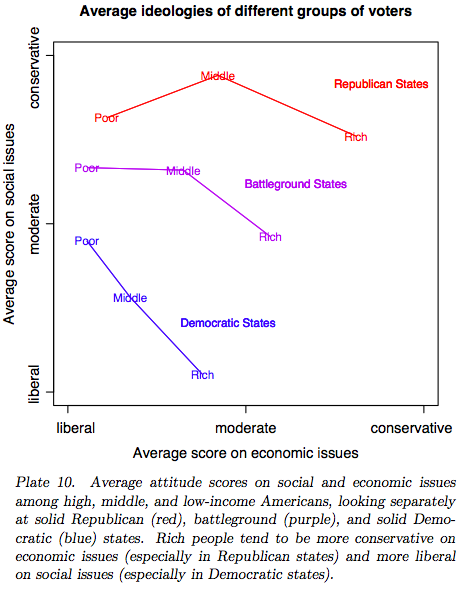
As it happens, however, the GOP relies on the upper class even more than Democrats. Median household income in the United States is $52,250, and if you look at the 2012 election, voters below that mark broke hard for Obama, with those above going for Mitt Romney by lesser margins. This trend of the Democrats getting way more votes below the median income level has roughly held for decades. These days, strong support for Republicans really doesn’t kick in until you get close to $75,000, or roughly the top third of the income ladder.
The difference between the parties is not that one relies on the wealthy and one doesn’t. Both parties lean heavily on those voters and divvy them up in various ways. (Mainly through cultural and social issues.) But the Democrats’ coalition also includes a fair portion that’s lower and working class, that’s still fighting for attention in the party, and that occasionally gets it. Conversely, lower- and working-class voters are mostly just absent from the GOP.
This matters because the upper class also has a pretty distinctive set of economic policy preferences. According to a recent study by Pew, the most financially secure Americans — roughly a fourth to a third of the population, by Pew’s definition — disproportionately say that government can’t afford to do more to help the needy, and that poor people “have it easy” thanks to government benefits. The less financially secure think the opposite. Large majorities of those making below $75,000 say the thing that bothers them the most about taxes is that the wealthy don’t pay their fair share. Large majorities of Americans oppose cuts to everything from Social Security and Medicare to aid for the poor. They support making union organizing easier and more federal spending on education.
Hell, 57 percent of the Republican or Republican-leaning voters who do make less than $30,000 think government doesn’t do enough to support poor people.
The reason the GOP can get away with being on the opposite side on all these matters is the fact that the voting population skews upper class: Even Democrats in the top third of the income distribution are noticeably more economically right-wing than poorer Democrats or Republicans, and Republicans in the top third are really economically right-wing.
There’s a pretty straightforward argument for why the upper class tilts in this direction. As Salam notes, the policy preferences of the upper class that really stick in his craw boil down to protecting their incomes and thus making the goods and services they provide more expensive for everyone else. But the flip side of that is making sure the goods and services everyone else provides — and thus their incomes — come cheap. That’s where the GOP comes in.
The essence of worker bargaining power is the ability to tell an employer “no.” That forces business owners to offer a better deal, driving up wages and benefits. A broad and generous welfare state gives workers leverage in that regard. It also helps boost aggregate demand, getting us closer to the full employment that really gives workers an edge. In short, the income of the working class is inversely proportional to its level of economic desperation. The effect of conservatives’ preferred economic policies — from slashing spending to imposing work requirements for aid — is to keep that desperation as high as possible. And of course, the upper class certainly doesn’t want to shoulder the taxes necessary to make such a system work.
The thing to remember is that, when it comes to what to do with the working class, the interests of the upper class and the super-rich cohere. Whether you’re a corporate CEO, a small-business owner, or just a well-heeled professional who consumes a lot of high-end goods and services, it benefits you to keep the labor of everyday Americans as cheap, compliant, and disposable as possible. It’s true, as Salam notes, that the truly rich aren’t quite as desperate to defend their interests as the upper class is; if you’ve got Mitt Romney’s dough, you can put up with more taxes, regulations, and workers demanding dignified pay and good benefits.
But that just bolsters the point that the fervent bastion of the economic right is the upper class. They’ve got the most to gain by slashing taxes, cutting regulations, scrapping government aid programs, and busting unions.
As Salam acknowledges, he doesn’t want high taxes on the wealthy, or for America to go down the road of the big European welfare states. His fellow reform conservatives and the Republican Party agree with him in this regard. Salam then says of the upper class: “I sensed that their gut political instincts were all about protecting what they had and scratching out the eyeballs of anyone who dared to suggest taking it away from them.”
But aren’t conservative economic policies the perfect expression of that exact impulse?
By: Jeff Spross, The Week, February 3, 2015
Share This Blog


 Unknown Feed
- An error has occurred; the feed is probably down. Try again later.
 mykeystrokes.com