“The GOP’s 20-Year War On Health Care”: Republicans Are Going To Extraordinary Lengths To See That More Americans Die
Stop the presses: John Boehner admitted Thursday that the Republican Party’s long-awaited alternative to Obamacare needs a little more time in the oven. “You know, the discussions about Obamacare and what the replacement bill would look like continue. We’re trying to build consensus around one plan,” the Speaker told Hill reporters. “Not there yet.”
As if you even needed me to tell you, rest assured: It could be six months from now, a year from now, five years from now, or the day Bibi Netanyahu and Khaled Mashal share a Nobel Peace Prize—they aren’t going to have a plan. Oh, they might have a “plan.” They had a “plan” last year, or at least Oklahoma Sen. Tom Coburn and two others did. For about two days, they were really tooting its horn. Then it dawned on people that paying for it would involve a hefty middle-class tax increase, on higher-end insurance plans. You may have noticed since then that the Coburn “plan” has not exactly become a leading Republican talking point.
As conservatives continue to hail the Halbig decision, some historical context is called for. In my last column, I wrote that conservatives and Republicans are going to extraordinary lengths to see that more Americans die. Not every reader was won over by that opinion, as you might imagine. But I think it’s beyond dispute, as a little discussion of political history should show.
The problem of millions of uninsured has existed in this country since—well, since forever. But as a running news story that the media paid attention to, for the last 25 or 30 years. I remember when the then-horrifying number was 15 million uninsured. Then 20 million, then 30 million, on up to the 46 million figure we often saw bandied about before the Affordable Health Care was enacted (10 million new Americans are insured as a result of it—a very respectable dent, for just one year). So, 30 years, a full generation, tens of millions of people adversely affected. And what, in all that time, has the Grand Old Party proposed to do about it all?
Not. One. Thing. Republican presidents had (if we go back to 1984) 16 years to pass some kind of health-insurance law. But none of the three ever even proposed one. George W. Bush did pass his Medicare law, but that was about adding prescription-drug coverage for seniors; it didn’t insure any previously uninsured citizens. What the GOP did instead, of course, was to fight tooth-and-nail to stop the two Democratic attempts to insure more people, succeeding the first time, failing the second.
And “tooth-and-nail” hardly begins to describe the demented and nearly sociopathic reality of Republican and conservative opposition to trying to make health insurance affordable for working-class people. Opposition to doing so has been one of the four grand accomplishments of the Republican Party of our time, which I would rank as follows, one scratched on each side of the obelisk: one, start disastrous wars and commit torture; two, make people despise the government; three, nearly cause a new Depression; and four, deny health insurance to as many people as possible, as aggressively and nastily as possible. It’s a grim record generally, and with regard to health care specifically, inarguably one that has promoted insalubriousness and suffering and, indeed, deaths that might have been avoided or delayed if people had had insurance.
It is true that some conservative intellectuals have offered up some ideas—as we know, the same individual mandate that the right now calumniates was a conservative idea at first. And John McCain actually had a decent-ish health-care platform plank in 2008. But if McCain had been elected, it’s very unlikely that the constellation of interests and power centers in the GOP would have permitted him ever even thinking about pursuing it. It was just something he felt he had to say to have credibility with middle-of-the-road voters. And in any case he wasn’t elected, and those conservative intellectuals’ ideas were never seriously proposed by elected Republicans, so the historical record is what it is.
The 20-year war on health care—since their 1993 defeat of the Clinton plan—has been about Republicans’ hatred of government; their view of people who don’t have insurance as lazy or flawed and not worth lifting a finger for; and their fear that if a law is passed and succeeds in bringing health care to millions, they and their whole vision of society will be discredited in the eyes of millions. Of course, these days, all that is shot through with one more element: a heavy dose of Obama hatred.
I was on Hardball Wednesday evening with David Corn, and Chris Matthews showed poll numbers during our segment that surprised even me. The topic was “rooting for failure.” Back in 2006, he said, Democrats were asked in a Fox News poll whether they wanted President Bush’s policies to succeed or fail. Answers: 40 succeed, 51 fail. Not particularly generous. But earlier this year, he said, CNN asked Republicans the same question about President Obama. Answers: 14 succeed, 73 fail.
Think about that. Three-quarters of regular Republicans want Obama to fail. And just one in seven wants him to succeed. We pundits spend most of our time blaming politicians for inaction, but maybe it’s time to start blaming the people. If regular Republicans feel like this, there’s no way the elected officials who represent them are going to do anything that looks remotely like compromise or cooperation.
And no, they’re not going to offer a real health-care plan either. They first promised that in 2010, during the campaign season, so they could say “repeal and replace” instead of just “repeal” and sound like they had a positive side. Then they dropped “and replace,” and now that it’s election time again, it’s back. But it’s not in their DNA to do anything constructive about health care. Or—the VA crisis, the border crisis, the Middle East crisis, the wage-and-inequality crisis, et cetera—about much of anything.
By: Michael Tomasky, The Daily Beast, July 25, 2014
“A Collective GOP Orgasm”: Today’s Conservative Obamacare Baloney Debunked
If you were perusing the conservative twitter-sphere this morning, you would have witnessed a kind of collective orgasm, as it was discovered that back in 2012, MIT economist Jonathan Gruber gave a talk to a small group in which he seemed to support the analysis of the two judges on the D.C. Circuit who ruled this week in Halbig v. Burwell that the subsidies for buying health insurance under the Affordable Care Act should go only to people who live in states that set up their own insurance exchanges. Since Gruber advised Mitt Romney on the creation of Massachusetts’ health reform (which became the model for the ACA) and then advised the White House and Congress during the preparation of the ACA reform, conservatives are now convinced they have their smoking gun: The law, they contend, was always designed to deprive millions of Americans of subsidies, and was in fact never meant to achieve that “universal coverage” that everyone involved said was its goal.
Up to the point where the Supreme Court rules on Halbig, those conservatives will be citing Gruber’s 2012 comments. A lot. But the idea that something Gruber said in response to a question in front of what looks to be around 20 people is more relevant than literally everything else that happened during the drafting and debate over this law’s passage is, to put it plainly, insane.
Let me provide a partial list of people who spent over a year between the beginning of the debate over health-care reform and the passage of the law talking about the ACA, but never mentioned what was supposedly the intent of Congress that people in states using the federal exchange would be deprived of subsidies:
- Barack Obama
- Kathleen Sebelius
- Harry Reid
- Every other Democratic senator
- Nancy Pelosi
- Every other Democratic House member
- Every health-care analyst in America
- Every health-care reporter in America
- Every Republican in the Senate
- Every Republican in the House
- Every conservative opponent of the law
Ezra Klein, who wrote as much about health-care reform during this period as anyone, tweeted this morning that he interviewed Gruber dozens of times, and not only did Gruber never mention this issue, “[t]he same is true for literally everyone else I interviewed. I never heard a single person say subsidies don’t work in federal exchanges.”
As for Gruber himself, this morning he spoke to Jonathan Cohn, and here’s what he told him:
I honestly don’t remember why I said that. I was speaking off-the-cuff. It was just a mistake. People make mistakes. Congress made a mistake drafting the law and I made a mistake talking about it.
During this era, at this time, the federal government was trying to encourage as many states as possible to set up their exchanges. …
At this time, there was also substantial uncertainty about whether the federal backstop would be ready on time for 2014. I might have been thinking that if the federal backstop wasn’t ready by 2014, and states hadn’t set up their own exchange, there was a risk that citizens couldn’t get the tax credits right away. …
But there was never any intention to literally withhold money, to withhold tax credits, from the states that didn’t take that step. That’s clear in the intent of the law and if you talk to anybody who worked on the law. My subsequent statement was just a speak-o—you know, like a typo.
There are few people who worked as closely with Obama administration and Congress as I did, and at no point was it ever even implied that there’d be differential tax credits based on whether the states set up their own exchange. And that was the basis of all the modeling I did, and that was the basis of any sensible analysis of this law that’s been done by any expert, left and right.
I didn’t assume every state would set up its own exchanges but I assumed that subsidies would be available in every state. It was never contemplated by anybody who modeled or worked on this law that availability of subsidies would be conditional of who ran the exchanges.
Cohn, too, says he never spoke to anyone who mentioned this before the Halbig lawsuit. If this was actually what Congress thought the law would do, then liberals would have been freaking out about this provision for years, because it would mean that millions of people wouldn’t be able to get coverage. And conservatives would have been crowing about it for years, for the same reason. But nobody on either side was, because it was never part of Congress’s intent. It was a mistake, and one contradicted by multiple other provisions in the law.
I have no doubt that when the Halbig case is re-argued before the full D.C. Circuit, either the plaintiffs’ attorneys or one of the conservative judges will bring up Gruber’s 2012 comments. Let’s just hope it gets shot down like the baloney it is.
By: Paul Waldman, Contributing Editor, The American Prospect, July 25, 2014
“Soft Bigotry Of Low Expectations”: The Right’s Pathetically Low Curve; How It Got A Pass On Race And Poverty
Rep. Paul Ryan, budget-slasher, releases a paternalistic poverty plan that has one good idea. Sen. Rand Paul, Civil Rights Act skeptic, speaks to the African-American National Urban League. The Koch brothers, backers of voter suppression efforts and union busting, give $25 million to the United Negro College Fund.
And each winds up hailed, even by some liberals, as taking a big step for the Republican Party when it comes to questions of race and poverty. Why do people settle for so little when it comes to the right trying to signal a change in its damaging approach to both?
Ryan’s one good idea is expanding the earned income tax credit, originally a Republican policy that Republicans turned against because Democrats embraced it too. The EITC is one big reason for the “47 percent” of people who pay no taxes that Ryan’s running mate railed against. Now Ryan says he wants to expand it, and some other programs – which doesn’t square with his infamous budget proposals of recent years.
So MSNBC’s Chuck Todd politely asked Ryan to reconcile his poverty plan with his budget plan – which cuts $5 trillion over 10 years, and takes 69 percent of the cuts from low- and moderate-income families – and he couldn’t do it.
“Does this mean you would change your budget proposal to reflect your new poverty plan?” Todd asked.
“No,” Ryan answered. “I didn’t want to get into a debate over the funding levels of the status quo. I want to talk about how to reform the status quo.”
Todd tried again. “So we should ignore your budget proposal for these programs?”
“No, Chuck, what I’m trying to tell you is, let’s not focus on dollars and cents for these programs,” Ryan replied, a little peevishly. “Let’s focus on reforming these programs so they work more effectively.”
Paul Ryan: a profile in equivocation.
Then there’s Rand Paul, continuing his “outreach” to African-Americans with his visit to the Urban League annual convention. Paul actually deserves credit for trying to tackle issues of criminal justice reform with Sen. Cory Booker. But in his Friday speech he also seemed to decry voter suppression laws, insisting his goal is to “help more people vote,” in the words of the Louisville Courier-Journal.
“We have to be together to defend the rights of all minorities,” Paul said.
But Paul flip-flops on this issue every chance he gets. “I don’t think there is objective evidence that we’re precluding African-Americans from voting any longer,” he said last year, after the Supreme Court curtailed the Voting Rights Act. But a few months later, he seemed to have second thoughts.
“Everybody’s gone completely crazy on this voter-ID thing,” Paul the New York Times. “I think it’s wrong for Republicans to go too crazy on this issue because it’s offending people.”
That was big news. But then, confronted by his friends at Fox, he lurched into reverse. Paul assured Sean Hannity he was fully on board with the Republican voter ID strategy. “No, I agree there’s nothing wrong with it. To see Eric Holder you’ve got to show your driver’s license to get in the building. So I don’t really object to having some rules for how we vote. I show my driver’s license every time I vote in Kentucky … and I don’t feel like it is a great burden. So it’s funny that it got reported that way.”
“It’s funny it got reported that way,” when that’s what Paul said. Maybe that’s where Paul Ryan learned how to equivocate.
Then there are the Koch brothers. I said everything I needed to in this story. I’m sympathetic to the UNCF wanting more scholarship funding. But “Koch scholars”? A no-strings gift would be one thing, but scholarships Koch foundation appointees help award, based on a student’s affinity for “entrepreneurship” and the free market is something else entirely.
Liberals who applaud UNCF taking the money, and decry AFSCME’s parting ways with the group, insist it’s possible to separate the principle of education for black children from the Kochs’ funding of efforts to break unions in the public sector – which disproportionately employ their parents – and suppress their voting rights.
But it’s true that all of these moves are preferable to outright race baiting and demonizing black people and the poor, so liberals give them extra credit. Applauding minimal GOP gestures toward decency reflects the soft bigotry of low expectations once again.
By: Joan Walsh, Editor at Large, Salon, July 25, 2014
“Bizarre Looking-Glass Ideology”: Deficit Scolds Are The Most Crazed Ideologues In America
A new Congressional Budget Office report shows that the projected increase in the national debt has slowed dramatically. Good news for deficit scolds, right? Not for Ron Fournier, who still thinks the nation is on its last legs:
Only in Washington, the place where you land when you fall through the looking glass, could this be hailed as good news… Our deficit levels (annual totals of red ink) are stalled at breathtakingly high levels — and are projected to soar again in a few years… Scary news, right? Not according to many media outlets and a cynical leadership class in Washington. Some news organizations focused on the sugar-high of good news — the (temporary) dip in deficits.
Think of a reporter covering a shooting. The police tell him the victim is dying of blood loss. Is the headline “Shooting Victim Expected to Die” or “Blood Flow Slows for Shooting Victim”? [National Journal]
Fournier’s economic analysis, if it may be so dignified with the phrase, is comprehensively wretched. As I’ve argued, the real problem with the deficit is that it’s coming down way too fast. Premature austerity has crippled the economic recovery and kept millions out of work. The biggest economic problem facing the nation is unemployment, which outweighs the stupid deficit by Graham’s Number levels of importance.
But the main problem is that his scold case is weak even on its own terms. Fournier understands neither what is driving the increase in the national debt nor why that might be a problem — all of which betrays a bizarre ideology that holds that pain must be inflicted before any gains can be made.
The huge increase in the annual deficit in 2008-09 was driven by two things: first, the economic collapse, which caused revenues to fall and spending to increase as people drew on safety net programs like unemployment insurance. Second, the Recovery Act, aka the stimulus, which provided a one-time surge of spending to restore aggregate demand and get people back to work. Though the stimulus was not nearly large enough to fill the hole in demand, this is what macroeconomic policy is supposed to do in a recession (a fact that Republicans were happy to accept when they were in power).
The long-term debt and deficit projections, on the other hand, are entirely about health-care spending. As Peter Fisher once said, the government is basically an insurance company with an army, and for many years the price of health care increased much faster than the rate of economic growth. This made government spending on health care (mostly Medicare and Medicaid) consume an ever-greater portion of the federal budget. Past CBO projections just assumed this trend would continue, which accounts for past reports predicting that the national debt would eventually eat the whole budget.
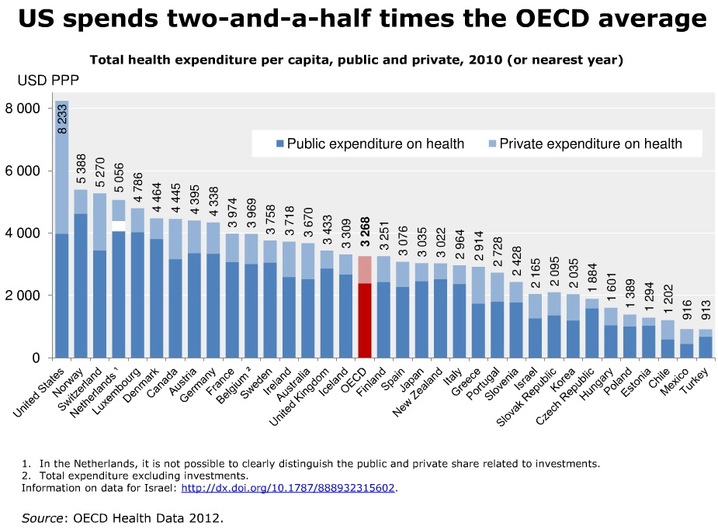
What this means is that Fournier’s preferred solution for dealing with this trend — higher taxes, fewer entitlements — is completely pointless. We have to fix the problem of rising prices, otherwise eventually a single tablet of aspirin will consume the entire federal budget. And the price problem is driven by awful policy design, not excessive generosity. America manages the rare trick of having very patchy and stingy social insurance that is simultaneously incredibly expensive. We spend more government money per person than Canada does — and the Canadians have universal single-payer coverage.
Fewer entitlements or higher taxes will get you a few years of breathing room before price increases eat up all the savings — and the whole point of Fournier’s column is that a couple decades of breathing room is still grounds for hair-on-fire panic.
Luckily, since the passage of ObamaCare, price increases have indeed slowed dramatically. That, plus a new projection that interest rates will stay low for a long time, accounts for the new CBO analysis showing slower debt growth. Just why this is happening is a matter of some dispute; I suspect it is partly the result of several programs in ObamaCare designed to bring prices down, and partly that health-care prices are already so high they’re running into resource constraints.
I think the fact that Fournier is patently uninterested in any of these things, and favors a policy that would accomplish nothing whatsoever on the deficit by his own standards, reveals that the pro-austerity school of punditry isn’t about the deficit at all. Instead, he says that his entitlement-cutting agenda is “going to happen sooner or later, painfully or more painfully.” As with David Gregory, the pain is the operative concept. The centrist definition of responsible politics holds that the American people must suffer a little more to keep the nation healthy. It’s only the “hateful partisans” who are keeping the wise, reasonable moderates from making those tough bipartisan compromises to slash social insurance and inflict pain.
But make no mistake: This has nothing to do with economics, and everything to do with the bizarre looking-glass ideology of “serious people” in Washington, D.C.
By: Ryan Cooper, The Week, July 24, 2014
“Coming Up Short”: Rubio Tries And Fails To Thread Culture-War Needle
Sen. Marco Rubio (R-Fla.) has been quite candid on most of the hot-button social issues of the day, and despite national ambitions, the Florida Republican has positioned himself well to the right of the American mainstream on issues like contraception, reproductive rights, and marriage equality.
But the senator nevertheless believes he has a strong case to make when it comes to the culture war, and yesterday he delivered a big speech his staff billed as an address on “the breakdown of the American family and the erosion of fundamental values that has followed.” The remarks, which can be read in their entirety here or watched online here, covered a fair amount of ground, though as Benjy Sarlin explained, there was a special emphasis on gay rights.
Florida Republican Sen. Marco Rubio acknowledged Wednesday that American history was “marred by discrimination against gays and lesbians.” But in a speech at Catholic University in Washington, Rubio drew the line sharply at marriage equality and accused supporters of same sex unions of “intolerance.”
“I promise you even before this speech is over I’ll be attacked as a hater or a bigot or someone who is anti-gay,” Rubio said. “This intolerance in the name of tolerance is hypocrisy. Support for the definition of marriage as one man and one woman is not anti-gay, it is pro-traditional marriage.”
Rhetoric like this is familiar – the right has long believed it’s unfair for the left to be intolerant of intolerance. Despite its repetition, though, the argument always seems to come up short.
Consider the underlying point Rubio is trying to make. On the one hand, he and his allies intend to keep fighting, hoping to use the power of the state to deny equal rights and basic human dignity to Americans based on sexual orientation. On the other hand, Rubio and his allies would appreciate it if no one said mean things about them while they push these policies.
I’m afraid the public discourse doesn’t quite work this way. No one is suggesting Rubio must abandon his opposition to civil rights for LGBT Americans, but if he wants to avoid criticism while pushing public policies that create second-class citizens, he appears to have chosen the wrong line of work.
That said, let’s not overlook the part of the speech in which Rubio also tried to position himself as a critic of anti-gay discrimination.
“We should acknowledge that our history is marred by discrimination against gays and lesbians. There was once a time when the federal government not only banned the hiring of gay employees, it required private contractors to identify and fire them. Some laws prohibited gays from being served in bars and restaurants. And many cities carried out law enforcement efforts targeting gay Americans.
“Fortunately, we have come a long way since then.”
Yes, that is fortunate. But under existing federal law, American employers, right now, can legally fire gay employees – or even employees they think might be gay – regardless of their on-the-job performance.
Our history is, in fact, “marred by discrimination against gays and lesbians,” but that discrimination can still happen under existing law – and though he didn’t mention it yesterday, as far as Marco Rubio is concerned, federal anti-discrimination laws should not be changed. Indeed, when the Senate rather easily passed the Employment Non-Discrimination Act last fall, only 30 senators voted against it, and Rubio was one of them.
The far-right senator, in other words, is trying but failing to thread a culture-war needle. Rubio wants to block consenting adults who fall in love from getting married, but he doesn’t want to be accused of intolerance. The Republican senator wants to decry employment discrimination against LGBT Americans, but he doesn’t want to take action to prevent the discrimination he claims not to like.
As culture-war visions go, this one needs some work.
By: Steven Benen, The Maddow Blog, July 24, 2014
Share This Blog


 Unknown Feed
- An error has occurred; the feed is probably down. Try again later.
 mykeystrokes.com