“The Scourge Of The Businessman Politician”: I’m No Politician, But I Can Clean Up Washington
Attentive readers will recall that among my many pet peeves (and being able to complain to a wide circle of people about your pet peeves is one of blogging’s greatest fringe benefits) is the candidate who proclaims that you should vote for him because he’s “a businessman, not a politician.” As though the fact that there are a lot of shady car mechanics out there means that when you need a new timing belt, the best person for the job would be a florist or an astronomer, because they’re not tainted by the car repair racket.
I’ve written at some length about why exactly success in business doesn’t prepare you to be a good senator or governor, but the short version is that the two realms are extremely different. So it isn’t too surprising that when businesspeople decide to run for office, most of the time they fail. They come in with a lot of money, flush it down the toilet on an overly expensive campaign, and quickly discover that there is a whole set of skills necessary for success that they don’t possess. When you try to think of business leaders who got elected, then used their business acumen to do things differently and really made a major impact, it’s hard to think of many names other than Michael Bloomberg. Here and there you’ll find someone like former Tennessee governor Phil Bredesen who did pretty well, but more common is candidates like Ross Perots, or Meg Whitman, or Linda McMahon, or Al Checci (there’s a blast from the past for you political junkies). They think, “Sure I can do this better than those empty suits—I’ve made a billion dollars!” And then they lose.
Not every time, of course, but most of the time. Which is why Democrats should be pleased to hear this:
Republicans are banking on businessmen to help them retake the Senate in 2014.
A half-dozen top GOP candidates boast records as wealthy businessmen and entrepreneurs. If voters decide they’re successful job creators on Election Day, Republicans could be on their way to the six seats they need to win the upper chamber.
Now maybe these candidates are all going to turn out to be just aces. But if history is any guide, more than a few of them are likely to be terrible at running for office. For many of them it’s their first time, which is often a disaster, and it’s particularly hard to have your first run for office be a high-profile Senate race with lots of pressure and press scrutiny. (The list of highly successful politicians who had a loss in their first run for office, or one of their first runs, is a notable one. It includes Barack Obama, George W. Bush, and Bill Clinton, among many others. It seems that early loss is a highly edifying experience.)
It’s easy to see why this is happening. These candidates are attractive to party leaders because they bring their own money. Republicans have also spent years creating a cult of the businessman, trying to convince others, and no doubt convincing themselves, that those who succeed in business are the most virtuous, brilliant, and generally admirable of all human beings. And that may extend to primary voters, to a degree anyway. Which gives them a good shot to make it to the general election, and which also means that we’re going to have to endure a lot more of that “I’m no politician, so I can clean up Washington!” crap in this election. But what else is new.
By: Paul Waldman, Contributing Editor, The American Prospect, February 26, 2014
“Show Me The Medicaid Money”: Buckle Up Republicans, Obamacare Is Here To Stay
Somewhat quietly, Obamacare enrollment hit 4 million this week. Now, it’s certainly true—as critics have noted—that enrollees aren’t the same thing as people who will continue to stay with their plan for a full year. If an enrollee encounters an unexpected expense of replacing a head gasket or something like that, he might skip a payment. But even so, 4 million’s a more-than-respectable number.
Also rather quietly this week, a new tracking poll from the Kaiser Family Foundation showed support for repeal of Obamacare down to 31 percent. As Jay Bookman noted in the Atlanta Journal-Constitution, overall the poll wasn’t something the president would exactly brag about, but it did represent noticeable change, especially among independents, 57 percent of whom now support the law.
That 31 percent number made me sit up straight for one reason. The percent of Americans who identify themselves as conservative is, lately, about 38 percent, says Gallup. So 31 percent is getting down there. And consider this: As of mid-December 2013, the percentage of Americans who favored repeal was 52.3 percent in a Real Clear Politics average of numerous polls. The Affordable Care Act may not be as popular as Twelve Years a Slave, but it’s not The Lone Ranger anymore either.
I would think there’s a direct correlation between these two sets of facts, no? The more people go to the web site and see that they can get insurance at a decent price (in most cases), the more they tell their co-workers and neighbors that doing so wasn’t the horror show they expected. The more people learn about some of the law’s benefits, the more opposition to it softens.
There are still a few more things the American people need to learn about the law, though, and it’s up to the Democrats to tell them, and I’m going to bang on about this until I see some action. As I wrote Wednesday, Governor Rick Perry has said no to $9 billion in free money. Texas is the largest state in the union that hasn’t accepted the Medicaid expansion money, so that’s the biggest figure, but the figures are significant in relation to the population and budget in every single state.
These figures are from a Commonwealth Foundation report from three months ago. Florida is saying no to $9.6 billion, Georgia to $4.9 billion, North Carolina to $5.7 billion. Wisconsin is passing on $1.75 billion, Virginia on $2.15 billion, and Pennsylvania on $5.5 billion (although Pennsylvania is considering the opt-in). And this report’s figure for Texas is actually $9.6 billion.
You know how states clamor for federal highway money? Well, as Commonwealth points out, in every one of these cases, the Medicaid money is more—at least double, typically, and sometimes far more—than what these states get in highway money. And yet they say they don’t want it. They say that over time, they’re going to be on the hook for vast expenditures they can’t afford, or they fret publicly that Washington might change the formula. They’re both bogus arguments.
The federal government is paying 100 percent of states’ expansion costs through 2016 and no less than 90 percent thereafter on a permanent basis. It’s a sweet deal. But okay, what about that (up to) 10 percent that states are going to have to start paying? Ten percent doesn’t sound like a lot, but in dollar terms, isn’t that real money?
The answer is, not really, in most cases. This gets complicated and involves a category of spending by the states for something called “uncompensated care,” which is just what it sounds like—health care provided for free to poor people. State and local governments typically pitch in now on uncompensated care. But as the Center on Budget and Policy Priorities explains in a 2012 report: “The Medicaid expansion will reduce state and local government costs for uncompensated care and other services they provide to the uninsured, which will offset at least some—and in a number of states, possibly all or more than all—of the modest increase in state Medicaid costs.” Overall, the health-care consulting firm The Lewin Group estimates a minimal increase in states’ spending obligations, around 1 or 2 percent, depending on the state.
As for the argument that some GOP governors make that they fear Washington might change the formula…well, that’s straight from Orwell or Kafka. That is: Barack Obama isn’t going to change any formula. President Hillary Clinton wouldn’t be changing any formula. A Democratically controlled Congress won’t be changing any formulas. Only Republican presidents and congresses would do that. In other words, these Republican governors are saying—yeah, the deal looks fine now, but my party might take over, and then I’d be really screwed!
The ACA is here to stay. It’s not going to be struck down. It’s not going to be repealed. That would require a Republican president and 60 GOP senators and a solid GOP House majority, and the odds are strongly against the emergence of such a confluence. It’s going to exist. And inevitably, it’s going to grow. And more and more people are going to get used to it and learn to live with it. And over time, the people in states like Texas and Georgia and Wisconsin are going to see that people in nearby states that took the money are in fact pretty happy with their situations.
It’s only a matter of time before these resistant governors and state legislatures start caving. Democrats have it in their power to help hasten that timetable by making this an issue. They have to have the courage not to wilt or get the vapors whenever a right-winger invokes the evil gummint or the hated Kenyan. Democrats say they’ve waited decades for this moment. Well, it’s here. Now’s not the time to run away from the fight.
By: Michael Tomasky, The Daily Beast, February 28, 2014
“The Right Defends A New Jim Crow”: 50 Years Since The Civil Rights Act, Wingnuts Still Don’t Get It
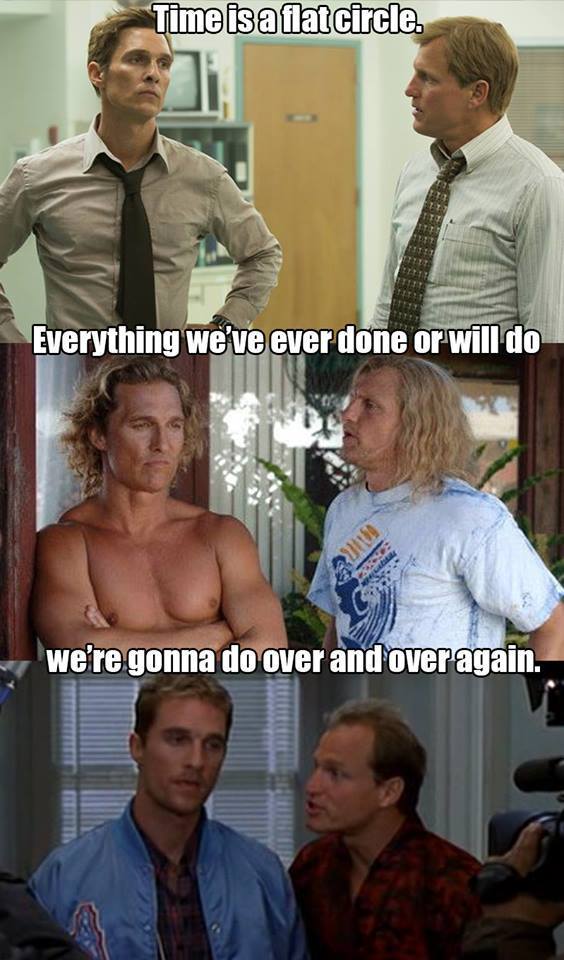
Watching the debate over Arizona’s SB 1062 (better known as the state’s anti-gay Jim Crow law) unfold this past week, I couldn’t help but think of the already iconic line from Matthew McConaughey’s “True Detective” character Rust Cohle: “Time is a flat circle.” As is always the case with the nihilistic and willfully esoteric Cohle, it’s not entirely clear what he’s trying to say with the metaphor, but we get the gist: Like Nietzsche’s “eternal return,” Cohle’s flat circle theory holds that all of us are destined to relive every moment of our conscious lives, forever. It’s as if we all were stuck in the late Harold Ramis’ “Groundhog Day,” but instead of repeating a single day, we repeat our entire lives.
Beyond the fact that, like many others, obsessing over “True Detective” has increasingly become the chief way I spend my free time, Arizona’s brief foray into the politics of segregation reminded me of the flat circle quote because I had recently seen Bryan Cranston’s Broadway debut, “All the Way,” in which the “Breaking Bad” star plays former president Lyndon B. Johnson during the historic period between Kennedy’s assassination and Johnson’s reelection, a time when the 36th president was working feverishly to ensure the passage of the Civil Rights Act of 1964. The play is good and Cranston is great, but what was most striking throughout was how much Johnson’s opponents then sounded like SB 1062’s supporters today. It was, as Cohle would say, some “heavy shit.”
The similarities weren’t merely superficial, either. Sure, the play, written by Pulitzer prize-winning playwright Robert Schenkkan (who obviously did his homework), was littered with hysterical charges of “fascism” and “socialism” and “big government” from no-name Dixiecrats that most of us never knew or were happy to forget. And of course these moments brought to mind much of the anti-Obamacare rhetoric that has emanated from conservatives during the past five years. But the parallels went deeper than that. It wasn’t just the language that sounded so familiar, but the logic behind it, too. Whether conservatives were defending Jim Crow proper or the Southwest’s latest variant, their worldview, all these years later, was disturbingly unchanged.
To explain what I mean, allow me to cite two of conservatism’s leading lights: Kentucky Sen. Rand Paul and all-around media mogul Glenn Beck.
As the opposition to SB 1062 increased in fervency and numbers, the usually loquacious Paul was, unlike his fellow Senate Republican John McCain (who opposed the bill), deafeningly mute. Anyone familiar with Paul’s history knows why: Because the obvious presidential aspirant wanted to avoid reminding people of the unfortunate 2010 interview with Rachel Maddow in which he stated that, even today, he would not support the government-run dismantling of Jim Crow. “I don’t want to be associated with those people,” Paul said, referring to white supremacists who’d bar blacks from their restaurants, “but I also don’t want to limit their speech in any way…” Paul’s orthodox libertarianism told him that the freedom to discriminate was too valuable, too sacred, to let the federal government stand in its way. Like Sen. Barry Goldwater did in 1964, when he voted against the Civil Rights Act, Paul argued that the Constitution had no room for anti-discrimination.
Roughly four years later, Glenn Beck made a similar argument, this time in defense of SB 1062. After doing his best impression of Hamlet, grappling aloud with his competing interest to not be a bigot while on the other hand maintaining allegiance to his understanding of liberty, Beck cut to the chase, telling his coworkers that he could only support Arizona’s bill, because “freedom is ugly.” Like Paul, Beck was sure to make clear that he held no sympathy for anyone who would ban LGBTQ people from their premises. But also like Paul, Beck had no choice but to conclude that the freedom to ostracize and discriminate was, in part, what the American experiment was all about. “I don’t like that world,” Beck said, “but that’s freedom! That’s freedom! Freedom is ugly. It’s ugly.”
High-profile though they may be, Beck and Paul are hardly the only conservatives who still cling to a vision of freedom that many Americans wrongly thought was swept into Reagan’s “ash-heap of history” decades before. Tucker Carlson — who, if Paul is to be Goldwater, we must describe as today’s version of the braying, segregationist Dixiecrats — was adamant in his defense of SB 1062, saying on Fox News that opponents of the bill were advocating for “fascism” and had gone “too far” in their quest to prevent state-sanctioned bigotry. “Everybody in America is terrified to tell the truth,” Carlson warned, “which is, this is insane, this is not tolerance, this is fascism.” Tellingly, when his sparring partner, Fox’s house liberal, Alan Colmes, asked Carlson whether he would have supported the Civil Rights Act, the editor of the Daily Caller could only respond by saying, “Don’t bring [that] into this,” with a sneer.
Even conservatives who are more intellectually inclined than Beck, Paul and Carlson put forward a defense of SB 1062 that could easily and quickly be adopted to oppose the federal government’s dismantling of Jim Crow. Ilya Shapiro of Cato, libertarianism’s premiere think tank and ostensible guardian of liberty for all, wrote, “I have no problem with SB 1062.” Repeating an argument that was offered by Goldwater, Paul, Beck and Carlson, Shapiro maintained that those who would be discriminated against, were SB 1062 to pass, should simply trust that the free market would punish bigots and, eventually, guarantee their liberty. “[P]rivate individuals should be able to make their own decisions on whom to do business with and how – on religious or any other grounds,” Shapiro wrote. “Those who disagree can take their custom elsewhere and encourage others to do the same.”
The fact that this very same logic recently undergirded a century of Jim Crow seemed to escape Shapiro. Either that or he, like W. James Antle III of the American Conservative, was content to dismiss comparisons to Jim Crow on the grounds that Arizona is not the Jim Crow South and 2014 is not the mid-’60s. “People often argue for or against the civil-rights laws of the 1960s on the basis of abstract principles,” Antle wrote, “but they were in fact a reaction to a very specific set of circumstances.” (This is an argument that, more than anything else, raises the question as to whether this is the first time Antle’s come into contact with an analogy.) Perhaps Shapiro, like Antle, was content to support the bill not because it wouldn’t give the government’s imprimatur to homophobia, but because such an outcome is, in their minds, “not very likely.” After all, what’s a little discrimination in the grand scheme of things?
If we put all these and many other conservative defenses of SB 1062 together, it’s hard not to reach a clear and unsettling conclusion: While conservatives themselves have largely given up the racism that coursed through a previous generation’s defense of Jim Crow, conservatism itself has learned no enduring lesson from the Civil Rights Movement and has made no ideological adjustments as a result. Indeed, National Review’s Kevin Williamson recently declared that Goldwater’s brief against the Civil Rights Act “has been proved correct” for worrying that “expanding the federal mandate … would lead to cumbrous and byzantine federal micromanagement of social affairs.” Going further, National Review’s editors, writing on the 50-year anniversary of the March on Washington (which NR at the time opposed) would only concede that the magazine was wrong to oppose the Civil Rights Movement because its principles “weren’t wrong, exactly” but were instead “tragically misapplied.”
For all of her many flaws, Jan Brewer decided on Wednesday to refrain from applying her conservative “principles” in such a “tragic” manner, opting instead to veto the bill and maybe — just maybe — push her party that much closer to joining the rest of us in the 21st century. And while many conservatives received the veto as a crushing disappointment, or even a step toward “slavery,” I’d caution my right-wing fellow citizens against slipping into outright despair. If the events in Arizona have taught us nothing else, they’ve shown that time is indeed a flat circle; future right-wingers will have plenty of chances to keep getting this most basic question of freedom terribly, terribly wrong.
By: Elias Isquith, Salaon, March 1, 2014
“Senate GOP Blocks Veterans’ Bill”: Shame On Republicans For Bringing Base Politics Into A Bill To Help Veterans
As a rule, legislation related to veterans’ benefits tends to garner bipartisan support, but as we were reminded this afternoon, there are exceptions.
Senate Republicans stopped Democrats from advancing a bill that would have expanded healthcare and education programs for veterans.
In a 56-41 vote Thursday, the motion to waive a budget point of order against the bill failed. Democrats didn’t have the 60 votes needed to overcome the Republican roadblock.
Only two of the Senate’s 45 Republicans – Sens. Dean Heller (Nev.) and Jerry Moran (Kan.) – voted with the Democratic majority. That was obviously not enough to end the GOP’s obstruction.
The bill, the Comprehensive Veterans Health and Benefits and Military Pay Restoration Act, was quite expansive. Sen. Chris Coons (D-Del.), a co-sponsor, posted an overview of the legislation, highlighting its expanded VA health care access, tuition assistance, and job training. These certainly sound like the sort of things GOP lawmakers could go for.
So why did Senate Republicans block it?
Some GOP senators said they were unsure of the pay-for provisions – helping veterans matters, but making sure the deficit isn’t slightly larger really matters – but perhaps the biggest complaint had to do with Iran.
Senate Republicans demanded a vote on their own alternative legislation, which included a provision to impose new sanctions on Iran, and which would imperil the delicate international nuclear talks that are still ongoing.
GOP senators want a vote on the sanctions, regardless of the consequences; Senate Majority Leader Harry Reid (D-Nev.) won’t go along; so the Republican minority blocked the bill on veterans’ benefits.
“I hope all the veterans groups have witnessed all the contortions the Republicans have done to defeat this bill,” Reid said this afternoon. “Shame on Republicans for bringing base politics into a bill to help veterans.”
By: Steve Benen, The Maddow Blog, February 27, 2014
“They Never Really Cared In The First Place”: Why Republicans Don’t Want To Acknowledge The Falling Deficit
An important budget memo was issued this week celebrating just how far the deficit had fallen over the last five years. But in one of the incongruities that define the political moment, the memo was issued by a Democrat, Senator Patty Murray of Washington, chairwoman of the Budget Committee, not a Republican.
The steep decline of the deficit is not something Republicans really want to talk about, even though their austerity policies were largely responsible for it. If the public really understood how much the deficit has fallen, it would undermine the party’s excuse for opposing every single spending program, exposing the “cost to future generations” as a hyped-up hoax. In fact, it would lead to exactly the conclusion that Ms. Murray reached in her memo to Senate Democrats: that the country can now afford to spend money to boost employment, stay competitive with the rest of the globe in education and research, and finally deal with the long-deferred repairs to public works.
In 2009, the deficit was more than $1.4 trillion, which was nearly 10 percent of the nation’s gross domestic product. This year, the deficit will be a little more than a third that size: $520 billion, or 3 percent of G.D.P. The Treasury Department said on Thursday that the deficit fell more sharply in the last fiscal year than in any year since the end of World War II.
Some of the deficit reduction — about 23 percent — is due to tax revenue increases, mostly from the deal to raise income tax rates to Clinton-era levels on households making $450,000 or more. And some is due to lower interest costs, and the slowing growth of health care costs, which is partly attributable to the health care reform law.
But about half of the reduction, the biggest part, is the result of $1.6 trillion in cuts over several years to discretionary spending demanded by Republicans in several rounds of budget negotiations. As a recent Times editorial noted, this has become the tragedy of the Obama administration, undoing the positive effects of the 2009 stimulus, keeping the economic recovery sluggish, and hurting millions of vulnerable people who depended on that spending for shelter, food and education.
Having prevailed over all of those liberal programs, why can’t Republicans acknowledge that the deficit has been vanquished? Just yesterday, they blocked a bill to provide expanded medical and education benefits for veterans, citing the looming deficit. “This bill would spend more than we agreed to spend,” said Senator Jeff Sessions of Alabama. “The ink is hardly dry and here we have another bill to raise that spending again.”
The answer, of course, is that Republicans never really cared about the deficit, having raised it to enormous proportions during the administration of George W. Bush. Their real goals were to stop government spending at any cost, and to deny President Obama even a hint of political victory or economic success.
And so Republicans will resist any attempt to use their budget triumphs for Democratic purposes. As Ms. Murray writes, that will create different kinds of deficits: a deficit of people working, of students studying, of roads and bridges and research projects that can lead to prosperity instead of the gloom of austerity.
By: David Firestone, Editor’s Blog, The New York Times, February 28, 2014
Share This Blog


 Unknown Feed
- An error has occurred; the feed is probably down. Try again later.
 mykeystrokes.com