For “A Government That Represents All The People”, Overturn Citizens United
In America today, the top 1 percent earns more income than the bottom 50 percent and the wealthiest 400 individuals own more wealth than the bottom half of the country–150 million Americans. We have the most unfair distribution of wealth and income of any industrialized country.
In America today, the middle class is largely disappearing while the rich and largest corporations are doing phenomenally well. Meanwhile, despite a $15 trillion national debt, the effective tax rate for the top 1 percent is the lowest in decades and many large corporations enjoy huge tax loopholes and pay little or nothing in taxes.
In America today, while insurance companies and the pharmaceutical industry enjoy large profits, 50 million Americans lack health insurance, and we are the only major country on Earth that does not provide healthcare to all as a guaranteed right.
All of these disturbing American realities, and many more, are related to the sad fact that the Washington political establishment is much more interested in representing the wealthy and the powerful than the needs of ordinary Americans. Why is that? The answer is simple. We have a horrendous campaign finance system in which Big Money is able to elect the candidates of its choice and defeat those who oppose its agenda.
The absurd Citizens United Supreme Court decision makes a bad situation much worse. Now, corporations can go right into their treasuries, set up super PACs, and spend as much as they want, without disclosure, on political advertising. This gives the Big Money interests even more power over the political process. It makes it harder and harder for the voice of the average American to be heard.
If we are serious about giving ordinary Americans the power to control their political future, we must overturn the Citizens United decision, eliminate super PACSs, and move toward public funding of elections. Our goal must be a government that represents all of the people, and not just those wealthy individuals and corporations who can put millions into political campaigns.
By: Sen Bernie Saunders, Vermont; U. S. News and World Report Debate Club, January 13, 2012
“Still Not Fully American”: Republicans Keep Moving Obama To Europe
This is what progress looks like for a president named Barack Hussein Obama.
Not so long ago, many in conservative and Republican ranks were eager to paint him as an alien creature far removed from American life as most Americans understand it. A determined cadre insisted Obama was not even eligible to be president, claiming he was born outside the United States. Obama eventually put that to rest by making public his birth certificate, which proved he was born in Hawaii.
Fox News falsely reported that he had attended a “madrassa” during his childhood in Indonesia. (He actually went to a public, non-religious school.) And Newt Gingrich concluded that Obama exhibited “Kenyan anti-colonial behavior,” a strange description that’s hard to square with such Obama undertakings as ordering the killing of Osama bin Laden.
Obama’s adversaries have not thrown in the towel in their efforts to distance him from his own country. But they are bringing him closer and closer to home.
Thus did Mitt Romney’s victory speech after the New Hampshire primary link Obama to Europe not once or twice but three times. Obama, Romney said, “wants to turn America into a European-style entitlement society” and “takes his inspiration from the capitals of Europe” as opposed to “the cities and small towns of America.”
“I want you to remember when our White House reflected the best of who we are,” Romney declared, “not the worst of what Europe has become.”
So Obama is still not fully American, in Romney’s telling. But conservatives talk a great deal about defending and preserving Western civilization, which we share with our European friends. So moving Obama from Indonesia and Kenya to Europe seems like a big concession for their side. Who knows? In a few months, Obama might even be moved to some midpoint in the Atlantic.
The Europeanization of Obama is progress in another way. Not so long ago, it was common for the extreme right to accuse liberals of harboring a desire to turn the U.S. into a Soviet-style communist state. Now that the Soviet Union is dead — and China, which claims to be communist, is pioneering an anti-democratic capitalist model — that particular libel is passe. If the very worst the liberals are trying to do is mimic European social democracy, that sure beats creating gulags or imposing commissars.
The most benign reading of Romney’s speech is that he is suggesting Obama’s economic policies will send us into a crisis like the one that has engulfed the European Union. This charge is nonsense. Like it or not, the U.S. government and the Federal Reserve have been far more aggressive than their European counterparts in protecting our financial institutions from the sorts of problems that European banks face. And we have a strong federal government, which the European Union lacks. A crisis in Rhode Island would not threaten the nation the way a meltdown in Greece affects the E.U.
And the core premise of Romney’s claim is untrue. The notion that Obama wants to turn the United States into a “European-style entitlement society” is laughable. It’s not even a fair description of Europe, which boasts of some highly productive and innovative capitalist economies. As for Obama, he has bent over backward to strengthen market capitalism, sometimes to the consternation of his own supporters. Yes, Obama is trying to get more people health insurance. Is that a bad idea just because the Europeans have done a better job of this than we have?
But by far the biggest flaw in Romney’s Euro-Obama riff is the implication that there is something terribly wrong about learning from Europe. The genius of the American character is that we have always been willing to take lessons from any country that had something to teach us. We don’t turn away from good ideas just because they didn’t originate here. We refine them and adjust them to suit our needs and our tradition. Openness is an American strength.
Two fine historians, James Kloppenberg and Daniel Rodgers, have written illuminating books on how progressive ideas crisscrossed the Atlantic at the end of the 19th century and the beginning of the 20th. Teddy and Franklin Roosevelt and Woodrow Wilson were all happy to learn from Europe. Were they un-American? Then again, no one ever accused them of “Kenyan anti-colonial behavior.” Is it asking too much of Obama’s opponents to acknowledge once and for all that he is really and truly American?
By: E. J. Dionne, Jr., Opinion Writer, The Washington Post, January 15, 2012
After Supporting Health Care Mandate In 1994, Santorum Now Says He Never Supported Mandates
Former Pennsylvania Sen. Rick Santorum (R) stepped up his criticism of GOP presidential primary front-runner Mitt Romney on CBS’ Face The Nation this morning, slamming Romney for providing “the basis” for the Affordable Care Act when he signed a comprehensive health reform law while he was governor of Massachusetts.
In addition to providing a model for national health care reform, RomneyCare is to blame for raising taxes, rising health care costs, and, worst of all, Santorum said, an individual mandate requiring people to buy health insurance. That, Santorum said, represented a government intrusion into health care that he never has and never could support:
SANTORUM: Gov. Romney’s plan, as much as he’d like to say it’s not, was the basis of Obamacare. He was for an individual mandate, he was for government top-down control of the health care system in Massachusetts. And it’s led to the highest cost health care in the nation in Massachusetts, it’s led to higher taxes. … It is an absolute disaster. […]
He would not have the clear record that I have…of being for government out of the health care business, being for a plan that is bottom-up, private sector health care reform. Unlike other folks in this race, I’ve had a consistent record over that time of not being for individual mandates. … He has been for individual mandates, I have not.
Watch it:
As Igor Volsky reported last week, however, Santorum supported an individual health insurance mandate during his 1994 Senate campaign, shortly after a host of Senate Republicans had offered the mandate as an alternative to President Clinton’s health reform plan.
And aside from the fact that RomneyCare did lay the groundwork for the Affordable Care Act — Romney repeatedly touted his plan as a national model before the ACA passed — Santorum’s criticisms are largely off-base. Massachusetts’ health costs are rising, but at rates comparable to the national average, and the cost of some premiums has fallen dramatically. Meanwhile, the state has the lowest uninsured rate in the nation, with just 4.7 percent of Bay Staters lacking health insurance.
By: Travis Waldron, Think Progress, January 15, 2012
Remembering Dr. King
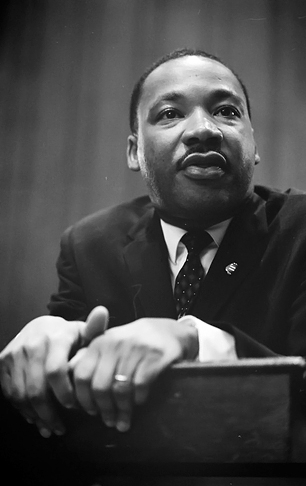
Dr. Martin Luther King, Jr (BuyenLarge/Getty Images)
I was surprised by his assassination. I didn’t see the Poor People’s Campaign as the threat to Washington and the Establishment that I now see it was. We feared for Dr. King’s life more in the early Sixties, through 1963, than we did by 1968. Up through 1965, there was a civil-rights-related death every couple of months, though most of them didn’t make headlines. By the end of ’65, there was a lull in the killings, and I thought perhaps we were finally beyond all that.
In his last year, we worried about Dr. King’s health. He was working eighteen to twenty hours a day. He would stay up all night reading, talking, clowning – whatever he felt like doing – and then wake up at five-thirty raring to go. His wife used to say that he had a war on sleep.
We would tell him that it looked like he was going to be around for a long time, and he couldn’t possibly keep this pace up, because he was close to forty. But if you said anything, he’d brush you off. I could never argue with him anyway. He was a preacher. And whenever we argued, he’d get to preaching. You never won an argument because he would take off on flights of oratory, and you’d forget your point trying to listen to him.
The year he died was the year he felt he had to establish the agenda for America’s future. For fifteen years he’d been struggling with the issues of racism, poverty and war. He refused to be just a civil rights leader. He was a sensitive lover of people who saw his primary responsibility in the black community. By 1968, though, it was clear to him that the black community could not concern itself with civil rights issues alone. The country was spending billions of dollars in Vietnam, and he saw racism and war becoming ever more tied up into one big problem for this country.
It was a time of increasing desperation for him. The SCLC had a fraction of the budget it should have had, about $700,000, and a small staff of fifty people, trying to take on the problems of the urban North, as well as the South, which still had large pockets of resistance. Not only weren’t we getting any aid from the federal government, but we had legions of FBI agents tracking us down, harassing us, trying to disrupt the work we were doing – work which I thought was the only thing that was giving America a fighting chance to survive.
The dangerous times when we were together were always the times he was most humorous. For years we couldn’t go anywhere without FBI men following us around. Dr. King was philosophical about it and very friendly toward them. Every now and then, we would leave a meeting through another entrance – not to escape the car that trailed us, but to sneak up on them. Dr. King would say hello, introduce us and (we always gave them the benefit of the doubt) thank them for the “protection” they were giving us.
I think he would have been quite content to be pastor of the Riverside Church, maybe teach at a university or a seminary. He wanted to teach the philosophy of religion, which was the subject of his Ph.D. He turned down a chance for the presidency of the NAACP when he first came to Montgomery in 1954, because he wasn’t sure he wanted to become that involved in the growing civil rights movement.
But when the bus boycott came in ’55, he was pressed into action. He had to respond. He was just twenty-six, and he never had the time to be the fun-loving man that he really was. He made the cover of Time magazine only a couple of years after he finished his degree, and then he was a celebrity.
From that time on he felt the burden of the country, his people and the world on his shoulders. He accepted it, but he always said he would have liked to do something else. He felt responsible for America’s future and its survival because he said that nobody understands nonviolence except black Americans, and if America was going to learn to live with the rest of the world, we’d have to help her find a nonmilitary course. In his Nobel Peace Prize speech, in fact, Dr. King said that the choice was nonviolence or nonexistence. I think back sometimes to what this country would have been like without Dr. King. The South was an armed camp in the Forties and Fifties. The GI bill and better job opportunities had created the beginnings of a black middle class, and they were not going to tolerate oppression any further. The white forces of reaction were trying to resist the advance of this new black middle class.
Every black family in the South had a gun. My father was probably the least violent man I know, and yet there were at least four guns in our household. Had there been no Martin Luther King Jr., the southern part of the United States would have looked like Northern Ireland or Lebanon.
And yet Martin saw that blacks and whites did not hate each other. They were being forced down through history on a collision course. Martin Luther King straightened out that course. He made it possible for blacks and whites to move in a parallel course of development and work together by using the tactic and methodology of nonviolence. He did not blame the white man for the problems that blacks were having. He saw blacks and whites caught up in a situation that they didn’t create, that they inherited. He saw nonviolence as a means for bringing people to realize that they could work their way together out of the situation.
Dr. King never understood why J. Edgar Hoover couldn’t comprehend what he was doing. If you read Hoover’s FBI reports on the March on Washington speech, you realize that he never saw Dr. King’s vision of a New America. He saw a powerful, radical political voice trying to destroy the nation.
I didn’t know then, but I now think that there lies the indirect responsibility for his assassination. I don’t know if it can ever be pinned down, but there are so many client groups that did dirty jobs around and for official people. I think now that Dr. King’s assassination was directly related to the fear that officialdom had of his bringing large numbers of poor people to the nation’s capital, setting up tents, demanding some response from them.
By: Andrew Young, Rolling Stone, January 13, 2012. (This story is from the December 1, 1977 issue of Rolling Stone). Writing in 1977, the famed civil rights activist Andrew Young reflects on the life and legacy of Martin Luther King.
Mitt Romney’s New Problem: A Rising Sun
Mitt Romney was on the campaign trail in South Carolina yesterday, and brought up the issue he expects to ride into the White House: the U.S. economy. Unfortunately for the former governor, the message isn’t quite the same as it was a few months ago.
In his remarks [Friday], Romney also acknowledged the economy was getting better — something he has said before….
“And [President Obama]’s going to say the economy is getting better,” Romney said. “Thank heavens it’s getting better. It’s getting better not because of him, it’s in spite of him and what he’s done.”
For those keeping track, Romney said twice in three sentences that he believes the economy is “getting better.”
I’ve noticed over the last week, this keeps coming up. Shortly before the New Hampshire primary, Romney said he’s “glad” the economy is improving, but quickly added that President Obama “doesn’t deserve” credit. In an interview with Bloomberg Television, Romney also said the economy is recovering, but said “this president has not helped it.”
And in a debate for the Republican presidential candidates last weekend, Romney made his case this way:
“The president is going to try to take responsibility for things getting better. It’s like the rooster trying to take responsibility for the sun rising. He didn’t do it.”
I believe campaign professionals call this a “losing argument.”
Look, I don’t know whether the recovery will strengthen in 2012. The recent evidence has been mixed; experts’ projections vary widely; and the global threats to the economy remain real and hard to predict. There is, however, room for some optimism and Romney himself believes, in his words, economic conditions are “getting better.”
But as a campaign matter, if Romney is right about a strengthening recovery, he has to realize he’s going to lose. For the entirety of 2011, the former governor had a single message he repeated ad nauseum: Obama made a bad economy worse. It wasn’t true, but so long as the recovery was largely invisible, it was a message that could fool a lot of the people a lot of the time.
Two weeks into 2012, Romney has a new message: don’t give Obama credit for making the economy better. In effect, the Republican is arguing, “Sure, Obama inherited a deep recession. And sure, he took a bunch of steps to turn the economy around. And sure, we’re now seeing more jobs being created and more economic growth. But vote against him anyway.”
This isn’t just a tough sell; it’s an impossible one.
Look again at what Romney said in last weekend’s debate: “The president is going to try to take responsibility for things getting better. It’s like the rooster trying to take responsibility for the sun rising.”
By Romney’s own reasoning, the sun is rising and it’s morning in America. As Jon Chait put it, “This seems like a shockingly weak line — if you concede that it’s morning, you’ve lost the argument.”
By: Steve Benen, Contributing Writer, Washington Monthly, Political Animal, January 14, 012
Share This Blog


 Unknown Feed
- An error has occurred; the feed is probably down. Try again later.
 mykeystrokes.com
You must be logged in to post a comment.