Mr. Speaker: What Comes After No?
The Republicans have vowed to “repeal and replace” President Obama’s historic health care reform law. Now that House Republicans have muscled through a symbolic repeal bill, they will have to deliver their own alternative plan. Don’t expect much.
By: New York Times- Editorial, The Opinion Pages, January 24, 2011
There are many more slogans than details. But it is already clear that their approach would do almost nothing to control skyrocketing health care costs and would provide little help to the 50 million uninsured Americans.
When Republican leaders talk of reducing medical costs they really mean reducing insurance premiums for some people, primarily by letting the young and healthy buy insurance in states that allow the sale of skimpy policies. That won’t help older and less healthy people and would probably drive up their premiums as they flock to states whose regulations guarantee them coverage.
The Republicans have offered no coherent plan for slowing the rapid rise in medical costs that is driving up insurance premiums, Medicare and Medicaid costs, and the federal deficit. The reform law, by contrast, has multiple provisions for changing the delivery of health care in ways that should reduce costs.
As for the Republicans’ calls to reduce waste and fraud in Medicare, reform the medical malpractice system, and expand high-risk pools to cover people with pre-existing conditions, most of these ideas are already in the reform law. They could surely be strengthened if both parties worked together.
Even as it denounces reform at every turn, the Republican leadership has figured out that many Americans want the many consumer protections that come with the new law. So, once reform is repealed, the leaders are vowing to reinstate such provisions as letting young people stay on their parents’ plans until age 26, preventing insurers from canceling policies after people become sick, and barring insurers from placing caps on what they will pay.
The problem is that such requirements will drive up the cost of insurance unless they are paired with a mandate (or comparable prod) requiring that everyone buy insurance so that healthy people offset the costs of less healthy beneficiaries. Yes, that’s the same mandate the Republicans have vowed to overturn.
Many Republicans have also vowed to restore more than $130 billion worth of unjustified subsidies to private Medicare Advantage plans that is needed to help pay for the expansion of coverage under health care reform.
In coming weeks, expect to see a lot more posturing on issues that might energize the party’s conservative base or poll well with people made skittish by months of Republican exaggerations about the new reform law. They have already introduced bills making it even harder for insurance policies in new insurance exchanges to cover abortions, never mind that the law already has incredibly strict provisions.
The Party of No will also try to use its new control of the House to block implementation of reform by withholding money needed to hire people to write necessary regulations. The House Republican Study Committee has proposed legislation that would prohibit using money in the annual budget to carry out any provision of the law or to defend it in court.
The Republicans need to explain how they plan to address the problems of covering the uninsured, wrestling down medical costs and controlling the deficit. Just saying no isn’t enough.
Size Matters: The GOP & Health Care
During the health care debate in 2009 and 2010, a serious issue emerged — the number of pages in congressional bills. I’m not kidding. The Republicans wanted short bills, and the health care reform bill was way, way too long (proving that it did too much and would end civilization as we know it). There was outrage across the country. Angry opponents of reform went to congressional town hall meetings brandishing huge stacks of paper. Then Minority Leader Boehner, foreshadowing his leadership priorities today, used a nationally televised address to condemn the length of the health care bill three times in as many minutes.
The extremists went wild. Rumors swept across the land. Some Tea Party types claimed the bill was 10,000 pages. Slate called the explosive stack-of-paper obsession “peculiar.” Ultimately, the New York Times set the record straight: “In the original version,” the Times said, “H.R. 3590 as passed by the Senate on Dec. 24, 2009, ran to some 2,400 pages, although with a very large font, triple spacing and huge left and right margins.” The newspaper went on to explain that, “With normal margins the document probably would shrink to about 500 pages or so.” Which meant the bill was not really that long when compared to other major bills, such as the financial reform law and past budget deals.
In the November mid-term elections, the Republicans ran on a platform of change, and change is what we got. Not only will the House Republicans vote to repeal the new health care law this week, they’re going to do so with a bill that’s only two pages long.
This is a triumph of conciseness, a 247-word beacon of brevity. The low word-count works especially well for the GOP, given the party’s unfinished “repeal and replace” campaign pledge. The Republicans addressed repeal, but they haven’t quite gotten to the “replace” part. That, we’re told, is a work in progress, and the question is being referred to various House committees to kick around for months.
In Sunday’s Washington Post, reporter Amy Goldstein noted that the Republican repeal vote is “the prelude to a two-pronged strategy that is likely to last throughout the year, or longer.” Great. Just what we need — another interminable debate on health care when the Republicans ought to be focusing on bipartisan solutions to create jobs. Rep. Fred Upton (R-Mich.), the new House Energy and Commerce Committee chairman, said it “may take time” for the GOP to develop a health care plan. Upton, who has been in Congress since 1987, has had only 24 years to come up with some health care ideas of his own. Instead, he hired Julie Goon, the former top lobbyist for the health insurance industry’s biggest trade group, as his special adviser.
I’m not sure what the Republican “replace” plan is (or how many pages it will be), but I know their two-page repeal bill is a bad deal for America’s families, seniors and small businesses.
The Republican repeal bill will take away dozens of benefits and important consumer protections that are making a real difference in peoples’ lives right now. When the Republicans vote for repeal, they’ll be taking away people’s newly won freedom from fear of insurers denying their care, dropping them when their sick and imposing double-digit premium hikes with impunity. They’ll be booting young adults off their parents’ health plans. They’ll be telling seniors they have to pay back the $250 donut hole checks they received to help buy prescription medications and give up their new 50% discount on brand-name drugs. The Republican repeal plan will force nearly 900,000 American families a year into bankruptcy because of huge medical bills. And it will take job-creating tax credits away from small businesses.
Speaker John Boehner and the Republicans don’t want the public to know the truth about the Affordable Care Act and what their repeal plan will take away from America’s consumers. And you can bet the debate about repeal will be filled with misleading information from Boehner and the new Republican majority. To help folks see beyond the rhetoric, Health Care for America Now made a chart that tells the truth. You can read and download a printable, high-resolution version with citations here and below.
The Republican Repeal Bill puts insurance companies back in charge of your health care.
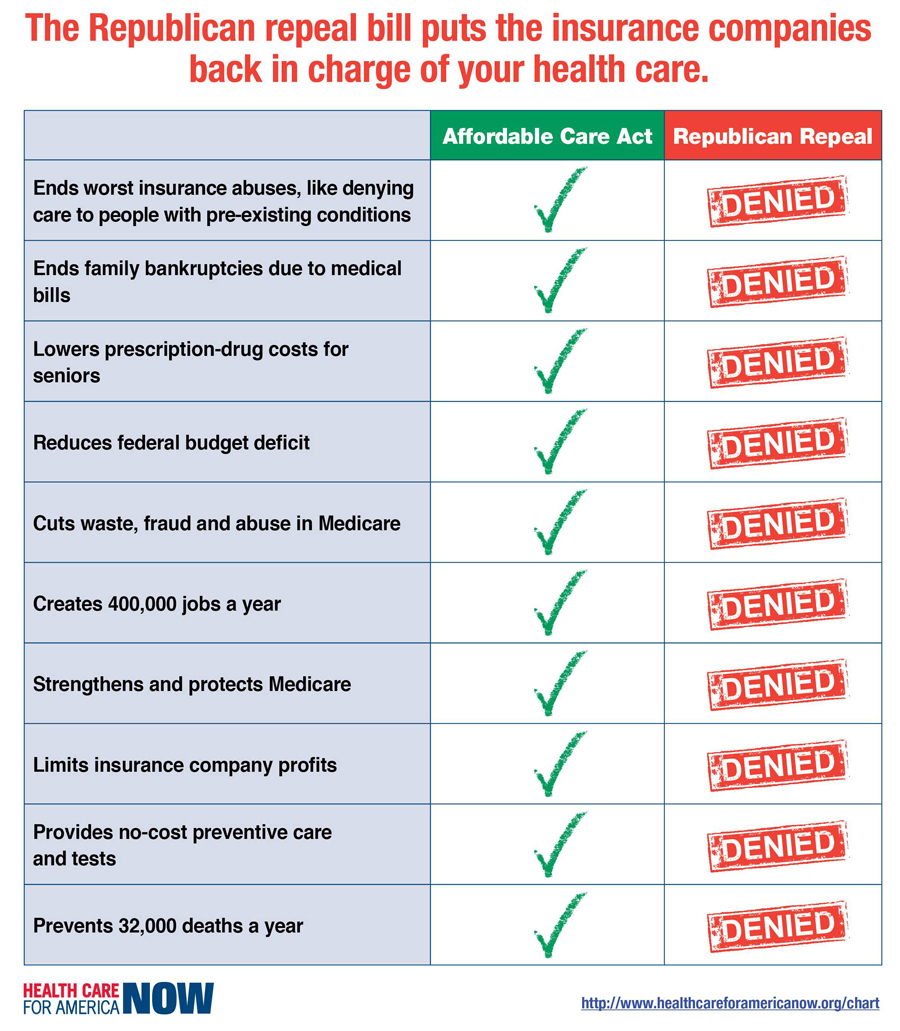
The Republican Repeal Bill
Share This Blog


 Unknown Feed
- An error has occurred; the feed is probably down. Try again later.
 mykeystrokes.com
You must be logged in to post a comment.